Renewed calls for constitutional change in Myanmar’s ‘military-state’

*This article first appeared in The East Asia Forum13 March 2019 and can be accessed here.

Constitutional change was a 2015 election campaign promise of Myanmar’s National League for Democracy (NLD) and Aung San Suu Kyi. As the 2020 elections loom large, they are now revisiting the proposal to recapture the attention and support of the people.

Over the past three years, the NLD government has been busy dealing with a wide range of governance issues. The peace process has been particularly difficult and hit a number of obstacles. It is unlikely that it will be able to show progress in this area.The NLD is instead turning to amending the military-enacted constitution to stimulate electoral momentum. Reforms could potentially affect the military’s role in governance, and so the move is mired in controversy.

To begin with, the NLD raised this legislative motion on the date of the commemoration of U Ko Ni — a lawyer and former advisor to the NLD — who was assassinated on 26 January 2017. Ko Ni was the country’s most vocal advocate for constitutional reform. His death has had a chilling effect on efforts to amend the Constitution.

When the NLD proposed forming a committee to amend the Constitution in the national legislature, the military claimed that they had failed to follow the correct procedure.

All of the military members of parliament refused to vote on the motion as a show of defiance. They have done this on a handful of other occasions, such as when the NLD proposed creating the Office of State Counsellor specifically for Aung San Suu Kyi. The military has also suggested they may not participate in the legislative committee.

Then in early February a group of pro-military protestors held a demonstration in downtown Yangon. The protestors waved two flags — the national flag and a blue flag with a white dove, a symbol of peace. The rally used a mixture of nationalist pride and appeals to peace to suggest that the Constitution should not be changed.

The military’s position has been challenged with a large counter-rally by pro-democratic actors calling for constitutional change.

After the legislature went ahead and approved the committee, the military warned that the ‘essence’ of the Constitution must not be changed. So, what is at the core of the Constitution? Why is it so contested?

There are three essential elements as designed by the military.

First, the military has a constitutional role as the leading body in national governance. This means that the military sits in the legislature and military appointees hold some high-level ministerial positions. The military also exercises informal influence over the government administration and the judiciary.

The military’s role in ‘national politics’ is said to be distinct from its role in ‘party politics’. This distinction means that the military claims to independently oversee the political system though does not technically have its own political party. The Constitution facilitates the military’s monopoly on power.

Second, the Constitution is animated by an ideology developed during the period of direct military rule (post-1988). Known as ‘Our Three Main National Causes’, this ideology supports the role of the military in governance.

This ideology has three elements: non-disintegration of the Union, non-disintegration of national solidarity, and the perpetuation of sovereignty.

The emphasis on non-disintegration represents the rejection and denial of the secessionist and separatist demands of ethnic groups. The non-disintegration of national solidarity is based on a fixed number of official ‘national races’ and the idea that they must not challenge Burman privilege. The reference to sovereignty relates not so much to fears of external interference, but rather to fears of internal disorder and conflict with ethnic armed organisations. The Constitution demands loyalty to these three principles.

The third key element in the Constitution organises the state around the idea of coercive centralism. Coercive centralism describes the relationship between the branches of government and between the Union and the sub-national units. There is a strong culture of coercive cooperation and collaboration among the institutions of the state. The courts cannot act effectively as a check on the power of the executive or legislature and the military remains entirely unaccountable.

These three elements are at the core of the Constitution and form the basis of the ‘military-state’ in Myanmar — the co-existence of military and civilian authorities.

These three principles link to and reinforce the role of the military in leading the country, silencing secessionist claims and promoting an exclusive idea of national races. These principles are repeated consistently and regularly throughout the Constitution.

The NLD fundamentally disagrees with the leading role of the military in governance and its ideology, as well as the structural advantages the Constitution grants to the military.

But this move to form a committee is unlikely to lead to major changes to the essence of the Constitution. It is instead the NLD’s chance to put on the record its demands for constitutional change, a mandate they will no doubt pick up again if they are successful in the 2020 elections.
The Death Penalty Paradox in Buddhist Myanmar

*This article first appeared in The Interpreter15 March 2019, and is available here.

On my recent visit to Myanmar, I attended the commemoration ceremony of U Ko Ni, the former lawyer and legal advisor to the National League for Democracy. He was among the most vocal advocate for constitutional change in Myanmar.

His death and the court case against some of his killers is a reminder of the death penalty paradox in Myanmar. Despite being a majority Buddhist country, Myanmar’s legal system endorses the death penalty for certain offences.

Ko Ni’s assassination two years ago, on 29 January 2017, was a horrendous shock and has had a chilling effect on efforts for constitutional reform.

His death had a chilling effect on pro-democracy actors and on the National League for Democracy who felt that one of their own had been targeted. His death was taken as another warning about the position of the Office of the State Counsellor held by Aung San Suu Kyi, an innovation he helped to create.

His death had a chilling effect on lawyers and broader civil society movements who support efforts at constitutional change.

His death also had a chilling effect on minorities, particularly Muslims. Ko Ni’s status as a Burmese Muslim and his willingness to criticise the failure of political parties to field Muslim candidates in the 2015 elections was widely known.

Since his death, four people were put on trial for his murder and also for the death of a taxi driver who ran after the gunman. The court case took two long years.

During this time, the court hearings generated controversy after supporters for the defendants attended court and implicitly threatened the judges.

Finally, in February the court found the accused guilty. The court handed down the death penalty for two of the accused.

The death penalty has long been a feature of the legal landscape in Myanmar.

The state has used the death penalty against political opponents, including democratic actors, members of ethnic armed groups or insurgencies, and students

For example, in 1948, a well-known independence figure and member of the Communist Party of Burma Major Chin Kaung was sentenced to death. The president has the power to pardon the death sentence, which he later did.

In late 1974, following the student protests against the socialist regime, a key student leader Tin Maung Oo was sentenced to death. He was executed a few months later.

In 1976, army captain Ohn Kyaw Myaint was sentenced to death for allegedly attempting to assassinate General Ne Win, the ruler at the time. Death sentences were also issued against members of ethnic armed organisations fighting against the government who were arrested by the military, such as in Karen State.

In recent years, there is evidence that the death penalty has been handed down against some Rohingya who were alleged perpetrators of violence in Rakhine State. These trials are often conducted without legal representation and with few safeguards for the accused. Some have died while in custody.

Critics of the death penalty are often told that Myanmar had not actually carried out the death penalty for many years.

It is certainly true that in 2014 President Thein Sein commuted all of the country’s death sentences to life imprisonment. However, since 2016, under the NLD government, the courts have already sentenced at least 66 people to death.

In addition to the state-sanctioned legal system, there is evidence that the death penalty has recently been issued or carried out in non-state trials. For example, some ethnic armed areas, such as parts of Karen State, have their own forms of criminal justice. There have also been reports of tribunals of the Kachin Independence Organisation in the Wa Region handing down the death penalty.

While some aspects of political and social life in Myanmar have opened up since 2012, this limited process of democratization has not necessarily come with a basic concern for human life.

Some of the new laws passed by parliament, such as the Anti-Terrorism Law, includes the death penalty for certain offences. There have also been attempts to expand the range of offences that may attract the death penalty, such as for child rape, although proposals have so far failed.

The irony is that Myanmar is a majority-Buddhist country, and yet support for the capital punishment remains strong. This is the paradox of the death penalty in Myanmar.

The perpetrators of Ko Ni’s death may have had a chilling effect on democratization, but the death penalty is unable to undo the major political setback his assasination triggered.

Book Launch: The Constitution of Myanmar

From 15-16 March, the ANU will host the biennial Myanmar Update in Canberra. As part of this event a book launch of “The Constitution of Myanmar” will be launched. Dr Nick Cheesman and Dr Björn Dressel from ANU will offer comments on the book followed by comments from the author, Melissa Crouch from the University of New South Wales.

The event will be held at 12:30pm in Seminar Rooms A & B, China in the World Building, Fellows Lane, ANU.

This timely and accessible book is the first to provide a thorough analysis of the 2008 Constitution of Myanmar in its historical, political and social context. The book offers an in-depth exploration of the key elements of the 2008 Constitution in theory and practice. The book identifies and articulates the principles of the Constitution through an analysis of legal and political processes since the 1990s. It highlights critical constitutional contestations that have taken place over fundamental ideas such as democracy, federalism, executive-legislative relations, judicial independence and the role of the Tatmadaw (armed forces). This book suggests that the 2008 Constitution facilitates the co-existence of civilian and military authorities in the form of a military-state. Distinct from direct military rule, the military-state promotes the leadership role of the military in governance, based on a set of ideological commitments and organised in the form of a highly centralised Union. The constitutional vision offered by the 2008 Constitution and its associated institutions have been the subject of fierce contestation. Not least is the debate over the militarisation of the state through direct and indirect means. Central to the future of the Constitution and the military-state in Myanmar is the role of the Tatmadaw, and the extent to which the country may shift from a highly centralised Union to a federal or decentralised system of governance.

Pre-orders now available: The Politics of Court Reform: Judicial Change and Legal Culture in Indonesia

Cambridge University Press will soon publish “The Politics of Court Reform: Judicial Change and Legal Culture in Indonesia”.

In this volume, experts on Indonesian law and courts reflect on the growth and changes in the role and function of courts in Indonesia. Indonesia’s judiciary is a critical part of its democratic system. Since the transition from authoritarian rule in 1998, a range of new specialized courts have been established, from the Commercial Court to the Constitutional Court and the Fisheries Court. In addition, constitutional and legal changes have affirmed the principle of judicial independence and accountability. A raft of judicial reform programs have been pursued to address various issues within the judicial system, not the least of these being corruption. The growth of Indonesia’s economy, combined with the size as the fourth most populous country in the world, means that the courts are facing greater pressure to resolve an increasing number of disputes – from contracts to property disputes, criminal matters, or family law. The aim of this volume is to offer in-depth reflections on the role of the courts and legal reform in Indonesia. The chapters acknowledge that late Professor Dan S Lev was a leading scholar of the politics of courts in Indonesia. The chapters share a common concern by reconsidering the relevance of Lev’s work in light of the changes to the judiciary in Indonesia. Not least of these is the question of whether Lev’s reflections on legal culture, and particularly his concerns about the increase of corruption and the decline in professionalism, remain true today and to what extent legal reforms have addressed these concerns. This volume will be of interest to scholars of law, political science, law and development, Asian Studies, the politics of courts, and law and society.

For the table of contents of the book see here

Pre-orders are available here.

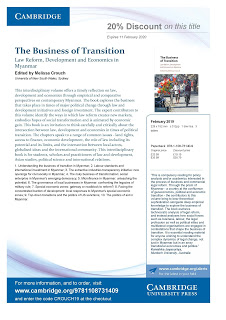
Paperback now available: The Business of Transition

Cambridge University Press has recently published the paperback version of The Business of Transition: Law Reform, Development and Economics in Myanmar.
This interdisciplinary volume offers a timely reflection on law, development and economics through empirical and comparative perspectives on contemporary Myanmar. The book explores the business that takes place in times of major political change through law and development initiatives and foreign investment. The expert contributors to this volume identify the ways in which law reform creates new markets, embodies hopes of social transformation and is animated by economic
gain. This book is an invitation to think carefully and critically about the
intersection between law, development and economics in times of political transition. The chapters speak to a range of common issues – land rights, access to finance, economic development, the role of law including its potential and its limits, and the intersection between local actors, globalised ideas and the international community. This interdisciplinary book is for students, scholars and practitioners of law and development, Asian studies, political science and international relations.
Chapters include: 1. Understanding the business of transition in Myanmar; 2. Labour standards and international investment in Myanmar; 3. The extractive industries transparency initiative: new openings for civil society in Myanmar; 4. The risky business of transformation: social enterprise in Myanmar’s emerging democracy; 5. Microfinance in Myanmar: unleashing the potential; 6. The governance of local businesses in Myanmar: confronting the legacies of military rule; 7. Special economic zones: gateway or roadblock to reform?; 8. Facing the concentrated burden of development: local responses to Myanmar’s special economic zones; 9. Top-down transitions and the politics of US sanctions; 10. The politics of aid in Myanmar.

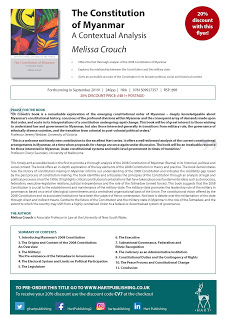
Pre-orders now available: The Constitution of Myanmar

Hart Publishing is pleased to announce that The Constitution of Myanmar is now available for pre-order. This timely and accessible book is the first to provide a thorough analysis of the 2008 Constitution of Myanmar (Burma) in its historical, political and social context. The book offers an in-depth exploration of the key elements of the 2008 Constitution in theory and practice. The book demonstrates how the history of constitution-making in Myanmar informs our understanding of the 2008 Constitution and indicates the credibility gap raised by the past process of constitution-making. The book identifies and articulates the principles of the Constitution through an analysis of legal and political processes since the 1990s. It highlights critical constitutional contestations that have taken place over fundamental ideas such as democracy, federalism, executive-legislative relations, judicial independence and the role of the Tatmadaw (armed forces). This book suggests that the 2008 Constitution facilitates the co-existence of civilian and military authorities in the form of a military-state. Distinct from direct military rule, the military-state promotes the leadership role of the military in governance, based on a set of ideological commitments and organised in the form of a highly centralised Union. The constitutional vision offered by the 2008 Constitution and its associated institutions have been the subject of fierce contestation. Not least is the debate over the militarisation of the state through direct and indirect means. Central to the future of the Constitution and the military-state in Myanmar is the role of the Tatmadaw, and the extent to which the country may shift from a highly centralised Union to a federal or decentralised system of governance.

Religious Education in Southeast Asia

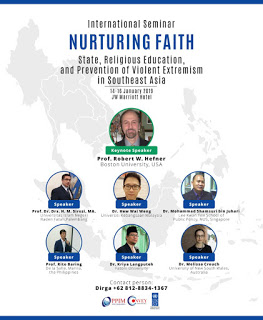
In January 2019, a conference on Religious Education in Southeast Asia was held in Jakarta, organised by the Centre for the Study of Islam and Society (Pusat Pengkajian Islam dan Masyarakat, PPIM) of the State Islamic University Jakarta, UNDP and Convey Indonesia.
The conference featured leading researchers on religious education from across Southeast Asia and was designed to discuss and debate the findings of empirical research that had been conducted under the leadership of PPIM.

UNSW Myanmar Research and Development Dialogue

From 4-8 February 2019 a group of academics affiliated with UNSW’s Institute for Global Development will be visiting Myanmar. The purpose of is to run a series of events and visits that facilitate dialogue on research and development between academics and local and international development actors. 
This includes a Research and Development Dialogue Workshop on Tuesday 5th February, with limited registrations open here.
We also encourage UNSW alumni to sign up for one of the alumni dinners, either in Yangon (eventbrite registration here) or in Naypyidaw (registration here).

China’s Presence in Mainland Southeast Asia

The Association of Mainland Southeast Asia Scholars (AMSEAS) invites submission of abstracts to a Workshop on the following theme:
China’s Presence in Mainland Southeast Asia Today
Date: Friday 21 June 2019
Place: Sydney Southeast Asia Centre (SSEAC), University of Sydney

The peoples of the mainland Southeast Asian countries of Myanmar, Thailand, Cambodia, Laos, and Vietnam, have a long history of relations with China. These relations covered the areas of trade, migration, religion and culture, and occasionally, conflict. The colonial period and the Cold War significantly disrupted contact between the two regions, but with China’s opening up and economic rise in the last 40 years relations have resumed arguably with greater intensity than at any time in recent history. As China seeks to convert its economic power into further regional influence this workshop aims to provide a clearer picture of the current relationship between mainland Southeast Asian countries and China. It will also consider its significance at a time of growing geo-political tension in the Indo-Pacific region.

The Workshop will give particular attention to four broad themes:

(i) security and shifting geopolitics in mainland Southeast Asia;
(ii) national politics, in particular how China’s authoritarian model is affecting political development in mainland Southeast Asian states;
(iii) economic and social change in mainland Southeast Asia, particularly in relation to China’s Belt and Road Initiative (BRI); and
(iv) Chinese Communist Party (CCP) influence operations in mainland Southeast Asian countries.

The Workshop particularly invites submissions from Postgraduate and Early Career Researchers. Some financial support for transportation and accommodation will be available.

AMSEAS plans to publish a journal special issue from selected Workshop papers.

Abstracts no longer than 200 words, as well as name, university affiliation, and contact details, should be submitted by 28 February 2019 via this form.

Successful applicants will be informed by 15 March 2019.

Applications should be submitted here