Indonesia Council law panels

The Indonesia Council is being held from 20-21 November 2019 at ANU.


The following panels focus on constitutional law in Indonesia


Wednesday, 9:00-10:30am


Panel 1: Constitutionalism and the Courts in Indonesia


Chair: Melissa Crouch, UNSW


Attacking Free Expression and the Rise of Authoritarianism in IndonesiaHerlambang P. Wiratraman

Indonesia’s democracy is challenged by the increasingly authoritarian model of governance (Power 2018; Wiratraman 2018, 2019; Heufer 2017). First, the political pattern established by the New Order continues to be influential; many practices are still rooted in its bureaucratic systems. This pattern was characterised by corruption and the use of political violence to resolve social-economic conflicts. Second, the state has shown a lack of political commitment to strengthen human rights, seemingly leading to circles of impunity (Wiratraman 2019). Unsurprisingly, the authorities readily reproduced numerous draconian laws which threatened public spheres, freedom of expression and opinion. Even worse, several attacks have been made on the right of citizens and groups to express their views through discussion, film screenings, art festivals, and even academia. Unfortunately, the government and its apparatuses have failed to protect such activities. Although the Constitution stipulates freedom of expression as fundamental rights, the words “… prescribed by statute” following free expression article have proved problematic, even, adverse situation has been clearly shown under all regimes since independence (Bedner 2001; Wiratraman 2014). This article aims to evaluate the development of freedom of expression as a fundamental freedom, especially in the context of the return of authoritarianism.


Constitutional (un)clarity: International Law in the Indonesian Legal SystemArie Afriansyah

The Indonesian Constitution only states on how Indonesia makes international agreement without addressing the implementation of such agreement into domestic law. In addition to that, Indonesia must implement decisions of international organisations where Indonesia is a member, such as the United Nations Security Council (UNSC) Resolutions. Legal enforcers such as judges, police, and military officers are bound by the legality principle. This means that legal proceedings must be based on Indonesian law despite such norms originally come from international agreements. The only relevant law on international agreements (Law No. 24 Year 2000), unfortunately, does not provide clear mechanism to implement international rules into domestic law. The inadequacy of Indonesia’s position towards international law is made so much more difficult in the implementation at the domestic level. This article observes Indonesia’s inconsistent practices in implementing international law and seeks some options to rectify such issue.


Title: Striking the Right Balance: Winding Back Indonesia’s ‘Big Bang’ Decentralisation

Dr Rachael Diprose

Abstract: Indonesia has achieved significant political and institutional reform over the past two decades with many wide-sweeping changes introduced during the early years of democratisation. Four sets of amendments to the 1945 Constitution allowed for the enactment of Indonesia’s decentralisation laws, which were ratified in 1999 and revised again in 2004. These reforms transferred significant fiscal and political authority to the districts and municipalities, bypassing the once powerful provincial administrations and providing this level of government with only oversight and coordinating functions, unless sectoral imperatives cross-cut district boundaries. This went some way to addressing subnational demands for greater political and fiscal autonomy that had long beleaguered Indonesia’s central administration – complaints that policy responses ineffectual in some regions or favoured other regions and groups, which in the extreme resulted in regional rebellions and separatist insurgencies.

However, while the new centre-periphery bargain that was struck mitigated past tensions, it presented new opportunities, challenges and in some cases, conflicts. Services are in many cases more readily accessible locally, and pockets of policy innovation suited to Indonesia’s wide-ranging and varied local contexts are evident. Yet, the substantial increase in the scale of actors vying for power and influence at the subnational level has introduced complexities to resolving disputes and seen larger numbers of actors pursuing predatory rent-seeking practices. Transnational actors have been able to bypass the centre in their efforts to access markets and resources by directly influencing subnational power brokers and authorities. Centre-periphery tensions over licensing authority have become increasingly acute when the licenses issued for land and resource use have overlapped or been unclear, and the central government struggled to respond to international and domestic complaints. In responding to these challenges, successive central administrations have sought to strengthen central powers in particular sectors, such as in mining. The most recent iteration of the decentralisation laws – the 2014 Local Governance Law – has also wound back the licencing authority of district and municipal governments in many of the most lucrative resource sectors to favour provincial governments. This was the tier of government that lost out in the initial ‘Big Bang’ decentralisation reforms. The question remains as to whether the emerging slow creep of recentralisation strikes the right balance in Indonesia’s centre-periphery and intra-periphery distribution of power and authority, learning from the lessons that brought about the initial reforms.

Title: Finding the Right Path to Establish Election Court in Indonesia

Fritz Siregar, Bawaslu

After General Election Law (Law Number 7 Year 2017) was enacted, an enormous authority to adjudicate election dispute was brought upon Election Supervisory Agency (Bawaslu). This authority leads to an enigma beneath Bawaslu, could Bawaslu become a fully function election tribunal. In order to adjudicate election dispute and administrative violation, each Bawaslu’s member from regency level, provincial level until national level need to learn and act like a real judge in the court. Even, judicial function was conducted by Bawaslu from regency level until national level. Bawaslu has a duty to excogitate a “judge” who could deliver a just decision in a very thin time frame. There are two main questions that need to be answered in regard to Bawaslu’s authority. First, could Bawaslu become an election tribunal and could Bawaslu become an election tribunal that possess an authority to adjudicate election result dispute. This authority was temporarily possessed by Constitutional Court according to Article 157 paragraph (2) Local Election Law (Law Number 10 Year 2016). It is also possible that actually Bawaslu  already becomes an election tribunal that possessed an election supervision function. If Bawaslu already possesses an election tribunal function, should Bawaslu make its own nomenclature that represents Bawaslu as an election tribunal. If Bawaslu is an election tribunal, should Bawaslu fall within the authority of Supreme Court. There is also an option that Bawaslu could stand alone as an election tribunal outside of the authority of Supreme Court like Commission of Information.


11:00-12:30pm


Book Launch

 
The Politics of Court Reform: Judicial Change and Legal Culture in Indonesia

Chair: Professor Ed Aspinall, ANU


Abstract: This book panel will feature several contributors and the editor of the volume The Politics of Court Reform: Judicial Change and Legal Culture in Indonesia (CUP 2019). Indonesia is the world’s third largest democracy and its courts are an important part of its democratic system of governance. Since the transition from authoritarian rule in 1998, a range of new specialised courts have been established from the Commercial Courts to the Constitutional Court and the Fisheries Court. In addition, constitutional and legal changes have affirmed the principle of judicial independence and accountability. The growth of Indonesia’s economy means that the courts are facing greater demands to resolve an increasing number of disputes. This volume offers an analysis of the politics of court reform through a review of judicial change and legal culture in Indonesia. A key concern is whether the reforms that have taken place have addressed the issues of the decline in professionalism and increase in corruption. This volume will be a vital resource for scholars of law, political science, law and development, and law and society.


Speakers:

Melissa Crouch, The Judicial Reform Landscape in Indonesia: Innovation, Specialisation and the Legacy of Dan S Lev

Daniel Pascoe, The District Courts: Sentencing Decisions as Evolving Legal Culture

Herlambang Wiratraman, Administrative Courts 

Discussant: Fritz Siregar


Thursday, Session 6

1:30-3pm

The Constitution, the Courts and the Administration in Indonesia

Chair: Fritz Siregar


Title: Judicial Independence: A Threat to Indonesia’s Democracy?

Associate Professor Melissa Crouch, University of New South Wales

Abstract:

Is Indonesia’s judiciary and its claims to judicial independence a threat to Indonesia’s democracy? Since 1998, major efforts to reform the courts have taken place. This includes the ‘one roof’ (satu atap) reforms that transferred control over management and administration of the courts from the executive to the Supreme Court; the creation of a Constitutional Court; the establishment of a new Judicial Commission to ensure judicial accountability; and the introduction of a range of specialized courts. Through a series of cases, the powers of the Judicial Commission have been compromised and the notion of ‘judicial independence’ expanded to include significant autonomy without meaningful accountability. In this paper I suggest that initial efforts to balance judicial independence with accountability have been compromised. This resonates with the theoretical work of Holmes and Fiss, who suggest that there are particular risks and dangers in granting judicial independence as part of a democratic transition. In the case of Indonesia, the persistence of corruption jeopardises the integrity of judicial independence and makes judicial accountability impossible to attain. The example of Indonesia offers lessons on constitution-making and court reform for countries in a transition to democracy.


Title: Contesting Marketisation and Predatory Rule: The 1945 Constitution, Social Rights and the Politics of Public Services in Indonesia

Professor Andrew Rosser

Following the collapse of the New Order in 1998, the Supreme Deliberative Council (MPR) amended the 1945 Constitution to, among other things, incorporate new provisions providing for better protection of social rights. This paper assesses the impact of these changes, focusing on provisions related to the rights to education, health and water services. The paper argues that i) along with other political and legal changes following the collapse of the New Order, these provisions contributed to a wave of litigation aimed at challenging neoliberal reform of public services and predatory control over public service providers; and ii) the extent to which such litigation has been successful has depended significantly on several factors: the institutional design of the court system as amended since the fall of the New Order; the presence of support structures for legal mobilization; the ideology of the courts and judges; and the roles and willingness of litigants to pursue redress. Broadly speaking, it is argued, this litigation has served to promote fulfilment of the rights of the poor and marginalized, although gains have largely come through better access to services, while issues of improving quality have been less prominent.


Title: Human rights and terrorism in Indonesia: a critical view

In the face of increasing state repression in the name of countering terrorism, human rights advocates have focused on articulating a model of counterterrorism that would be compatible with respect for human rights. While this move might bring amelioration to certain individual victims, it accommodates the problematic discourse of terrorism which often forms part of the very conditions that breed human rights violations in the first place. It risks the “legitimisation and perpetuation” of the discourse of terrorism, “rather than its dismantling or destruction.” (Jackson 2016, 122) In this talk, I present illustrations of this dynamic from Indonesia. I look at the attachment of a human rights language to Indonesia’s police-led approach to counterterrorism, and the role that plays in inoculating police abuse from scrutiny. The presentation concludes with the idea of disentangling human rights advocacy from counterterrorism. A disentangled advocacy would reaffirm and advance the critique of the discourse of terrorism while recovering the practice of human rights from minimalism or the tendency to think small and the aversion to politics.Jayson Lamcheck, National University of Singapore


The Constitutionalisation of “Religious Values” in Indonesia

In two different sections of the Amendment to 1945 Constitution, the phrase ‘nilai-nilai agama’ (religious values) are mentioned. First, in article 28J(2) on limitations of constitutional rights, and, second, in article 31(5) on the duty of government to uphold these values in education. The main question is: how far the State must endorse ‘Religious Values’ in public life as a constitutional requirement? My presentation will examine the interpretation of the phrase ‘Religious Values’ in the constitutional cases decided by the Indonesian Constitutional Court (Mahkamah Konstitusi) and evaluate the context of socio-legal politics in Indonesia.
Protecting Rights, Addressing Inequality

Workshop on the Promise of Writs as Constitutional Transfer

Here is the final program for the workshop this week at UNSW Laws


Friday 15 November 2019

9:45-10am – Welcome and Introductions

UNSW Law Welcome Melissa Crouch

Konrad Adenauer Stiftung Welcome Ms Gisela Elsner, Head of the Rule of Law Programme Asia


10am-10:45 – Alternative Histories of Modern Judicial Review

Speaker: Melissa Crouch

Chair: Theunis Roux

Commentators: Mayur Suresh, SOAS


11:15-12:00pm Locus Standi in Habeas Corpus Petitions and India’s PIL Jurisdiction

Speaker: Anuj Bhuwania

Chair: Melissa Crouch

Commentators: Theunis Roux


12:15-1:00pm Cutting a New Edge: Using Writs to Define Rights (Sri Lanka)

Speaker: Mario Gomez

Chair: Tarun Khaitan

Commentators: Rosalind Dixon


2:00-2:45pm Writ Petition in the Unmaking and Remaking of Informality

Speaker: Yugank Goyal

Chair: Theunis Roux

Commentators: Amy Cohen


2:45-3:30 Sri Lanka’s Writ Jurisdiction: Legal Transfer to Organic Growth

Speaker: Dinesha Samararatne

Chair: Melissa Crouch

Commentators: Mario Gomez  

4:00-4:45 – The Role of the Writ of Habeas Corpus in a Transitional Justice Context: Lessons from Sri Lanka

Speaker: Kumaravadivel Guruparan

Chair: Yugank Goyal

Commentators: Melissa Crouch


4:45-5:30pm: Ten Fathom Deep Thy Liberty lies: Suspension of Habeas Corpus and the Making of ‘Occupational Constitutionalism’ in Kashmir

Speaker: Jhuma Sen

Chair: Tarun Khaitan

Commentator: Cynthia Farid  

Saturday: 16 November 2019
10:00am-10:45 – Writ Remedies in South Asia: Constitutional Borrowing or Colonial Continuity?

Speaker: Cynthia Farid

Chair: Melissa Crouch

Commentator: Tarun Khaitan  

11:15-12:00pm: Writs of Quo Warranto in Pakistan: Re-writing the Electoral Landscape and Revolutionizing Executive Appointments

Speaker: Waqqas Mir

Chair: Moeen Cheema

Commentator: Melissa Crouch


12:00-12:45pm The ‘Writs’ Writ Large: The Postcoloniality of Administrative Law in Pakistan

Speaker: Moeen Cheema

Chair: Janina Boughey

Commentator: Dinesha Samararatne


1:45-2:30pm: The Fundamental Right to Judicial Review under the Indian Constitution 

Speaker: Vikram Aditya Narayan (co-author with Jahnavi Sindhu)

Chair: Melissa Crouch

Commentators: Mario Gomez


2:45-3:30 – Closing Session – discussion of publication

Closing remarks by Gisela Elsner, Head of the Rule of Law Programme Asia, Konrad Adenauer Stiftung

UNSW Law Melissa Crouch

Indonesian Law and Society Workshop

UNSW is pleased to host a work in progress seminar on Indonesian Law and Society

Monday 18 November 2019; UNSW Law, Staff Common room


11:30-12:30pm: Session 1

Chair: Melissa Crouch

Speaker 1 Yance Arizona, Indigeneity Trap: The limit of adat as a strategic framing in land conflict between rural communities against forestry enterprises

Speaker 2 Jacqueline Vel, Dirty water and poor people: How transformation of grievances blocks environmental justice


12:30-1:30pm Lunch


1:30-2:30 Session 2

Chair: Jacqueline Vel

Speaker 3: Tody Sasmitha Jiwa Utama, Adat Law in the Criminal Code and its Implications for Indonesian Plural Legal Order

Speaker 4: Lena Hanifah The Agency of Women in Accessing Informal Justice of Adat Badamai


2:30-2:45 Break


2:45-3:45: Session 3

Chair: Indri Saptaningrun

Speaker 5: Milda Istiqomah, Factors Contributing to Terrorism Sentencing Outcomes in Indonesia: A Quantitative Analysis

Speaker 6: Herlambang Perdana Cyber-Defamation, Law and Authoritarianism Tendencies in Indonesia


4:15-5:15pm Book Launch at UNSW Bookstore – The Politics of Court Reform: Judicial Change and Legal Culture in Indonesia. Chair: Jacqueline Vel; Panel Contributors: Herlambang Perdana, Fritz Edward Siregar, Melissa, Indri, Theunis Roux

Indigeneity Trap: The limit of adat as a strategic framing in land conflict between rural communities against forestry enterprises

Yance Arizona, PhD Candiate at Van Vollenhoven Institute, Leiden UniversityIn Indonesia, as many countries in the global south, the political struggle to obtain state recognition to customary land tenure has been used widely by rural communities as an alternative strategy for (re-)claiming their land rights against land dispossession. Although the effectiveness of this strategy remains questionable, the prevalence of this strategy continuously appears as an argument of rural communities encounter land conflict. This article discusses how rural communities involved in the emerging indigeneity discourse in Indonesia as a strategy among various options to defend their land right against a forest enterprise. This study finds how various strategies intersect and change over time. Using indigeneity rhetoric has strengthened the negotiation position of rural communities to discuss the available procedure to solve their problem through the district government. However, the legal recognition for indigeneity also led to unpredicted circumstances for the communities. The indigeneity framework shifts rural communities’ grievances from protecting their land rights into a complicated procedure of defining indigenous legal status. Subsequently, this strategy changes the nature of the land conflict between the rural communities and the company to government agencies. Moreover, rural communities have to transform their exposition to be fitted with indigenous imaginary of the state and restricts other potential redress-mechanisms. They can be caught in a legal labyrinth without promising results for resolving their initial grievances.     

Dirty water and poor people: How transformation of grievances blocks environmental justice


Jacqueline Vel ((Van Vollenhoven Institute, Leiden), (paper with Laure D’Hondt (Van Vollenhoven Institute, Leiden) and Stepanus Makambombu (Stimulant Institute, Waingapu ))

Abstract

Plantations and mining industries have a devastating environmental impact in the rural areas of Indonesia. One major problem is water pollution that causes shortage of clean drinking water, pollution related diseases and decline of agricultural production and fisheries. In a situation where the rule of law would function well, government and citizens would act against the polluters to protect the public interest in clean water and the human right to have access to safe and sufficient water for drinking, bathing and growing food. However, this is not reality in the cases we have investigated. This paper shows that in two different cases, in North Maluku and Sumba, the process of seeking access to environmental justice has been blocked and transformed. Initial grievances about water pollution and water shortage have gradually (been) changed into demands for compensation for land owners, or jobs at the polluting industry. Based on the two cases we analyze the processes at work causing the blocks in redress seeking, and the push factors for transformation of grievances concerning environmental protection into economic demands. What would be the key for redirecting attention of government institutions and NGOs toward ending water pollution and water grabbing?


ADAT LAW IN THE CRIMINAL CODE AND ITS IMPLICATIONS FOR INDONESIA PLURAL LEGAL ORDER

Tody Sasmitha Jiwa Utama, Center for Adat Law Studies “Djojodigoeno”, Faculty of Law, Universitas Gadjah Mada. Email: tody_sasmitha@ugm.ac.idIn September 2019, the Indonesian Parliament’s plan to pass the Bill of Indonesia Criminal Code (BICC) has sparked public tension. The Bill is protested as it threatens civil liberties and rights of vulnerable groups. It is designated to outlaw extramarital sex, unauthorised abortion, blasphemy, an insult to the president, and dissemination of Marxist-Leninist.

Among those problematic provisions, The BICC also has several articles that attempt to incorporate adat (customary) law into the state system. Using the term ‘living law’ and ‘adat’ consecutively, the Bill affirms that adat law can be used as a basis of criminalisation. In other words, although there is no written law that determined particular action as a crime, the state would be able to prosecute the perpetrator if the living law says so. To give the law enforcer more precise guidance, the Bill will be followed by the documentation of adat law through district regulations.

This presentation aims to discuss two aspects of such initiative. First, how does the BICC construct the adat law and what does such initiative aim for. Second, what are the implications of incorporating adat law in BICC towards Indonesia’s plural legal landscape.

The Agency of Women in Accessing Informal Justice of Adat Badamai

Lena Hanifah Hasan Basuni

This presentation is one part of my chapter discussing the emerge of disputes and women’s access to justice regarding inheritance cases in the absence of surviving son in South Kalimantan, Indonesia. Parker has described these options in her pyramid of access to justice which shows that cases were treated mostly in the indigenous ordering, following by informal justice, and formal legal justice at the tip of the pyramid. Ulama or Tuan Guru holds a critical position in the informal justice system in South Kalimantan. The practice of seeking advice from Tuan Guru to find a resolution in a dispute is called Adat Badamai which means ‘a tradition to reconcile.’ However, the agency of women in this process is challenged by the community’s favouring of men to oversee this process.

Cyber-Defamation, Law and Authoritarianism Tendencies in IndonesiaHerlambang P. WiratramanA decade after the enactment of Act on Electronic Information and Transaction (IET) in 2008, there have been attacks on free expression as well as free press. Criminalisation by using cyber-defamation law has been often used to silence criticism, not only for individuals, but also journalism works. This has been an easy situation for Indonesia’s democracy since the media freedom has been challenged by growing populism and the ‘return’ of authoritarian rules. On the other side, the dominance narrative of fake news which turns to hoax industry has been affecting political freedoms and democratic practices.

By limiting to the issues of cyber-defamation, this presentation addresses journalism/free press and free expression in Indonesia’s Jokowi first presidential term. Two questions are discussed. how the cyber-defamation law has been used to silence criticism, including news media? First, how it has been influencing to freedom of expression generally, and Second, how it has been affecting to democracy and authoritarianism tendencies in Indonesia.

Factors Contributing to Terrorism Sentencing Outcomes in Indonesia: A Quantitative Analysis

Milda Istiqomah

In terrorism prosecutions, some researchers have claimed that extra-legal factors tend to influence sentencing outcomes. However, there is no adequate evidence that this tendency applies in Indonesian terrorism trials. This paper aims to examine what factors contribute to sentencing decisions in Indonesian terrorism prosecutions. It specifically focuses on sentence length in Indonesian terrorism prosecutions and identifies factors that are significant predictors of sentence length. Using a quantitative approach, this paper examines approximately 135 terrorism verdicts in Indonesia. A range of variables used in the analysis consists of five main predictors including: (1) factors related to case characteristics; (2) factors related to the circumstances of the offence; (3) factors relating to the victim; (4) factors relating to the offender; and (5) factors related to aggravating and mitigating factors. The extent to which the selected independent factors predict sentence length is tested in a regression analysis. This analysis suggests that the sentences can be to a large extent predicted by the seriousness of the offences. The total number of people who died in the terrorist incident written in the verdict is the strongest predictor of sentence length in the model.

Book Launch: The Politics of Court Reform

On Monday 18 November, the UNSW Bookroom will host a book launch of “The Politics of Court Reform: Judicial Change and Legal Culture in Indonesia” (CUP 2019)Chair: Jacqueline Vel, with authors Melissa Crouch, Theunis Roux, Indri Saptaningrun, Herlambang Perdana and Fritz Siregar

Indonesia is the world’s third largest democracy and its courts are an important part of its democratic system of governance. Since the transition from authoritarian rule in 1998, a range of new specialised courts have been established from the Commercial Courts to the Constitutional Court and the Fisheries Court. In addition, constitutional and legal changes have affirmed the principle of judicial independence and accountability. The growth of Indonesia’s economy means that the courts are facing greater demands to resolve an increasing number of disputes. This event will launch the volume, which offers an analysis of the politics of court reform through a review of judicial change and legal culture in Indonesia. A key concern is whether the reforms that have taken place have addressed the issues of the decline in professionalism and increase in corruption. At the book launch, several of the contributors to the book will offer their perspective on the politics of court reform in Indonesia over the past 20 years.

Register at eventbrite

Indonesian Constitutional Court International Symposium

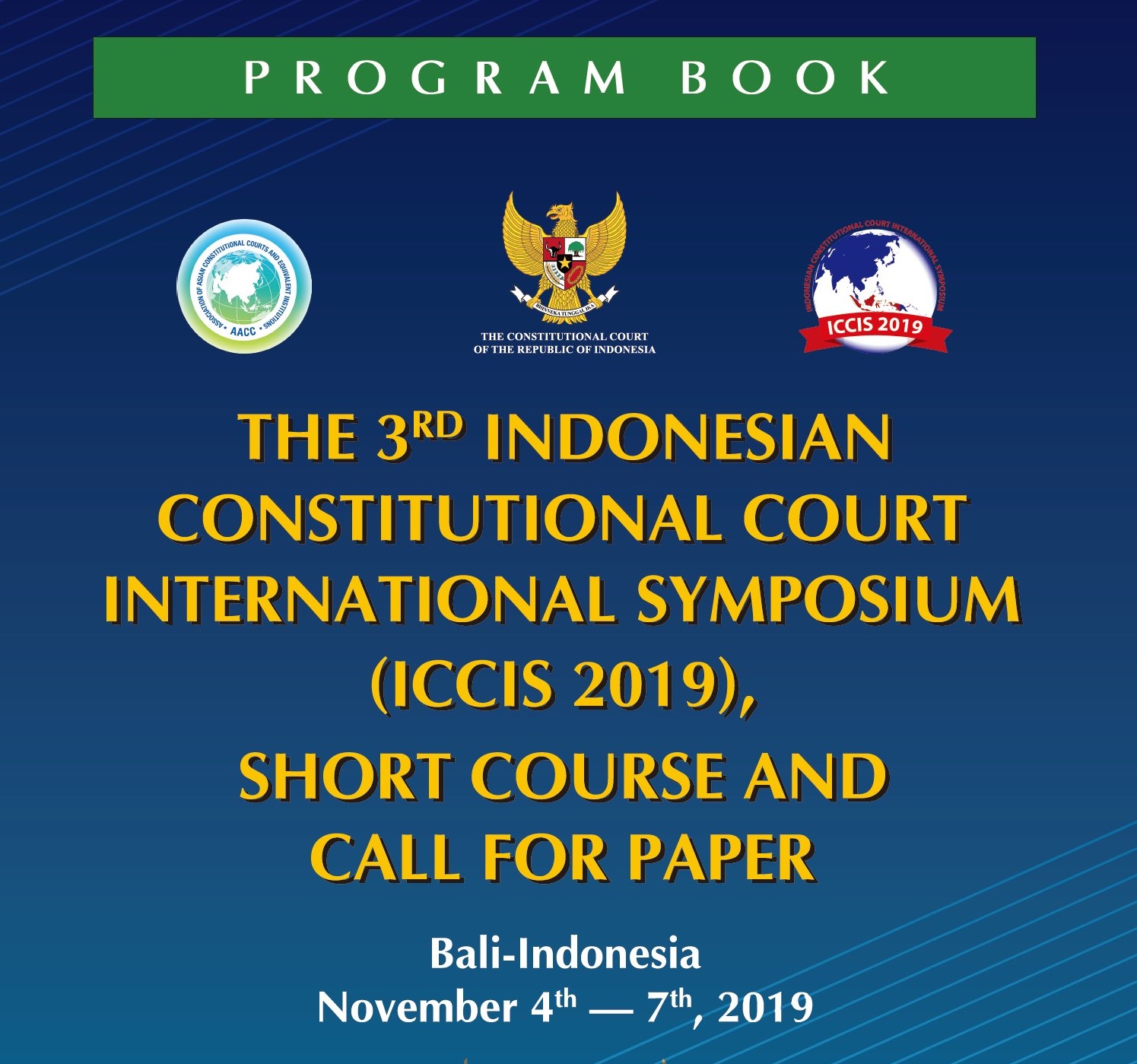
The third Indonesia Constitutional Court International Symposium 2019 (ICCIS 2019) will be held on Monday 4 November 2019 in Bali.

From 6-7th Nov, there will be an academic conference on ‘Constitutional Courts and the Protection of Social and Economic Rights’. It even has its own youtube video.
My paper will focus on “Court Reform after Authoritarian Rule: Specialised Courts and Corruption in Indonesia“. Abstract: Democratic transitions from authoritarian rule usually lead to a process of court reform. Indeed, court reform has been a central pillar of the law and development movement since the 1960s. What are the challenges for court reform after authoritarian rule? To what extent can specialized courts overcome these challenges? In this article, I examine court reform in Indonesia post-1998 and its strategy of establishing specialized courts. Building on the work of Daniel S Lev, I suggest we need to pay attention to the politics of court reform after authoritarian rule. Specialized courts as a type of institutional reform need to be considered together with judicial culture in order to address fundamental challenges in the courts.

ASAA book prizes

Early Career Book Prize

The Asian Studies Association of Australia (ASAA) is pleased to announce a call for nominations for the Early Career Book Prize in Asian Studies. This is a new prize that is being offered in response to our members’ feedback and is intended to recognize the outstanding work of early career scholars.

The winner of the prize will receive $1,000. There may be an honorable mention for the runner up.

Criteria
• The book must have been published in 2018-2019.
• The book must be a monograph and must deal primarily with a country or countries of Asia or with Australia’s relationship with Asia.
• The book must be in the humanities or social sciences disciplines, broadly defined.
• The prize will be awarded to a scholar’s first book, or to a later book published by an early career scholar, which is defined as up to five years post-PhD, with allowance for career interruptions according to ARC funding rules. The book must be sole-authored
• Authors must have had an association with an Australian university at the time of writing and/or publication of the book (for example, the book was based on a PhD submitted at an Australian university, the author is associated with an Australian university in a staff, casual or adjunct position, or in the form of a visiting fellowship etc.)

Click here to nominate by 31 January 2020.

Mid-career Book Prize

The ASAA is pleased to announce a call for applications for the Mid-Career Book Prize in Asian Studies. This is a new prize in response to our members’ feedback and is designed to recognize the outstanding work of mid career scholars.The winner of the prize will receive $1,000. There may be an honorable mention for the runner up.Criteria
• The book must have been published in 2018-2019.
• The book must be a monograph and must deal primarily with a country or countries of Asia or with Australia’s relationship with Asia.
• The book must be in the humanities or social sciences disciplines, broadly defined.
• The Mid-career Prize for Asian Studies will be awarded to a second or third book written by an author who is employed below level E (full professor) at an Australian university or who is otherwise formally affiliated to an Australian university (for example, in a casual or adjunct position, or in the form of a visiting fellowship) for at least three of the last five years. Eligibility is judged at time of publication.

Click here to nominate by 31 January 2020.

Book launch at UNSW Law

Please join us on the 14th Nov when we will launch Melissa Crouch’s book, The Constitution of Myanmar: A Contextual Analysis

About this Event

The Constitution of Myanmar: A Contextual Analysis, by Melissa Crouch

Date: Thursday 14 November, 2019

Time: 4.45pm for a 5pm start

Location: UNSW Book Shop, Quadrangle Building, E15, Kensington Campus

Author: Melissa Crouch, Associate Professor in the Faculty of Law at UNSW Sydney

Chair: Professor Theunis Roux (UNSW Law and member of the Australia-Myanmar Constitutional Democracy Project)

Commentators:

Associate Professor Tarunabh Khaitan (The University of Melbourne)
Dr Dinesha Samararatne (postdoctoral fellow at the University of Melbourne and academic of the Faculty of Law, the University of Colombo, Sri Lanka)

About the Book

In 2017, a prominent lawyer and advocate for constitutional change, Ko Ni, was assassinated at Yangon International Airport in Myanmar. His ideas about amending the 2008 Constitution were a challenge to those who hold power in Myanmar. The 2008 Constitution is the first constitution the country has had since 1988 and it is a constitution that was drafted by the former military regime.

This panel will reflect upon the meaning of the Constitution and its role in shaping political debate in a country that continues to struggle with the legacy of direct military rule. As the legislature in Myanmar is currently drafting a bill on constitutional amendment, this timely panel will consider the prospects for reform.

The case of Myanmar also offers an opportunity to reflect upon the possibilities and limits of the field of comparative constitutional law and society. The book, The Constitution of Myanmar: A Contextual Analysis, will be launched at the event.

Refreshments will be served after the event.

This event is free of charge, but you are kindly requested to register attendance by clicking the RSVP button above. Any questions regarding this event may be directed to Natalie Klein – n.klein@unsw.edu.au

RSVP at Eventbrite

UNSW ASEAN Conference

The UNSW ASEAN Student Society is organising a conference for students at UNSW.


Date: 12th October 2019, Saturday
Time: 9:00AM – 6:00PM
Venue: Leighton Hall, John Niland Scientia Building, UNSW Sydney
Ticket prices: $27 (Arc member); $32 (Non-Arc member)


This one-day event set to be in Saturday Week 4, T3 2019, will bring together driven students, regional stakeholders and distinguished diplomatic pioneers to discuss South East Asia’s most notable issues.

The conference will include keynote addresses, panels, case studies, debates and mini lectures to help participants gain a deeper understanding of issues within the ASEAN region.


Tickets available here: http://bit.ly/UACREGO19
LinkedIn: https://au.linkedin.com/company/unsw-asean-conference
Website: https://www.unswaseanconference.com/

Call for Panel Papers: Law and Society in Asia

Law and Society in Asia
Call for Panel Papers for the Asian Studies Association of Australia Conference (“Future Asias”), 6-9 July 2020, University of Melbourne

Panel Convenors: Melissa Crouch (UNSW), Petra Mahy (Monash), Jeff Redding (Melbourne) There is vast research potential for socio-legal studies in Asia, being home to a myriad of legal systems and cultures. Socio-legal (or law and society) studies address fundamental questions about the nature of law in society and its relationships to actual human thought and behaviour. Socio-legal scholars tend to investigate the dialectic relationships between law and morality and between law and other forms of regulation including social norms and cultural values. Research ranges from formal institutional settings to private domestic situations, and from major political upheavals to mundane everyday social interactions. By implication, research methodologies used in this area tend to be empirical and based on rich ethnographic approaches drawing on observational, interview and textual data sources.

We are calling for papers which generally fall within socio-legal studies in Asia, with potential themes as follows:

·       Law and politics of citizenship in Asia
·       Law, gender and religion
·       Constitutionalism in Asia
·       Law and authoritarianism in Asia
·       Transitional justice
·       Dispute resolution processes
To submit an abstract, please email the three convenors on: melissa.crouch@unsw.edu.aupetra.mahy@monash.edu and jeff.redding@unimelb.edu.au by Friday18 October 2019 providing an abstract of maximum 200 words and a brief speaker biography of 50 words.

Indonesia’s experiment with specialised courts

Note: this post first appeared on 1 Sept 2019, on Academic Perspectives from Cambridge University Press

Indonesia’s extensive court system delivers justice for the world’s third largest democracy. The dramatic end of authoritarian rule under Suharto in 1998 ushered in two decades of law reform. Since then, the constitutional and political system has undergone major changes and legal reform. These innovations and reforms have also affected the courts, which have been restructured and imbued with new powers.

Indonesian courts have expanded in expertise, size and geography, with the introduction of a wide range of specialized courts. The contemporary judicial landscape features at least 13 different types of courts. These specialized courts often seek to disrupt existing concerns with the general court system, such as appointing a majority of non-career judges to the bench in an attempt to circumvent the cycles of corruption inherent in the career judiciary.

This emphasis on judicial reform, new courts and the trend towards judicial specialization is not unique to Indonesia and can be found around the world. Nevertheless, the Indonesian case is remarkable in the number and breadth of topics and areas of specialization.

The politics of Indonesia’s courts are the subject of sustained scholarly analysis by the late Professor Dan S Lev. His work is grounded in a socio-legal approach to the study of law, legal actors and legal institutions. In this volume, The Politics of Court Reform, we seek to reinvigorate and affirm the importance of Lev’s work on the politics of courts and legal culture for the study of the judiciary in Indonesia.

There are at least three key aspects of specialised courts that contribute to their ‘specialised’ status: the subject matter or distinct jurisdiction of the court; a judicial selection process and judicial bench that often consists of a majority of non-career or ‘expert’ judges; and an investigation and determination procedure that differs from the general courts and is designed to be more efficient.

This volume considers specialised courts as a strategy of court reform. Specialized courts have one of two kinds of institutional status in Indonesia. Some specialized courts are institutionally separate from the general courts, with its own court buildings and procedures, such as the Constitutional Court, the Administrative Courts and the Religious Courts. I call these ‘independent specialized courts’. They operate relatively autonomously from the general court system, although for many of these courts there is still an avenue of appeal to the Supreme Court.

Other specialized courts exist within the scope of another court (usually the district or provincial courts). They may use the same buildings, are often subject to the same legal procedure and bench composed of the same judges as the general courts. I call these ‘dependent specialized courts’ in the sense that institutionally it is still reliant on the infrastructure and personnel of the general court system. These dependent specialized courts include the Industrial Relations Court, the Juvenile Courts, the Commercial Courts, the Anti-Corruption Courts, the Fisheries Courts, the Small Claims Court, the Human Rights Courts, and the Tax Courts.

Specialised courts share common characteristics. Most specialized courts are creatures of legislation and are the legacy of the active role of the legislature in justice sector reform. This means that specialized courts are dependent on the goodwill of the legislature for not only the scope of their jurisdiction but also its very existence as an institution. This is with the exception of the Constitutional Court, Administrative Courts, Military Courts and the Religious Courts, which all have constitutional recognition.

Across these courts, chapters in this volume find common challenges such as the difficulty of establishing a new judicial institution; balancing career judges with non-career judges, and preventing and addressing corruption within the judiciary. It remains an ongoing struggle to break away from the decline in professionalism and rise in corruption so prevalent under the New Order, as so aptly described by Lev. In extending Lev’s work on courts in Indonesia, this volume collectively suggests that specialised courts often have unintended consequences and do not necessarily avoid the corruption inherent in the general court system.