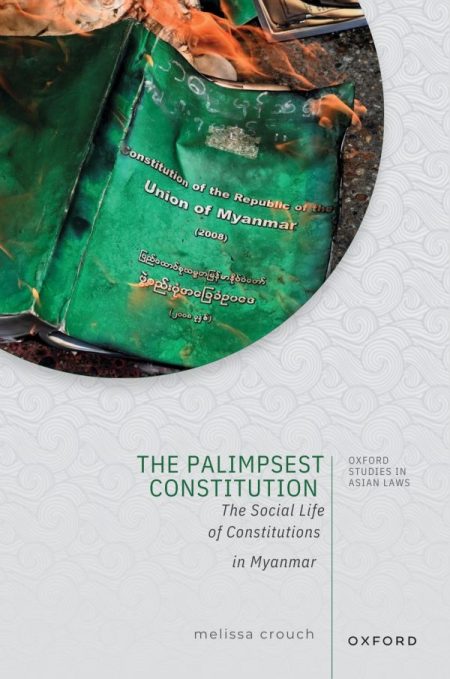
Since the mid-20th century, many former postcolonial states have engaged in multiple constitution-making exercises, with the turnover in written constitutions often due to coups or internal conflict. Conversely, people have resisted authoritarian rule through alternative constitution-making. The reality that most countries have had numerous official and unofficial constitutional texts begs the question: How do past constitutions matter in the present? This volume explores the social life of constitutions, or how past constitutions matter. Using the case of Myanmar, Crouch demonstrates that constitutions are a palimpsest of past texts, ideas, and practices, an accumulation of contested legacies. Through constitutional ethnography, she traces Myanmar’s modern constitutional history from the late colonial era through its postcolonial, socialist, and military regimes.
The Palimpsest Constitution captures the idea that contemporary debates about constitutional reform are informed by the contested legacies of the past. Today, the military insists on the endurance of its 2008 Constitution while pro-civilian actors resist military rule through alternative constitution-making endeavours. Offering a sociological view of constitutional endurance, the book demonstrates how the social life of contested constitutional legacies are central to the struggle for constitutional democracy and civilian rule in Myanmar.
Endorsements
“Melissa Crouch has written a remarkable book—thoughtful, honest, and deeply grounded in the lived experiences of the people of Myanmar. Her concept of the palimpsest constitution helps us understand how legal ideas are layered, repurposed, and at times weaponized—revealing how the past continues to shape the present in ways that are both subtle and stark. Rather than offering easy answers, Crouch explores how history, law, and politics intertwine in Myanmar’s long struggle for democracy. Her storytelling is vivid and personal, particularly in her reflections on the life and loss of U Ko Ni, a courageous lawyer who gave voice to the hope of a better future. The Palimpsest Constitution is essential reading for anyone seeking to understand how law operates—not only in courtrooms, but in peoples’ lives, memories, and acts of resistance.” – Thant Myint-U, historian and author, Honorary Fellow of Trinity College at the University of Cambridge (grandson of U Thant, the first non-Western Secretary General of the UN)
“In this persuasive and timely assessment of the fragility and endurance of constitutions, Crouch writes with clarity and passion about the social life of constitutions in Burma/Myanmar. Her sweeping history exposes the continuities of power and violence across colonial, democratic, and authoritarian regimes, successfully placing the Global South at the center of broad debates about constitutional politics.” – Lauren Benton, Barton M. Biggs Professor of History and Professor of Law, Yale University
“In this detailed history of the feints and parries of constitution drafting in Myanmar, Professor Crouch shows how past constitutions circulate not only in present constitutional debate but also in social memory, political mobilization, public commemoration, legal professionalism, resistance, and social control—even book selling—making this account instructive for sociolegal scholars and ethnographers of post-coloniality and authoritarian rule. Clear and engaging writing and thoughtful thematic organization make the work accessible to readers beyond regional specialists and legal comparativists. Her fieldwork narrative adds further value, especially for ethnographers of law.” – Carol J. Greenhouse, Arthur Marks ’19 Professor of Anthropology Emeritus, Princeton University
The Palimpsest Constitution offers a clear, accessible account of Myanmar’s modern constitutional trajectory, enriched by vivid ethnographic insights … Moving beyond text-focused legal analysis, Crouch shows how people invoke and rework older constitutional ideas in their everyday struggles, providing a fresh and innovative perspective on constitutional change and the evolving role of the military.
Sida Liu, Professor of Law and Sociology, The University of Hong Kong
‘a worthy example of comparative scholarship other-wise, that is, in my jargon, a comparative study at once different from orthodox positivist fare and sensitive to the singularity of otherness’
Professor Pierre Legrand, Sorbonne University, Paris; Northwestern University, Chicago
‘A powerful, passionate and painstakingly documented study of rule without and by law in Myanmar which shows the fruitfulness of the metaphor of treating constitutional change as like writing on a palimpsest.’
Professor David Nelken, Dickson Poon Law School, King’s College, London
 Melissa Crouch