Politics in Action in Southeast Asia

Upcoming Event: Politics in Action: Democratic Updates from Southeast Asia Policy Roundtable 
When: 29 July 2016, 10.00 – 18.00 Where: New Law School Lecture Theatre 104, New Law Building, University of Sydney

Southeast Asia is far from homogenous when it comes to political systems, government leadership and democratic transitions. Each country has a unique political history which separates it from its neighbours, in spite of efforts to present a unified face through institutions such as the Association of Southeast Asian Nations (ASEAN). The policy roundtable aims to provide current political updates on the states in Southeast Asia, providing individual country updates, as well as space to discuss the broader implications of political issues beyond national borders. Drawing upon expertise at the University of Sydney, as well as interstate and international colleagues, this event will bring you up-to-date with the latest political developments across Southeast Asia. 


See Sydney’s website to register

This is the abstract for  my talk on Politics in Action in Myanmar
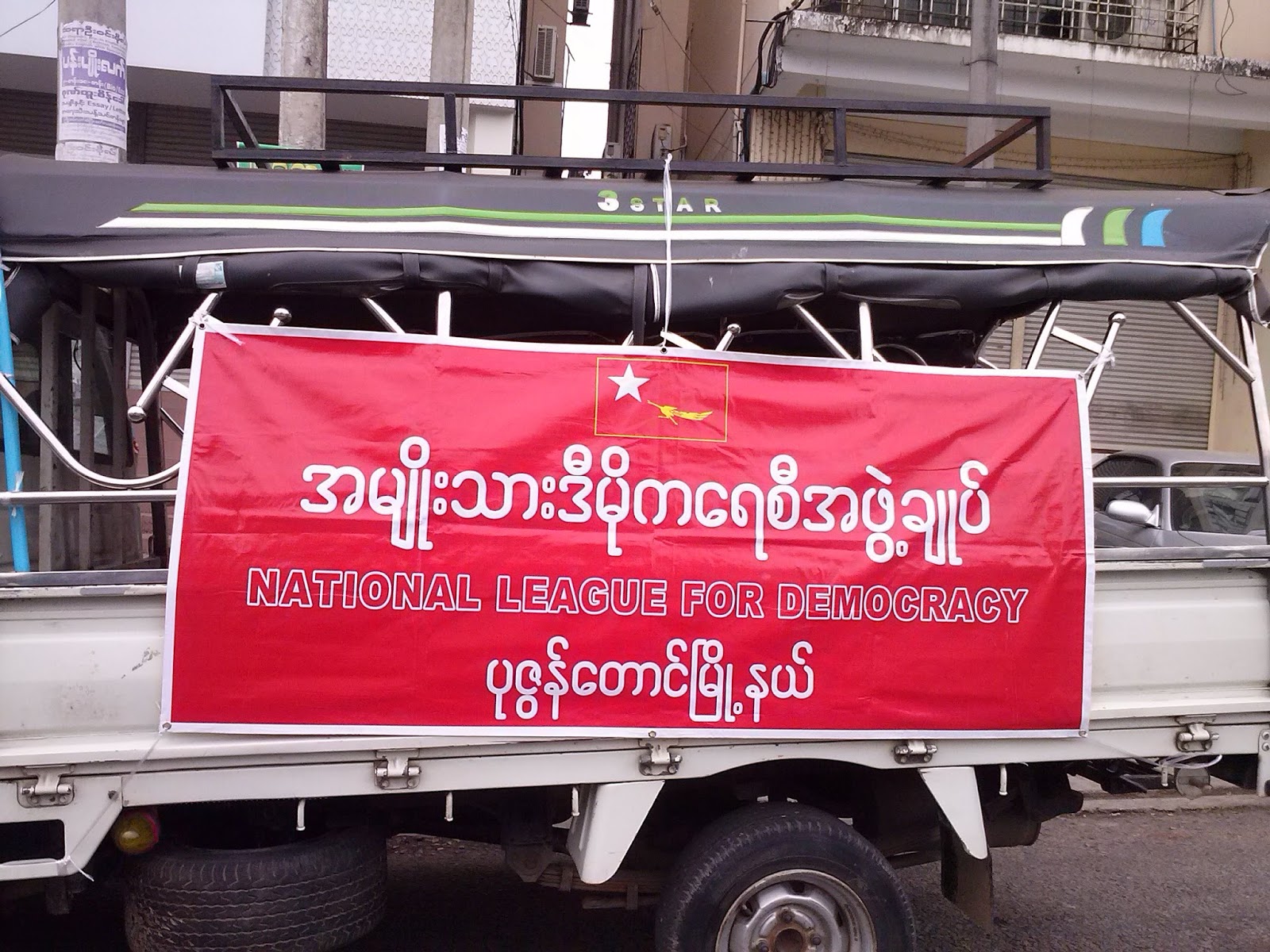
Politics in Myanmar has undergone a dramatic shift in recent months, or has it? This presentation considers the extent to which Myanmar’s political and legal system mandating quasi-military rule will constrain its newly-elected members of parliament. Pragmatism has led to a proxy president (U Htin Kyaw) and the tailor-made position of State Counsellor for Daw Aung San Suu Kyi. The current regime is a form of ‘semi-competitive authoritarianism’ and the National League for Democracy (NLD) government remains subject to certain constraints including the reserved domains of military power and the high concentration of power in the President. Acknowledging these constraints is key to understanding whether the NLD will be able to address the major challenges it faces – from the peace process, to economic reform, land disputes, anti-Muslim violence and constitutional reform.

Religion in Times of Crisis

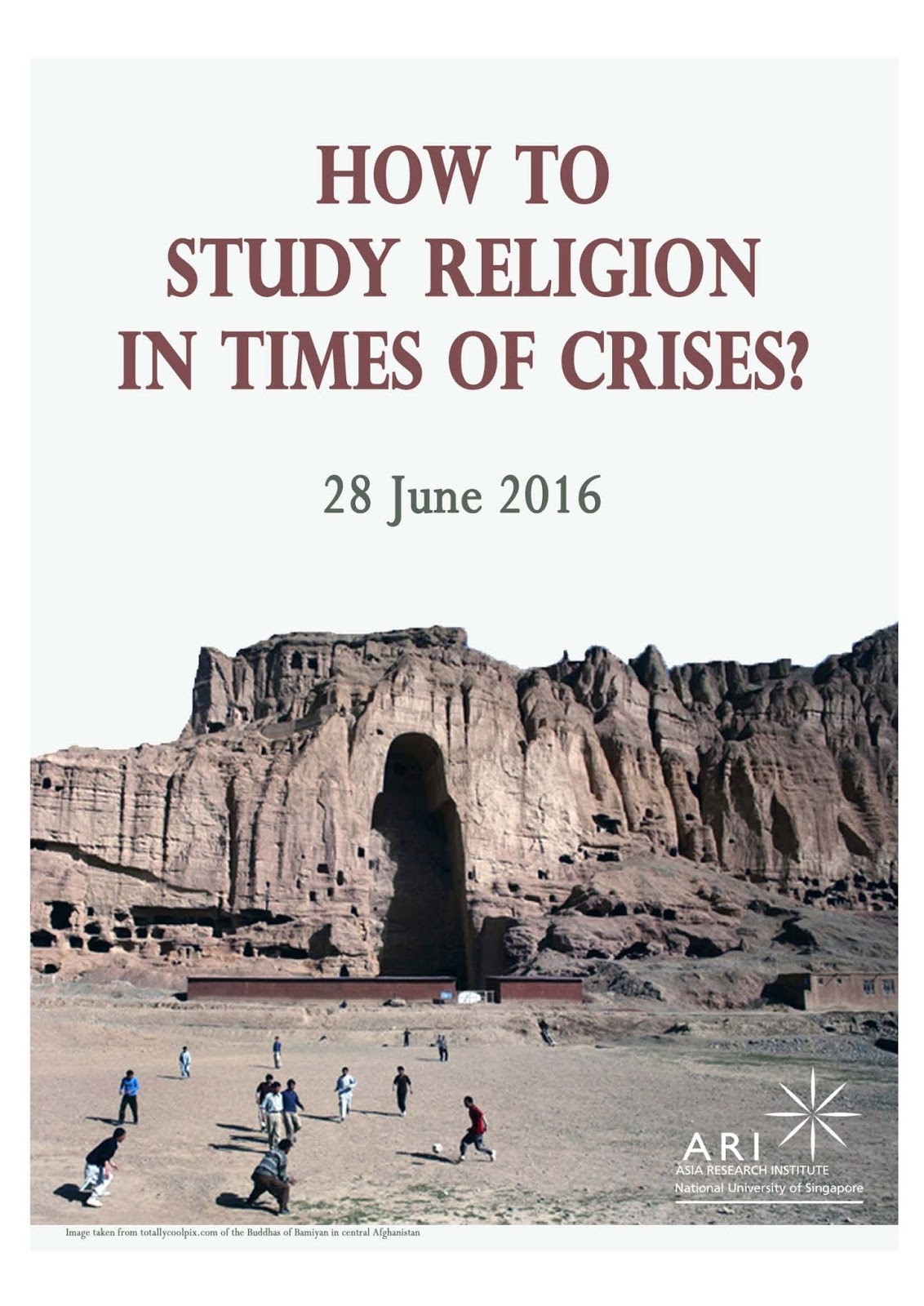
On 28 June 2016, the Asia Research Institute in Singapore will be hosting a seminar on “How to Study Religion in Times of Crisis”. The event is organised by the Religion and Globalisation Cluster Fellows Giuseppe Bolotta, Catherine Scheer, Nurfadzilah Yahaya and Amelia Fauzia. The conference program is available here, or the abstract is below: 


In times of crises, scholars of religion often feel compelled to address certain controversial issues as soon as they emerge. A growing number of scholars specialising in religious studies straddle the worlds of academia and the media. Under time constraints, they are sometimes forced to reduce context-specific and flexible religious traditions to generalizations in order to be accessible to the public. As a result, debates within the different fields under the broad rubric of religious studies that have a longer trajectory and pervasive role in the academy tend to be cast aside. Many scholars continue to feel a heightened sense of responsibility in presenting their research through careful crafting of narratives to avoid sensationalization or shallow analyses which are not helpful in the long run. This roundtable proposes to explore how scholars working on Asia could balance in-depth research amidst the quick unfolding of crucial current events that could not be analysed fast enough.


How can scholars stay relevant by being current whilst producing trenchant analyses?
How have scholars adjusted their investigations to methodologies that address events that require their attention immediately?
How has scholarship on religion been presented outside of academia?
How has the rise of social media impacted upon scholarship on religion?
How do scholars of religion incorporate these events into their research afterwards?What frameworks should be adopted and avoided?


We hope that this conversation between scholars will help incubate new approaches to studying religion in Southeast Asia in particular, a region that has been neglected in despite its fair share of religious crises

UNSW engagement in Myanmar

Ithought I would just provide an update of all the things going on at UNSW Law in relation to Myanmar. See flier here, or info below:

UNSW Law has numerous projects to contribute to legal education, constitutional literacy and protection of human rights in Myanmar, including:

· the Australia-Myanmar Constitutional Democracy Project;
· the Diplomacy Training Program;
· National Pro Bono program;
· Legal education initiatives;
· Myanmar/Burma online legal database at AsianLII;
· UNSW International focus on partnership with Myanmar;
· Other academic events

Australia Myanmar Constitutional Democracy Project
In 2013, the Australia-Myanmar Constitutional Democracy Project was established by Sydney University, in cooperation with UNSW, ANU and NUS. This was done at the request of Daw Aung San Suu Kyi, of the National League for Democracy, and her concerns to enhance constitutional literary and promote legal reform in Myanmar. The Project aims to directly increase the capacity of local actors to participate positively in the process of constitutional reform in Myanmar. It will do this by expanding the constitutional vocabulary of different groups within society (ethnic communities, grass-roots organisations, political leaders, members of the media) so that they can contribute to political discourse. It will also provide a forum for debate and discussion between groups and actors who may not previously have had opportunities to come together to participate in constitutional conversations. In the long term, the Project’s objective is to expand the democratic political space during a critical time in Myanmar’s transition towards constitutional democracy. The Project aims to support increased constitutional stability, leading to an environment where there is greater prospect for peaceful and equitable development. The Project also strengthens linkages and networks between scholars and members of civil society in Myanmar and Australia.
The first workshop was held in May 2013 in Yangon, and this was the first major international workshop on constitutional reform of its kind in Myanmar. It was attended by Daw Aung San Suu Kyi herself, as well as a wide range of civil society organisations, lawyers, judges, and politicians. Academics from UNSW included Professor Martin Krygier and Professor Adam Czarnota, and Dr Melissa Crouch. The workshop was sponsored by the Australian embassy, Rotary International, and Konrad Adenauer Foundation, and well as the partner universities concerned. The workshop was attended by See report on proceedings here, and media release here and here.
In 2014, UNSW Law School took over leadership of the Australia Myanmar Constitutional Democracy Project. Core project members include Professor Martin Krygier, Professor Theunis Roux, Dr Catherine Renshaw (UWS), Dr Melissa Crouch and Professor Wojciech Sadurski (Sydney). In November 2014, major workshops were again held in Yangon and Naypyidaw covering topics from constitutional amendment to federalism, separation of powers, bills of rights and the role of courts. The workshop was again sponsored by the Australian embassy, Rotary International, and the Konrad Adenauer Foundation, as well as the universities involved. See a report on proceedings here.
From 2015-2016, major funding was offered by the Community of Democracies and the Korea International Cooperation Agency (KOICA) to undertake further workshops to enhance democratic participation and constitutional literacy in Myanmar. In July 2015, two major workshops were held, one in Mandalay with a wide range of civil society actors, members of parliament and lawyers; the other in Naypyidaw with the Constitutional Tribunal members and court staff. A further workshop was also held on 23 November 2015 that explored the relationship between justice and constitutional democracy during periods of transition. This workshop was attended by over 90 people including Members of state and federal Parliaments, political party representatives, members of ethnic minorities, lawyers, members of the Myanmar National Human Rights Commission, academics, representatives of civil society organisations) and international experts from Asia, Australia and Myanmar.

In November 2016, there are plans for a workshop in Yangon with a wide range of actors, and in Naypyidaw with the new members of the Constitutional Tribunal. The Australia Myanmar Constitutional Democracy Project is currently a joint enterprise of Law Schools: including the University of New South Wales (UNSW); the University of Sydney; and University of Western Sydney.  

Contact persons:
Professor Martin Krygier: m.krygier@unsw.edu.au
Professor Theunis Roux: t.roux@unsw.edu.au
Dr Melissa Crouch: melissa.crouch@unsw.edu.au

Legal Education
In 2014, UNSW Law School signed a Memorandum of Understanding (MOU) with Mandalay Law Department, at the University of Mandalay. This was the initiative of Professor Carolyn Penfold and Professor Brendon Edgeworth, and was the result of their visit to Mandalay University in 2013. In February-March 2015, two law professors, Daw Htin Htay Ei and Daw Nu Nu Yee, from the Law Department at Mandalay University visited the UNSW Law School. In July 2015, Professor Brendon Edgeworth and Dr Melissa Crouch gave guest lectures at the Law Department in Mandalay to about 100 students and staff.
In March 2016, Professor David Dixon, Dean of UNSW Law, visited the University of Yangon, met with the Myanmar Centre for Responsible Business and the Australian Embassy. Further cooperation on legal education is planned in the future.

Diplomacy Training Program (DTP)
The Diplomacy Training Program is a unique initiative that is affiliated with the UNSW Law School and has a strong history of capacity building in the region. In May 2014, the Diplomacy Training Program (DTP), led by Patrick Earle,  held its first human rights training program in Yangon, Myanmar. Australia’s Ambassador to Myanmar, Bronte Moules, hosted a reception for the participants and for DTP’s alumni. U Win Mra, the chairperson of the Myanmar Human Rights Commission participated in the closing ceremony and the awarding of UNSW certificates. See here for more information.
In November 2014,the 24th Annual Regional Human Rights and Peoples’ Diplomacy TrainingProgram was held in Kathmandu, Nepal in partnership with INSEC, and some participants from Myanmar attended the program. Many participants from Myanmar have attended DTP training programs over the past decade. In September 2015, DTP held a training program on business and human rights at UNSW Law and about eight participants from Myanmar attended.

Asia Pro Bono conference in Myanmar
The Australian Pro Bono Centre has been located at UNSW Law since 2012. In September 2015, the Australian Pro Bono Centre contributed to the major annual Asia Pro Bono conference, which was held for the first time in Mandalay. This was a large international conference that draws together practitioners, scholars and students from around the region.

Myanmar/Burma Online Database at AsianLII
Professor Graham Greenleaf and Philip Chung have led the team at the Australasian Legal Information Institute (AustLII), in consultation with Dr Melissa Crouch, to set up a Myanmar/Burma online law database as part of the AsianLII program. On 23 May 2016, an official launch of the new database was hosted by UNSW Law. This is a significant resource and the database will continue to be expanded in the future. A guide on how to use the database is available online.

UNSW International
At the university wide level, there are plans for greater partnerships with University of Yangon, University of Medicine and Yangon Technological University (engineering). In May 2016, the Pro-Vice Chancellor (International), Mrs Fiona Docherty visited Yangon and met with the rector of the University of Yangon.

Major Events at UNSW Law on Myanmar
UNSW Law has hosted a series of events to raise awareness and promote understanding of the legal and political situation in Myanmar, including:
· April 2015, Book Launch of Islam and the State in Myanmar, chaired by Professor Clive Kessler, and with Dr Nich Farrelly and Melissa Crouch
· 27 Nov 2015, International Workshop on The Business of Transition in Myanmar, organised by Dr Melissa Crouch
· 19 Oct 2015, Seminar on Myanmar’s elections, with two guest speakers, organised by Dr Melissa Crouch. See podcast here
· March 2015, Book launch of Law, Society and Transition in Myanmar, organised by Dr Melissa Crouch
· February 2014, Martin Krygier and Theunis Roux organised a forum on constitutional reform in Myanmar ‘Stumbling Towards Democracy?’ at UNSW Law school. Guest speakers included U Htay Oo, National League for Democracy (NLD); U Thein Than Oo, Myanmar Lawyers Network; and Janelle Saffin, lawyer and former federal MP. See here.
Further information on future events can be found at the Asia Pacific Law and Policy Forum page of the UNSW Law website.
Engaging with Policy in Southeast Asia

Sydney’s Southeast Asia Centre are holding two workshops in July that may be of interest to scholars of Southeast Asia:

Engaging with Policy in Southeast Asia: Postgraduate Research Workshop
28 July 2016

The University of Sydney will bring together research students from around Australia to explore how activists interface with the governments of countries in Southeast Asia and the associated challenges.
Apply now
Politics in Action: Democratic Updates from Southeast Asia
29 July 2016

The policy roundtable aims to provide current political updates on the states in Southeast Asia as well as space to discuss the broader implications of political issues beyond national borders.

Register now

The Oxford Handbook of Islamic Law

Anver Emon and Rumee Ahmed are the editors of The Oxford Handbook of Islamic Law (available now online, in print next year). Here is the bio: 


The Oxford Handbook on Islamic Law offers a historiographic window into the scholarly treatment of a wide range of topics in the field of Islamic legal studies. Each essay, authored by an expert in the field, situates its subject in relation to historical academic scholarship. The historiographic feature of the volume is deliberate. It aims to assist readers—graduate students, scholars, and others—to appreciate the contested nature of key concepts and topics in Islamic law without taking any particular account for granted. The essays both describe and reflect on scholarly debates, and gesture to future areas of fruitful research.

The Handbook includes chapters on Anthropology and Islamic Law by John R. Bowen; Ijtihad by Anver M. Emon; Islamic Law and Constitutions by Nathan J. Brown and Mara Revkin; and my own chapter on Islamic Law and Society in Southeast Asia.

Launch of Myanmar/Burma law database on AsianLII

The Australasian Legal Information Institute (AustLII) and The Australia-Myanmar Constitutional Democracy Project
Invite you to a seminar and the launch ofMyanmar/Burma Databases on AsianLII

DATE:Monday 23 May 2016
TIME:5.30pm for 5.45pm till 7.00pm
LOCATION:UNSW Law Staff Common RoomLaw Building, Level 2
RSVP:Friday 20 May 2016
TO:Richard Hunter, Development Manager,richard@austlii.edu.au 


Agenda

  • Welcome by Professor Martin Krygier – ‘UNSW Law’s engagement with Myanmar’
  • Dr Melissa Crouch (UNSW Law) – ‘The Opportunities for legal research on Myanmar and the importance of online resources’
  • Dr Philip Chung and Professor Graham Greenleaf (AustLII) – demonstration of the new Myanmar/Burma databases on AsianLII and how to use them
  • Professor David Dixon (Dean of Law UNSW) – launch of the new databases
  • Comments and questions from the floor

 Drinks and light refreshments will be available before and after the event.
Presented by:Australasian LegalInformation Institute (AustLII)  and the Australia-Myanmar Constitutional Democracy Project

Special Issue: Buddhism and Law

A special issue on Buddhism and Law has been published with the Asian Journal of Law andSociety, Vol 3(1), 2016. It includes the following articles:

Benjamin SCHONTHAL, Tom GINSBURG, Setting an Agenda for the Socio-Legal Study of Contemporary Buddhism, Asian Journal of Law and Society, 3(1) pp 1 – 15

Tomas LARSSON, Keeping Monks in Their Place? Asian Journal of Law and Society , 3(1), pp 17 – 28

Benjamin SCHONTHAL, The Impossibility of a Buddhist State, Asian Journal of Law and Society , 3(1), pp 29 – 48

Jolyon Baraka THOMAS, Varieties of Religious Freedom in Japanese Buddhist Responses to the 1899 Religions Bill, Asian Journal of Law and Society , 3(1), pp 49 – 70

David M. ENGEL, Blood Curse and Belonging in Thailand: Law, Buddhism, and Legal Consciousness, Asian Journal of Law and Society , 3(1), pp 71 – 83

Melissa CROUCH, Promiscuity, Polygyny, and the Power of Revenge: The Past and Future of Burmese Buddhist Law in Myanmar, Asian Journal of Law and Society, 3(1), pp 85 – 104

Event: The Future for Myanmars Muslims, Implications for Australia and the Region

The future for Muslims in Myanmar affects the region and Australia. While many have lauded Myanmar’s transition since 2011, the political changes have come at significant cost for certain social groups. Serious violence in 2012 spread from Rakhine State to many major towns across Myanmar and primarily targeted Muslim communities. This led to widespread displacement within Myanmar, as well as beyond its borders. The Bay of Bengal and Andaman Sea crisis last year promoted a renewed sense of urgency for the region, including Australia. Domestically, in 2015, some monks were successful in lobbying the Myanmar parliament to pass several laws in an attempt to stop Muslims from marrying Buddhists. In addition, changes to electoral laws that meant those without citizenship (many of whom are Muslim) were not allowed to vote or run in the elections of November 2015. In short, law has been used as an instrument to fuel anti-Muslim sentiment and Muslim-Buddhist relations have reached new lows.

This timely seminar and book launch, chaired by Professor Clive Kessler, will offer a fresh perspective on the future for Muslims in Myanmar and the implications for the region and Australia. Dr Melissa Crouch will provide an overview of the Muslim community in Myanmar and focus specifically on the potential impact of recent laws passed that attempt to mandate monogamy, outlaw adultery, and restrict certain inter-religious marriage. Dr Nicholas Farrelly will address the history of Muslim political participation in Myanmar and the implications of the recent elections for Muslim communities. Professor Clive Kessler will officially launch the new publication, Islam and the State in Myanmar: Muslim-Buddhist Relations and the Politics of Belonging in Myanmar (Oxford University Press 2016).

Event date:Wednesday, April 6, 2016 from 3:00 PM to 4:00 PM (AEST) – Add to Calendar
Where: The University of New South Wales – Staff common room, level 2 Law Faculty, Building F8, Kensington Campus, Sydney, NSW 2052 


RSVP: bit.ly/myanmarbooklaunch

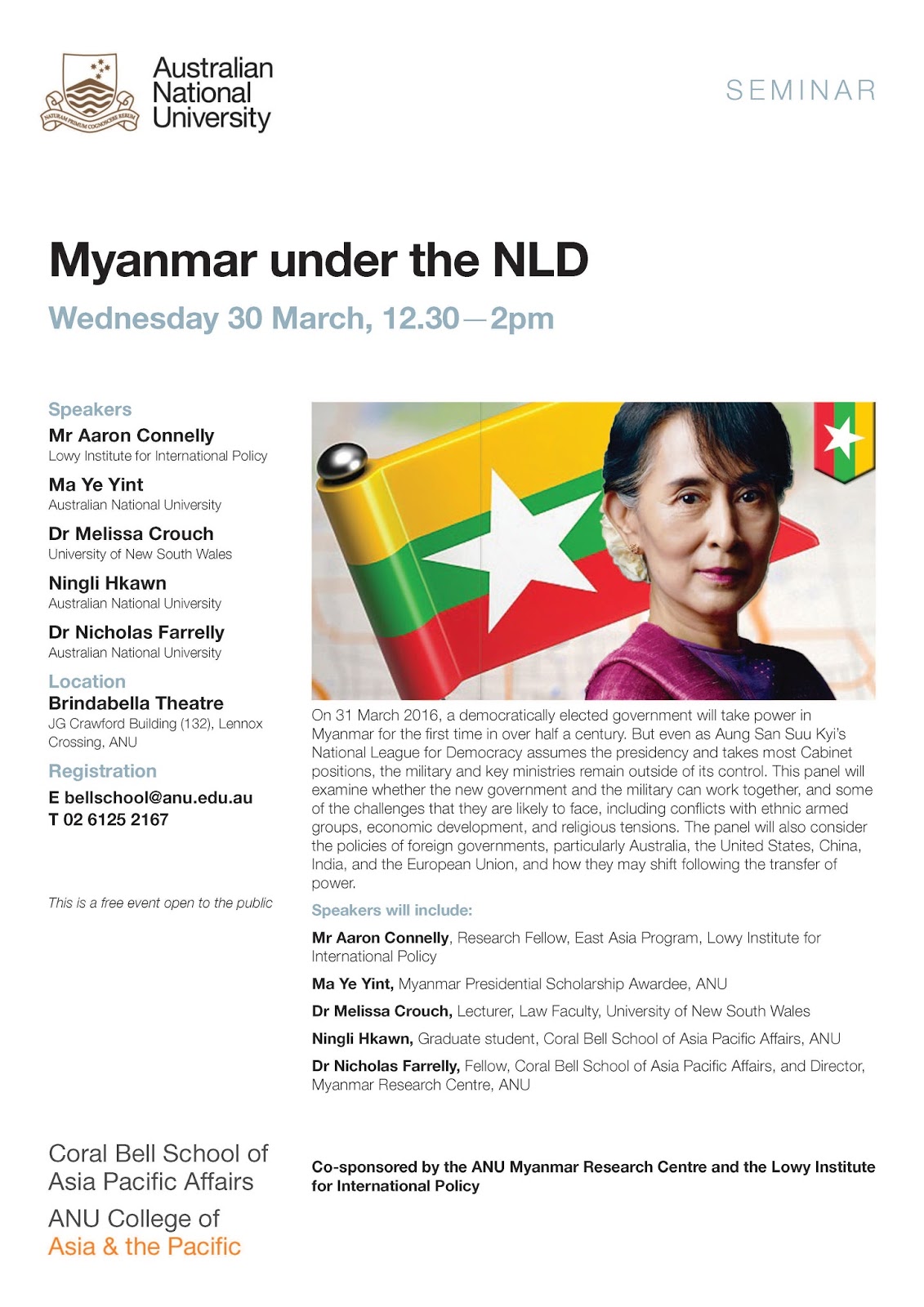
Myanmar under the NLD

Wednesday 30 March, 12.30-2pmBrindabella Theatre, JG Crawford Building (132), Lennox Crossing, ANU

Overview

On 31 March 2016, a democratically elected government will take power in Myanmar for the first time in over half a century. But even as Aung San Suu Kyi’s National League for Democracy assumes the presidency and takes most Cabinet positions, the military and key ministries remain outside of its control. This panel will examine whether the new government and the military can work together, and some of the challenges that they are likely to face, including conflicts with ethnic armed groups, economic development, and religious tensions. The panel will also consider the policies of foreign governments, particularly Australia, the United States, China, India, and the European Union, and how they may shift following the transfer of power.

Speakers will include:

Mr Aaron Connelly, Research Fellow, East Asia Program, Lowy Institute for International Policy

Ma Ye Yint, Myanmar Presidential Scholarship Awardee, ANU

Dr Melissa Crouch, Lecturer, Law Faculty, University of New South Wales

Ningli Hkawn, Graduate student, Coral Bell School of Asia Pacific Affairs, ANU

Dr Nicholas Farrelly, Fellow, Coral Bell School of Asia Pacific Affairs, and Director, Myanmar Research Centre, ANU

Co-sponsored by the ANU Myanmar Research Centre and the Lowy Institute for International Policy


EVENTBRITE: SEE HERE

The Indonesian Constitutional Court

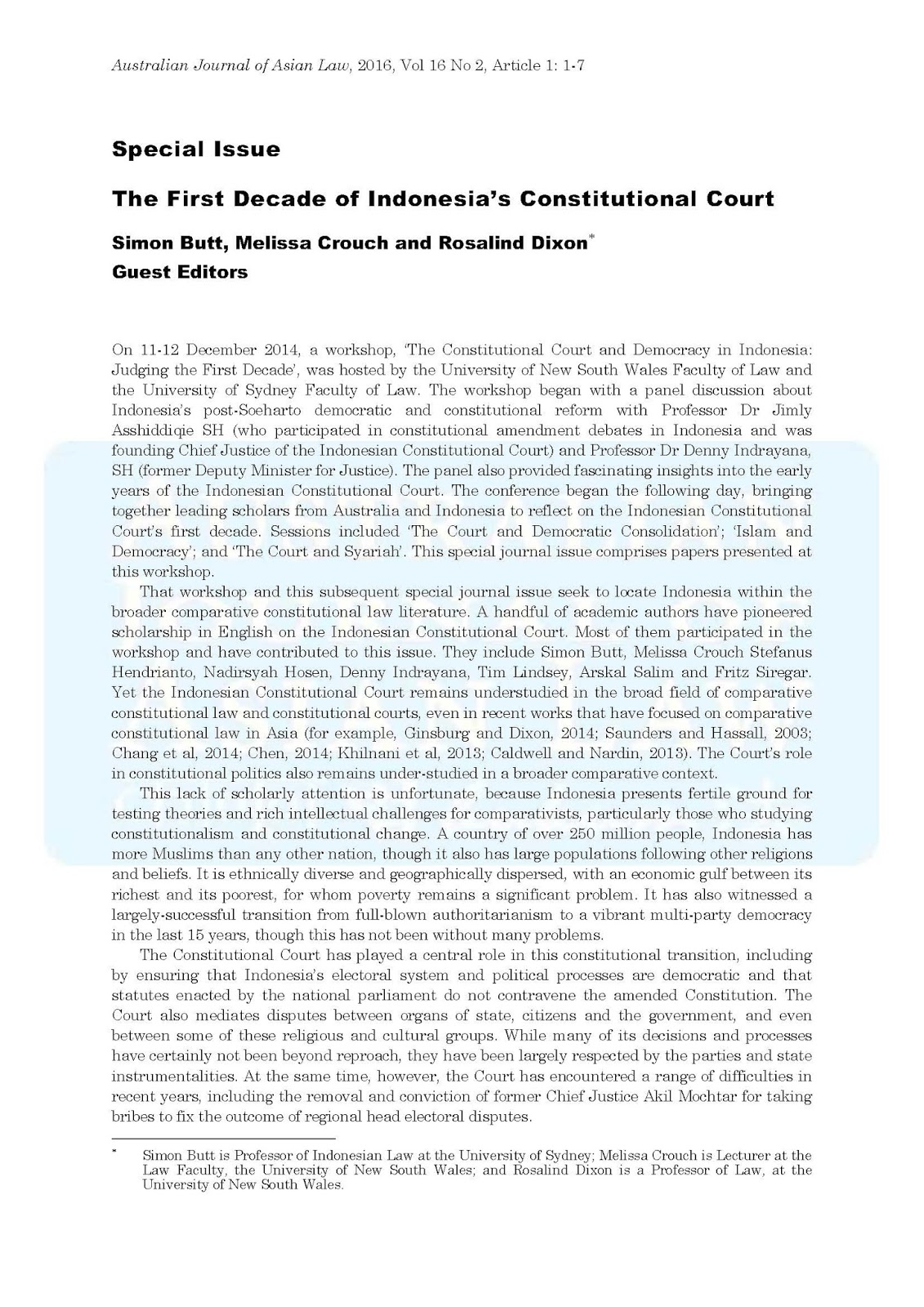
Aspecial issue on The Indonesian Constitutional Court has been published in the Australian Journal of Asian Law 2016, and is available online at SSRN.


It includes the following articles:

Rosalind Dixon, Simon Butt and Melissa Crouch, The First Decade of Indonesia’s Constitutional Court

Theunis Roux and Fritz Siregar, Trajectories ofCurial Power

Simon Butt, The Constitutional Court and Indonesian Electoral Law

Stefanous Hendrianto, Socio-Economic Rights and the Indonesian Constitutional Court

Nadirsyah Hosen, The Constitutional Court & ‘Islamic’ Judges in Indonesia

Melissa Crouch, Constitutionalism, Islam and the Practise of Religious Deference


The articles are available for free download from SSRN