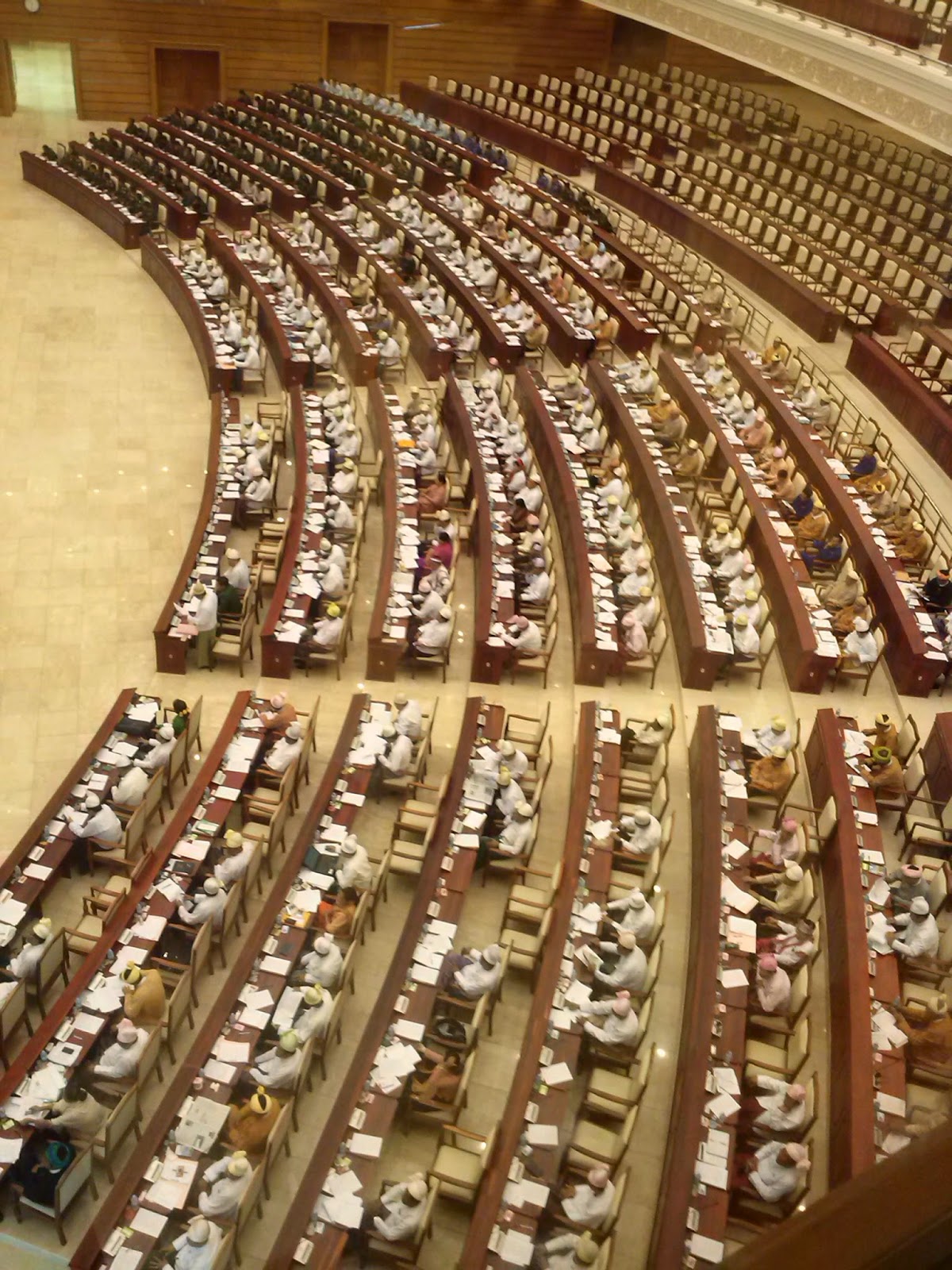
Myanmar elections lack legitimacy without constitutional change

Constitutional reform is an important part of Myanmar’s transition from military rule. Although widespread political reforms have been enacted since 2011, these have not yet been accompanied by constitutional change. The next few months will determine whether constitutional amendment will take place before the elections scheduled in November. This will affect the very legitimacy of the election itself.
In February 2015, the parliament passed a law detailing the process for holding a national referendum on constitutional amendment. This is a very important step as it indicates that the government does intend to allow for a constitutional referendum at some point in the future.


Setting out the formal process for holding a constitutional referendum is important because it demonstrates that the government wants to learn from the past. In 2008, the referendum on the constitution was held despite the devastation caused by Cyclone Nargis, which undermined the legitimacy and results of the referendum. The new law provides that a referendum can be postponed or cancelled in the event of a natural disaster.


The most pressing question now is whether any constitutional amendments will take place before the election in late 2015. The Union Parliament started its session on 11 May 2015, and discussion over what should be proposed for constitutional amendment is on the agenda. But parliament needs to allow for a diverse range of voices to be heard and considered. The debate must not be rushed. This must be balanced with the sense of urgency because this is likely to be the last parliamentary session before the elections.


While the process of constitutional amendment began in 2013, little progress has been made on the substance of any possible changes. The Constitution Review Committee did invite public submissions and this generated a flurry of constitutional campaigns across the country. The committee submitted its report to the parliament in January 2014, but failed to offer specific recommendations concerning which provisions should be amended and how. This led to widespread disillusionment on the prospects of democratic reform.
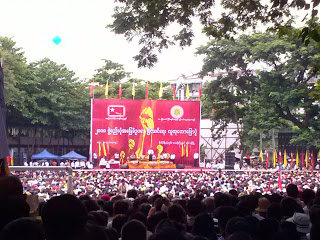
Rally to amend constitution held in 2014

The most controversial part of the committee’s report was that it recommended three key aspects of the constitution should not be amended. First, it advised that the military should retain its role in governance. Second, that the presidential requirements should be retained, which would mean that Aung San Suu Kyi of the National League for Democracy could not be nominated by the presidential electoral college after the 2015 elections. And, finally, that the provisions on the constitutional amendment process should be retained. These provisions require more than 75 per cent approval of parliament and more than 50 per cent of eligible voters at a national referendum in order to amend some provisions of the constitution. These three provisions have been central to demands for change.


In 2014, an Implementation Committee for the Amendment of the Constitution  was formed to continue the process. Around the same time, in mid-2014, the National League for Democracy held major rallies and a petition campaign across the country. Its single demand was for the amendment of Section 436, because at present this provision effectively grants the military veto power over any constitutional amendment. This would affect future efforts for reform. Yet the government has given no clear response to this demand.


By late 2014, the committee submitted its report to parliament. It suggested a large number of amendments to the constitution, but it also offered various ways in which it could be amended. Again, it did not offer clear recommendations.


Time is now running out for change before the elections. While the amendments are not necessary for the 2015 elections, some amendments would clearly enhance the legitimacy of the election itself. For example, changing the requirements for presidential candidates would send a strong signal that the military is willing to allow Aung San Suu Kyi to potentially be nominated in the presidential electoral college. This would be a significant indication of the depth of the political reforms.


Other amendments would indicate that the government is committed to furthering its agenda for democratic reform in the future. For example, greater judicial independence is critical, yet at this stage there have been no significant reforms to the courts, in contrast to the changes taking place in the executive and legislature.


Regardless of whether amendments are made in 2015, constitutional reform remains highly relevant to the long-term consolidation of the rule of law in Myanmar. The recent passage of a law on the constitutional referendum process demonstrates that the government is willing to consider constitutional amendment in the future, but this may ultimately come too late to bolster the legitimacy of the 2015 national elections.

This article first appeared as Melissa Crouch, ‘Myanmar Elections lack legitimacy without constitutional change‘ East Asia Forum, 26 May 2015.
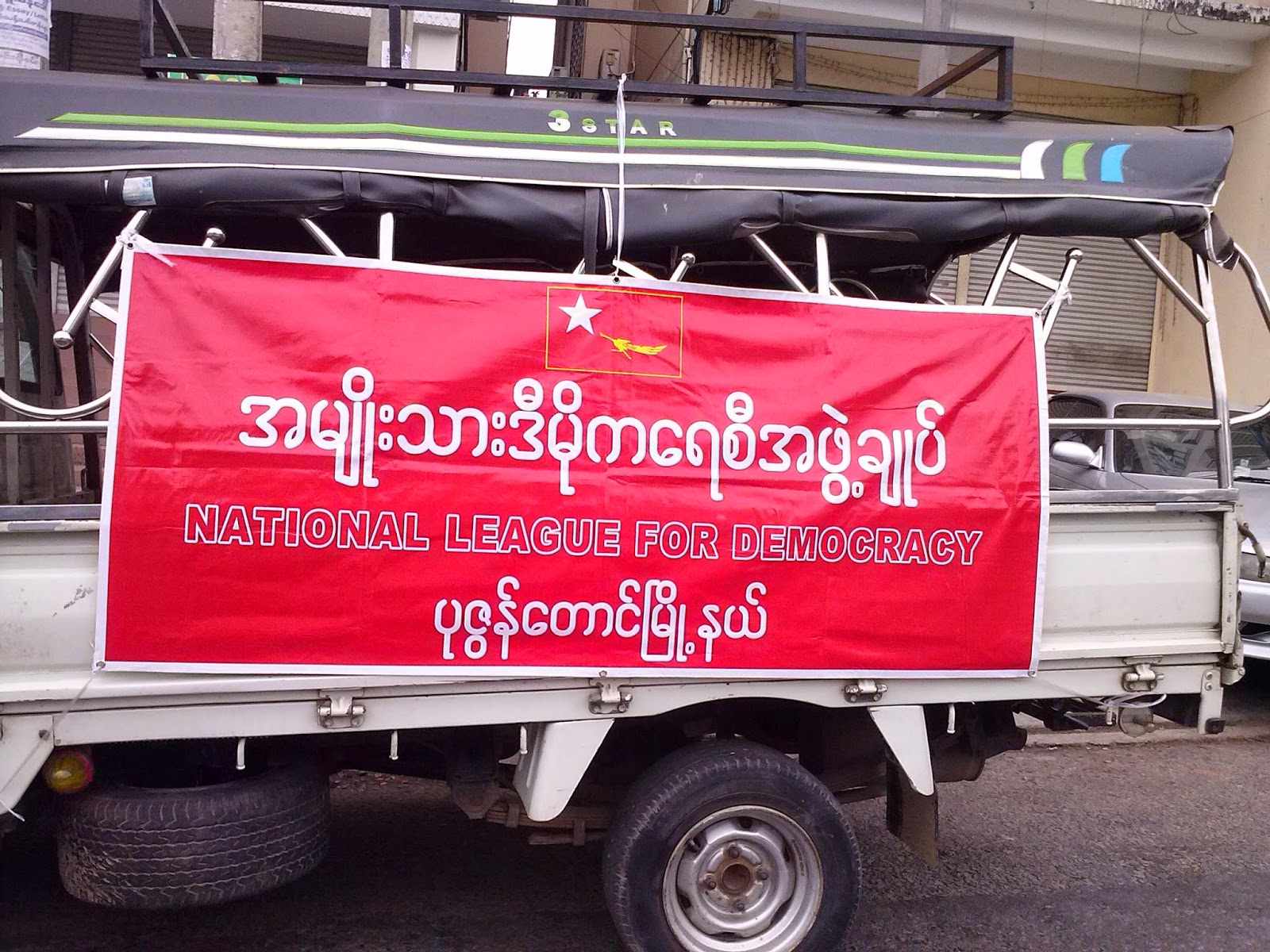
Rohingya Community Seek Citizenship And Safety

Here is the link to a radio interview I gave on the Rohingya that puts the current crisis in the context of the political transition to a quasi-civilian regime since 2011. It highlights the current atmosphere of uncertainty and insecurity, and the particular challenges Rohingya who still remain in Myanmar face in terms of whether they will be allowed to vote in the elections later this year.

2SER 107.3 interview link

Constitutional Reform in Myanmar

Constitutional amendment is an important part of any transition from military rule. In Myanmar/Burma, a transition from military rule to a quasi-civilian government was made in 2011 under the new Constitution. Yet despite calls for change, the Constitution has yet to be reformed. 
On Wed 28 May 2015, I will give a talk as part of the Scientia Scholars program at UNSW. My presentation is part of a project on constitutional reform in Myanmar and will provide an update of the current situation in Myanmar, while reflecting on its broader history and the challenges for legal systems facing political transitions.

The Scientia Scholars program is a prestigious scholarship awarded to high achieving students who study at the University of New South Wales.

Law and Investment in Myanmar

Tomorrow I will head over to the Law Faculty of the University of Sydney to give a lecture in the LLM program on ‘Law and Investment in Myanmar’. Part of the transition process since 2011 has been efforts to reform the economic and business sector. There have been many changes – such as the new Foreign Investment law, Central Bank Law and Special Economic Zone Laws – and there are many more in the works – such as the Bank and Financial Institutions Draft Law and efforts to reform the Company Act. Yet many of these reforms are based on previous policies introduced after 1988 and the dismantling of the socialist economic system. I seek to put these changes in context, and consider the challenges and opportunities that lie ahead in terms of law and investment in Myanmar.

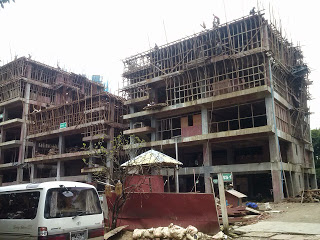
Construction site in Mingalartaung nyunt, 2014

Ethnic Rights and Constitutional Change

Ive recently put out a paper on Ethnic Rights and Constitutional Change with the UNSW Working Paper series. This paper explores the provisions of the 2008 Constitution of Myanmar that appear to give some of form of recognition to some ethnic nationalities. I am concerned with why a military regime would grant forms of special recognition to ethnic nationalities in a Constitution drafted under its control. I argue that in Myanmar, the divide between seven states and seven regions is a form of symbolic recognition for a select group of ethnic nationalities. Second, there is a system of special representation at the state and region level for Ministers of National Race Affairs to represent other major ethnic groups in the area. This allows both for fragmentation of ethnic nationality interests and for Burman representation in the ethnic-based states. Third, certain ethnic nationality areas are now recognised as Self-Administrative Zones or Divisions, which I identified as a new form of limited self-governance. The status as a zone was largely a concession to some ethnic nationalities after ceasefire deals in the late 1980s and early 1990s. The implications of all three forms of constitutional recognition, however, is that the Union government retains ultimate control. This demonstrates the way in which authoritarian regimes may include constitutional provisions for special recognition of cultural rights for some ethnic groups as part of the legitimising function of the constitution. Yet the meaning of these rights is dynamic not static, and they must continue to be assessed, over the coming years in order to gauge the impact of these provisions on the shifting nature of central-local relations more broadly. The paper is available here.

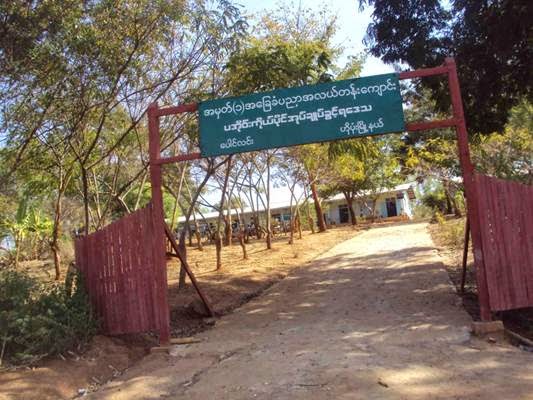
School in Pa-O Self Administered Zone, 2013

Making Sense of Conflict

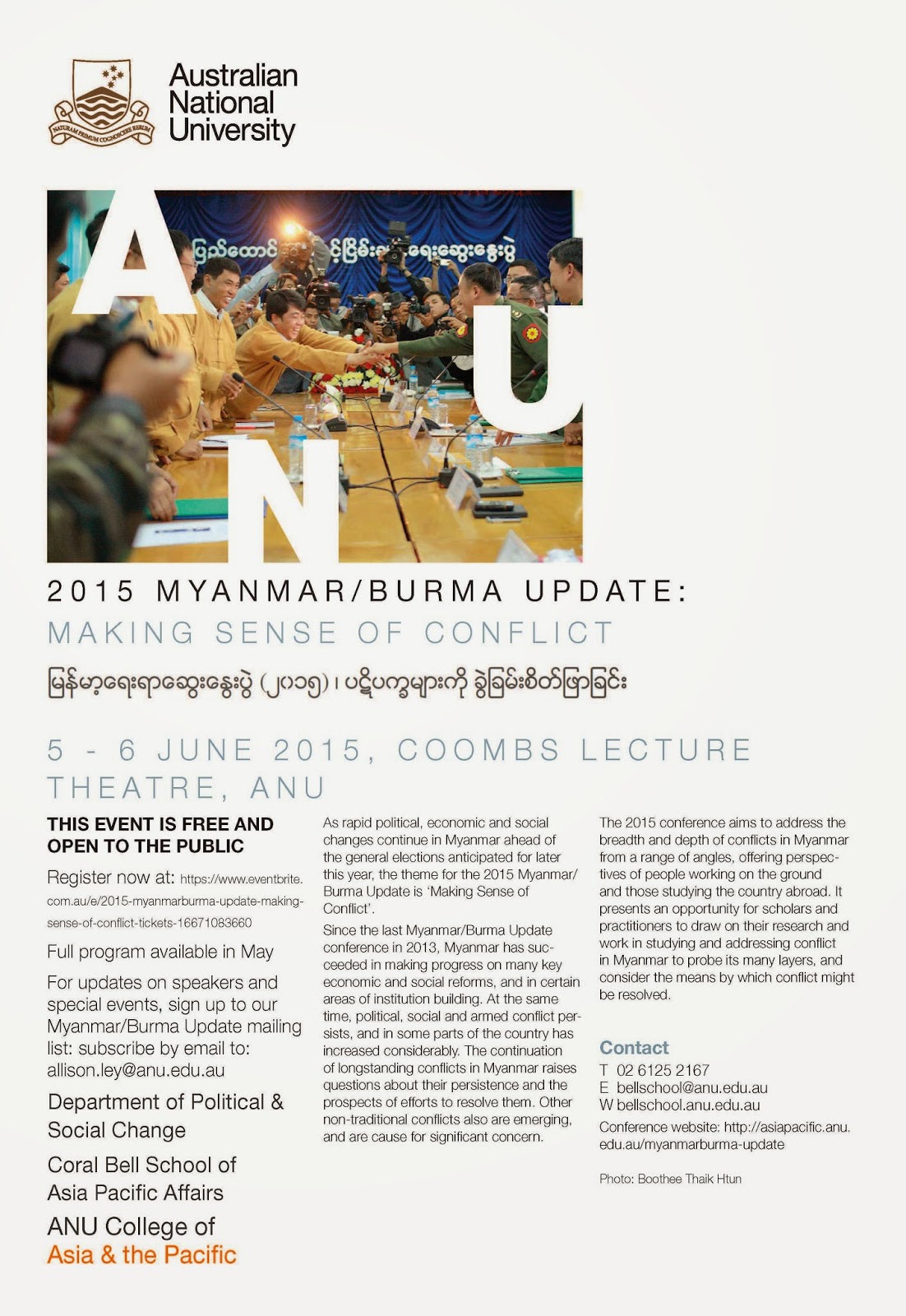
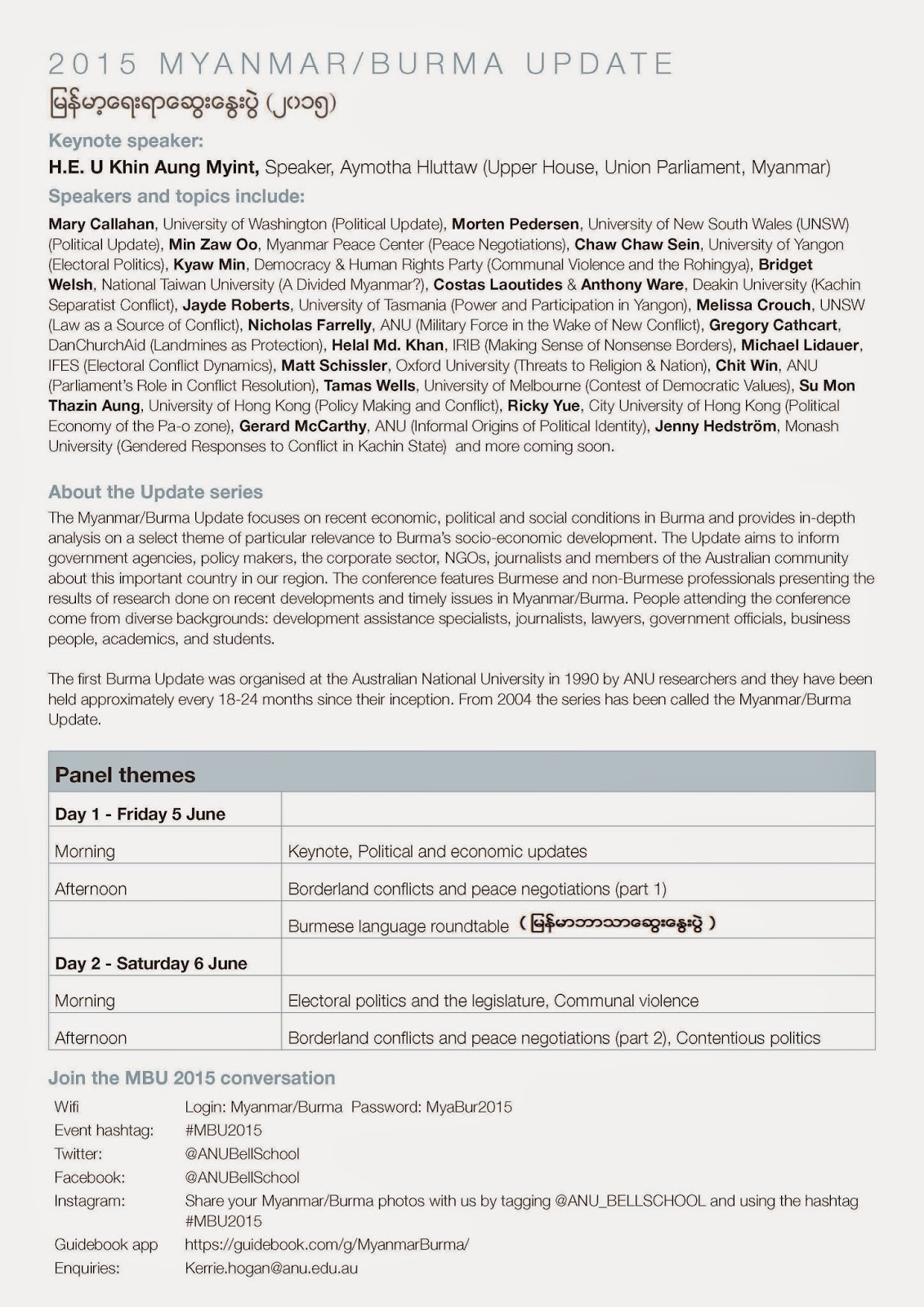
Myanmar Burma Update 2015: Making Sense of Conflict5 – 6 June 2015, Australian National University, CanberraAs rapid political, economic and social change in Myanmar continues, the next Myanmar (Burma) Update conference at the Australian National University will occur on Friday, 5 June and Saturday, 6 June 2015, ahead of the general elections anticipated for later in the year. Hosted by the Department of Political and Social Change, in the School of International, Political and Strategic Studies, ANU College of Asia and the Pacific, the conference has as its theme “Making Sense of Conflict”.Since the last conference in 2013, Myanmar has succeeded in making progress on many key economic and social reforms, and in certain areas of institution building. At the same time, political, social and armed conflict persists, and in some parts of the country has increased considerably. The continuation of long-standing conflicts in Myanmar raises questions about their persistence and the prospects of efforts to resolve them. Other non-traditional conflicts also are emerging, and are cause for significant concern.

The conference aims to address the breadth and depth of conflicts in Myanmar from a range of angles, offering perspectives of people working on the ground and those studying the country abroad. It presents an opportunity for scholars and practitioners to draw on their research and work in studying and addressing conflict in Myanmar to probe its many layers, and consider the means by which conflict might be resolved. It also enables presenters to draw upon discussions had at the 2013 Update on “Debating Democratisation”, and builds on the outcomes of an event that the ANU held in Myanmar during March 2014, on the theme of communal conflict.My own presentation will be on “Legislating Reform? Law and Conflict in Myanmar”. The abstract of the talk is as follows: Legal and constitutional change often occurs at moments of political crisis. Since the political transition in 2011, efforts of the parliament and civil society have focused on a range of legal and constitutional reforms in Myanmar. This paper will reflect on the past five years of law reform in Myanmar in the broader context of legal reforms undertake since the end of socialist rule in 1988. While many have analysed the personalities and parties in politics, little attention has been paid to the policies and laws that have been passed. First, constitutional amendment has been a critical demand over the past few years, as concerns that the military retain its role in governance rub against demands for a more democratic future. In early 2015 a law was passed regulating referendums for constitutional amendment, although this comes without clear agreement on what proposals for reform should be put to a referendum. Second, there has been an increase in legislative reforms in parliament on a diverse range of areas. I identifies three themes in law-making: functional reforms to implement the new constitutional and political system, though most added little to the text of the Constitution itself; economic and business reforms largely geared towards actual or perceived efforts at greater foreign investment, including on banking, the establishment of special economic zones, and Company Law; and social reforms that affect civil society such as on labor, the media and freedom of assembly. This paper will analyse the extent to which these legislative changes have contributed to the broader process of political reform, and to political and social conflict. It concludes that these two areas– constitutional amendment and legislative reform – demonstrate a struggle between the imagined past and future visions, and highlight the way in which law remains a source and site of conflict in Myanmar.

Muslim Minorities in East Asia

Irecently attended a conference on ‘Muslim Minorities in East Asia’, organised by Dr Yuka Kobayashi of the School of Oriental and African Studies (SOAS), Dr Jikon Lai of the University of Melbourne, and Dr Samer El-Karanshawy,  Qatar Faculty of Islamic Studies (QFIS), Qatar Foundation. The conference was hosted by the Center for the Study of Contemporary Muslim Societies, in Qatar.
A range of fascinating papers were presented, on Muslims in Japan, Thailand, South Korea, China, Philippines, among other localities in Asia.

The topic of my paper was ‘Localising Islam and the Burmese Muslim Identity’. The abstract for my paper is as follows: While many are extolling the new opportunities and reforms in Myanmar since the political opening in 2011, for many Muslim communities the past seems a more secure and safe place. This chapter begins with a reflection on a Muslim gravesite in Mandalay, which the city council has attempted to demolish on several occasions. It is sites like this that bear witness to the challenges Muslims face, and the way in which the Burmese Muslim identity, an expression of the localised nature of Islam, is reiterated and reinforced in response to such challenges. In this chapter I demonstrate that, rather than ‘Islamising’ local traditions, Islam has been ‘localised’ in Myanmar as a way of reaffirming Muslims’ sense of belonging to the state. In contrast to the trend of Islamisation around the world, the existence and practises of Muslims in Myanmar demonstrate a deep accommodation to local traditions. In this first part of this chapter, I canvassing the diversity within and among Muslim communities in Myanmar and the efforts Muslim communities have gone to in order to fit in. I argue that the construction of a distinct Burmese Muslim identity has served to reinforce their efforts to belong, and has been reiterated and strengthened in times when Muslims have been the targets of violence. I then identify several aspects of this trend of ‘localising Islam’ in comparison to other parts of Southeast Asia, which includes the significance of Muslim political participation; the role of Islamic education and language; and the centrality of Muslim women.

Mosque in Qatar

Podcast for Law Reform in Myanmar Beyond 2015

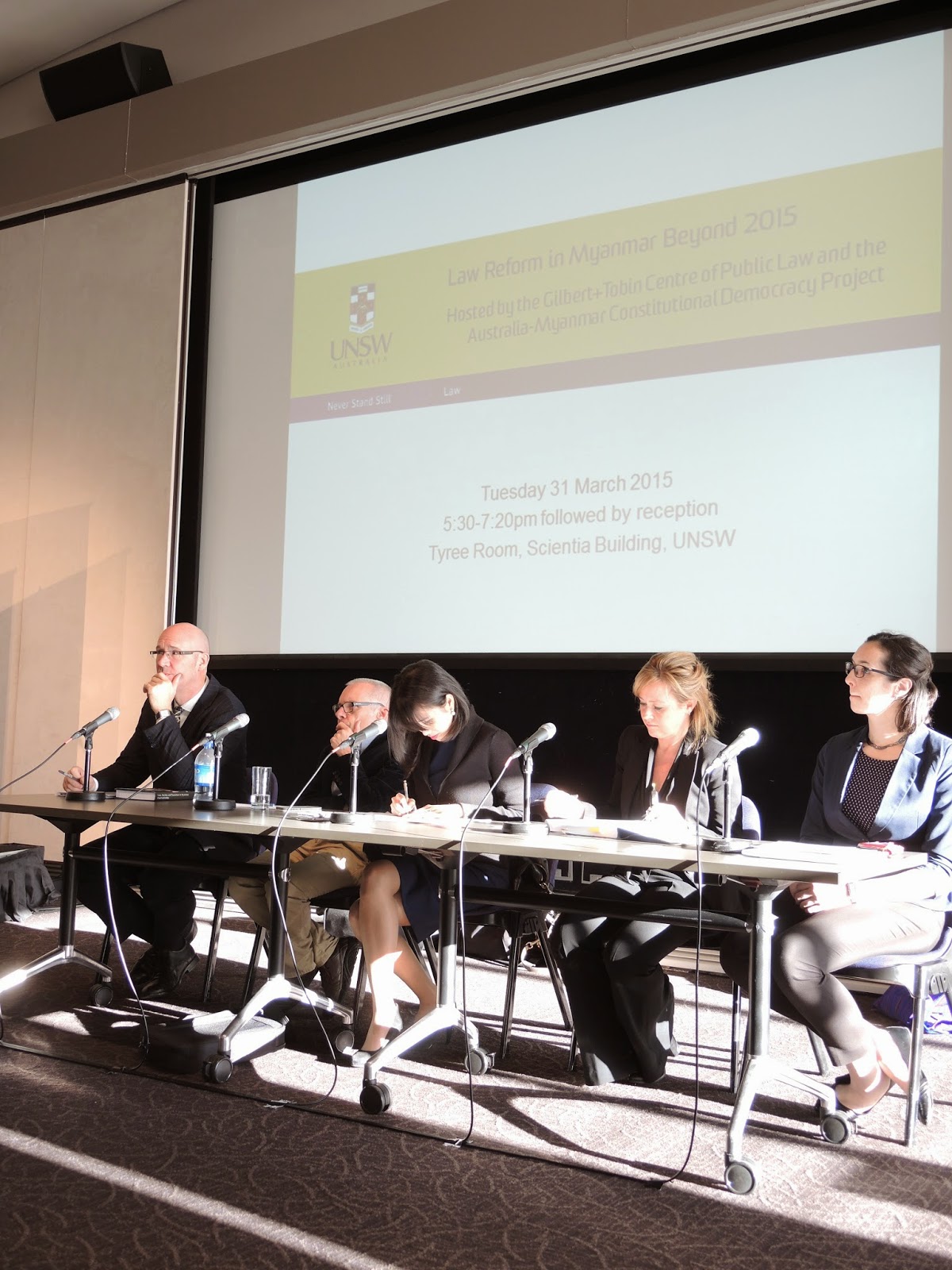
Last Tuesday evening a panel discussion on Law Reform in Myanmar Beyond 2015 was held at UNSW, Sydney. An audio recording of the panel discussion and book launch is available here 


The event was co-hosted by the Gilbert + Tobin Centre of Public Law and the Australia-Myanmar Constitutional Democracy Project. It built on legal education and constitutional law initiatives already established by several UNSW Law School faculty members who engage with Myanmar.


The speakers were all contributors to a recently published book ‘Law, Society and Transition in Myanmar’ (Hart Publishing, 2014), the first book to explore the dynamics of Myanmar’s legal reform process in their social, historical and political context. The panel was chaired by the book’s co-editor, Professor Tim Lindsey of the University of Melbourne, and  included presentations by the other co-editor, Dr Melissa Crouch of UNSW; and contributors Associate Professor Sean Turnell of the Economics Faculty at Macquarie University, Dr Catherine Renshaw of the Law Faculty at UWS, and Melinda Tun of Baker & McKenzie, Sydney. They addressed contemporary issues in constitutional reform, economic reform, corporate law reform and the prospects of transitional justice.

For more, see http://www.gtcentre.unsw.edu.au/events/law-reform-myanmar-beyond-2015

Seminar: A Stocktake on Law Reform in Myanmar

This talk is being held on Thursday 2 April 2015, from 1-2pm. Venue: Moot Court, Room 317, Building 5 (ANU College of Law) on Fellows Road


Speaker: Dr Melissa Crouch


Myanmar is the latest site for law and development and rule of law reform. In this talk I want to step back and reflect on the past five years of law reform in Myanmar (2011-2015), situate these developments in social and historical context, and identify future challenges in this area. First, there has been an increase in legislative reform, in areas as diverse as foreign investment; farmland, labour rights; media reforms; civil society organisations, and the Central Bank, while highly controversial reforms such as the national education bill or the four draft bills restricting various religious practises continue to generate debate. Several key patterns in law reform can be identified, and this points to the need for a more selective, substantive and meaningful law reform process in the future. Second, constitutional reform has been a critical demand over the past few years. While a Constitutional Tribunal has been established, it has been mired in controversy and effectively stalled any meaningful attempts at constitutional review given a lack of transparency and independence. The effort towards constitutional amendment has been an inherently uncertain process, and at this stage it is unclear whether a referendum will be held before May, and if so on what issues. Third, the pervasive and unrestricted exercise of executive power remains a dominant feature in the legal landscape, exemplified in the use of emergency powers. This is illustrated in executive decisions made under the Criminal Procedure Code in response to a range of demonstrations, protests and violence, which I characterise as legitimating a sense of the ‘everyday emergency’. Three constitutional states of emergency have been also declared by the President, and this should be a cause for concern. To conclude, any stocktake on the process of law reform in Myanmar needs come with a deep appreciation and awareness of past legal and political developments, as well as the current distorting effect of the highly politicised environment leading up to the 2015 elections.  

National parliament, 2014