Asian Law in Australian Universities: Research centres as critical institutional commitments

*this was first published at Asian Currents, April 2020  

Asian Law in Australian Universities: Research centres as critical institutional commitments


Melissa Crouch, Law School, University of New South Wales (UNSW Sydney)

In November 2019, Edward Aspinall and I convened a workshop on the state of Asian Studies in Australia. Bringing together leading academics in Asian Studies, we discussed the state of the field for the past two decades (2000-2020) across the disciplines (law, political science, international relations, anthropology, history), languages (Japanese, Korean, Indonesian, Chinese) and area studies (Mainland Southeast Asia, Indonesia, South Asia, China, Northeast Asia, and Asian diasporas).


In this post, I reflect on the field of Asian law. While law as a discipline is grouped as part of the social sciences, it became clear from our discussions that the study and research of Asian Law has a distinctive history in Australian universities.


The study of law around the world has traditionally been the study of a national legal system. At its core, legal education remains this way, despite the turn towards transnational or global law over the past two decades. In Australia, there are over 800 academics at or above the level of Senior Lecturer based in Law Schools. These academics are experts in Australian law, a legal system based on the common law, derived from a history of settler colonialism and affiliated with Western liberal democracy. Most law academics are required to teach core courses in Australian law. If legal academics do engage in comparative work, the focus is often on the West – perhaps comparing the Australian legal system to that of England, Canada, the United States or New Zealand.


Among this academic cohort, there are just 34 academics based in Australian law schools with permanent positions who primarily focus on Asian law. These academics have a sustained academic career commitment to the study of law in Asia, and most either speak an Asian language, have undertaken sustained research in Asia and/or have Asian law as their primary research focus. Out of these 34 academics, China, Indonesia and India are the three most common areas of focus, with Japan, Singapore and Malaysia following behind. However, the majority these academics are concentrated at just five out of the 44 law schools in Australia. This greatly limits the opportunity most Australian law students might have to learn about the legal traditions and systems of Asia from Asian law scholars.


What is distinctive about academics working in the field of Asian law is that many (although certainly not all) are supported by research centres that reflect a certain institutional commitment on the part of their law school. Throughout the rise and fall of Asian Studies in the past two decades, the experience of law suggests that research centres are critical for specialised fields to foster the next generation of scholars of Asia specialists and to weather the insecurities of bilateral and trade relations.


Research Institutes in the Asian Century


It is undisputed that the 21st Century is the Asian Century. This idea is a reference to the rising economic, social and political influence of diverse societies in Asia. Research centres can play a major role in promoting the study and knowledge of Asia.


Generally, university-based research centres are a tangible demonstration of academic and research leadership. Research centres are a means of offering intellectual leadership, facilitating professional networks among scholars and students, and supporting their members through a range of activities including conferences, publications and public engagement. Research centres can facilitate interdisciplinary engagement, which is certainly a hallmark of Asian studies research centres in Australia.


Research centres offer a community of intellectual support for scholars and students. A key role for research centres is to train the next generation of scholars, which is particularly important in highly specialised areas of expertise. Centres are a critical means to facilitate student involvement in academic life, as research assistants, through academic events and projects, and through mentoring and career building exercises.


This core internal role of building and fostering a support research community is similar to Robert Cribb’s idea of ‘circles of esteem’ in academic life.[1]


Centres also play a critical external facing role – promoting a concentration of research expertise and priorities to a national and global audience. Given Australia’s place in the region, it makes sense for Australian universities and law schools to make institutional commitments to the study of Asian law through research centres in order to foster such expertise.


The Rise of Asian Law Research Centres in Australia


One characteristic that marks a university’s or a faculty’s institutional commitment to Asian Studies is the establishment of a research centre. There are at least five research centres specifically dedicated to the study of Asian law in Australia universities today. These research centres are concentrated at three of Australia’s 44 law schools. I acknowledge that some other centres and programs based at Australian law schools also foster scholarship on Asian Law even if this is not been their primary focus.[2]


Asian Law Research Centres at Australian Universities

1985, Asian Law Centre (ALC), the University of Melbourne

1995, Centre for Asian and Pacific Law (CAPLUS), University of Sydney

2013, Centre for the Study of Indonesian Law, Islam and Society (CILIS), University of Melbourne

2015, China International Economic & Business Law Initiative (CIBEL), UNSW Law

2015, Southeast Asia Law & Policy Forum, UNSW Law


These centres have a diverse range of expertise (that is, across the public-private law divide) and act as a hub for fostering higher degree research students and early career scholars who are developing region-specific expertise.


The Asian Law Centre has existed for 35 years, which is a remarkable achievement for a research centre at an Australian university. Mal Smith (d. 2006), a Japanese law expert, founded the Asian Law Centre at a time when interest in Japanese law was at a height. His institution-building efforts left a profound institutional legacy for the field of Asian Law.


This was followed in 1994 by the Centre for Asian and Pacific Law (CAPLUS) established by Alison Tey at the University of Sydney.


Law schools that support Asian law offer elective subjects that are either country or region specific (with the most common being China, Japan, Indonesia, South Asia and Southeast Asia) or subject-matter specific, such as Human Rights in Asia; Rule of Law in Asia; Asian Competition Law; Drugs in Asia; Law and Investment in Asia; and, Land Law and Development in Asia. However, student enrolments in such courses are generally low, with some exceptions. This is generally because law students are required to complete the ‘Priestley 11’ (a core set of Australian-focused law courses) to qualify to practise law, and so the number of electives they can choose is often limited.


The research of Australian-based legal scholars on Asia has often been driven by themes relevant to public debate, bilateral trade relations and global commercial legal practise. This includes all aspects of commercial law; legal pluralism; criminal law, particularly terrorism; and constitutional law.


From 2000 to 2010, there was a decline in the field in terms of government funding, a contraction in institutional university support and a decline in student numbers. Since the 2010s, there has been sporadic interest, institutional support and external funding. There has also been a rise in the focus on Chinese law, with several law schools hiring Chinese law specialists.


From 2014, law schools have also enhanced the opportunities for their students to study intensively in Asia through New Colombo Plan funding. Examples include short term law programs such as ANU’s program in Japan, Monash University in Myanmar; the University of Sydney in China, Japan, Indonesia and Malaysia; and UNSW in China, India, Vietnam and the Pacific.


There are also law study programs in Asia offered by consortiums such as the innovative Indonesian Law Practicum established in 2018, run by the Australian Consortium of In-Country Indonesian Studies (ACICIS). This program includes students from across 20-30 different Australian universities each year. There are now greater opportunities and more funding than ever before for Australian-based students to undertake intensive courses on Asian law in Asia.


Further, Asian law research centres have historically prioritised efforts to open access to primary legal materials of countries in Asia that can be difficult to access. For example, the Australian Legal Information Institute (AustLII) hosted jointly by UNSW Law and UTS Law has established a free online Asian Legal Information Institute. The AsianLII database covers 28 jurisdictions in Asia, and the most recent country database launch is the Myanmar Law database. Access to such sources is critical both for students and scholars of Asian law, as well as fulfilling a broader public service in enabling access to the law.


The Future of Asian Law in Australian Universities


An institutional history of 40 years of Asian law in Australia (1980s-2020) shows that the establishment and maintenance of Asian law centres by Australian law schools has been critical for three reasons: as a tangible demonstration of university and faculty support for Asian law; as an external signal of the concentration and importance of expertise on Asian law; and as an internal means of fostering a future generation of Asian law scholars in Australia.


Just as Australia is known for its strength in Asian studies, so too is it known for its expertise in Asian law. Yet like Asian studies more broadly, the field of Asian law has experienced a rise from the 1980s to the mid 1990s, followed by a fall since the late 1990s. It is arguable that post-2012 in particular has seen both more new hires of Asian law scholars (particularly of Chinese law, but also of Indian law and Indonesian law), and the establishment of three new institutional research initiatives (as listed above).


Law stands out from other disciplines in the social sciences in terms of its sustained and dedicated discipline-based research centres, although these are concentrated at a handful of Australian universities.


The continued importance of trade relations between Australia and the region, and the potential growth in areas such as ASEAN, means that Asian law will remain an ongoing area of interest for universities, the government and the private sector.
In fact, a key reason for the success of Asian Law centres is precisely their attraction to the government and the private sector (particularly law firms) in terms of informing trade relations, foreign investment and the promotion of the rule of law in the region. At the same time, for those of us who research and teach on Asian law, the reality of the close engagement between academia, government and the private sector should be a cause for critical reflection in terms of who we partner with, the projects we prioritise, and where our funding comes from.


Notes


[1] Robert Cribb (2005) ‘Circles of esteem, standard works and euphoric cuplets’ Critical Asian Studies 37(2) 289.

[2] For example, the former ANU Law, Governance and Development Initiative, the ANU Centre for Public and International Law, and the University of Queensland Centre for Public International and Comparative Law.
The impact of Covid-19 on research

Covid-19 is currently disrupting academic publishing in a number of ways. 


There are disruptions to the global supply chain for the manufacture and distribution of printed journals. The following publishers have halted journal printing until further notice:

Cambridge University Press (from 25 March 2020)

Taylor & Francis (from 10 April)


Some journal editors or editing boards have suspended or delayed the review or publication process for academic journals.

 
On the other hand, some publishers are providing open access content for a limited period of time. See the following links from the UNSW library and the ANU library, or select publishers websites such as OUP. The University of California Press has opened free access to all its journals until the end of June 2020


Hart Publishing is currently offering free access for libraries to its online platform, Bloomsbury Collections, until the end of May. To enable access for your institution, email Hart at OnlineSalesUK@bloomsbury.com

The Australian Libraries Copyright Committee has information on the responses of libraries and archives. 

Archival access
National Archives UK open access


New grant schemes
Covid 19 research SSRC grant

If you know of other impacts covid 19 is having on publishers or academic publications ,or have suggestions on ways we should be responding to this as a faculty, please contact the me.

Trends in Asian Studies in Australia

In November 2019, Edward Aspinall and I convened a workshop on the state of Asian Studies in Australia. Bringing together leading academics in Asian Studies, we discussed the state of the field for the past two decades (2000-2020) across:

  • the disciplines (law, political science, international relations, anthropology, history)
  • languages (Japanese, Korean, Indonesian, Chinese) 
  • area studies (Mainland Southeast Asia, Indonesia, South Asia, China, Northeast Asia, and Asian diasporas)

We have launched a special blog series on the state of the field of Asian Studies on the Asian Currents blog of the Asian Studies Association of Australia. 


In the coming months, I’ll post links to the pieces as they are published.

Asian Politics in Australian Universities, Michael Barr
Evolution of Mainland Southeast Asia Studies over the last 20 years, Patrick Jory
Twenty Years of Korean Studies in Australia, Ruth Barraclough
Chinese Studies in Australian Universities, Anne McLaren
Australian International Relations and Asia, Jennifer Canfield and Mathew Davies
Anthropology of/with Asia in Australia, Tanya Jakimow

*Coming soon*

Asian Law in Australian Universities: Research Centres as Critical Institutional Commitments, Melissa Crouch

Write No Matter What

At UNSW Law next month, we have a discussion panel coming up on “Write No Matter What: Advice for Academics“. The panel will include colleagues Natalie Klein, Amy Cohen and Lyria Bennett-Moses.
This is hands-down the best book written by an academic (Joli Jensen) for academics about academic writing. It offers no-nonsense, practical advice on how to find joy in writing as an academic. It will make you laugh (and perhaps cry) as the examples of the challenges we face in writing resonate well with academic experience.
Her key advice “In order to be productive, we need frequent, low stress contact with a writing project we enjoy”… and you’ll have to read the book to find out more.

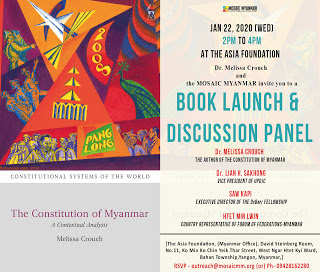
Yangon Book Launch The Constitution of Myanmar

On Wednesday 22 January, there will be a book launch and discussion panel at The Asia Foundation office in Yangon for the launch of The Constitution of Myanmar.
The panel will be chaired by Helene Maria Kyed, and feature panelists Dr Lian K SakhongSaw Kapi and Htet Min Lwin.

Copies of the book are available for sale at the Myanmar Book Centre.

စာအုပ္မိတ္ဆက္ျခင္းအစီအစဥ္ ႏွင့္ စကားဝိုင္းေဆြးေႏြးပြဲ
အခမ္းအနားဖိတ္ၾကားျခင္း။စကားဝိုင္းေဆြးေႏြးပြဲအား ေဒါက္တာ ဆလိုင္းလ်န္မွုန္း၊ ေစာကပီ၊ ဦးထက္မင္းလြင္ႏွင့္ စာအုပ္အား ေရးသားသူ Melissa Crouch တို့မွ ဦးေဆာင္ေဆြးေႏြးသြားမည္ျဖစ္၍ moderator အေနျဖင့္ Dr. Helen Maria Kyed မွ ေဆာင္ရြက္သြားမည္ ျဖစ္ပါသည္။
အခမ္းအနားတြင္ Melissa Crouch ျပဳစုေရးသားသည့္
“ျမန္မာနိုင္ငံ၏ ဖြဲ႕စည္းပုံအေျခခံဥပေဒ”
စာအုပ္အား မိတ္ဆက္ေပးသြားမည္ျဖစ္ၿပီး ဖက္ဒရယ္စနစ္၊
ဒီမိုကေရစီစနစ္ႏွင့္ ဖြဲ႕စည္းပုံအေျခခံဥပေဒ ဆိုင္ရာ
မ်ားအား ေဆြးေႏြးသြား
မည္ျဖစ္ပါသည္။ေန႔ရက္- ၂၂. ၁.၂၀၂၀
အခ်ိန္- ေန႔လည္ ၂ နာရီ မွ ၄ နာရီ ထိ
ေနရာ- The Asia Foundation (ျမန္မာ႐ုံး) ၊ ေဒးဗစ္ စတိန္းဘက္ဂ်္ အခန္း၊ အမွတ္ (၁၁) ၊ ကိုယ့္မင္းကိုယ့္ခ်င္း
ရိပ္သာလမ္း၊ အေနာက္ငါးထပ္ႀကီးရပ္ကြက္၊ဗဟန္းၿမိဳ့နယ္၊
ရန္ကုန္ၿမိဳ့။outreach@mosaicmm.org သို့မဟုတ္ 09-428162280 သို့ တတ္ေရာက္ရန္ စာရင္းေပး
သြင္းနိုင္ပါသည္။

Preserve the Asia Collection at the National Library of Australia

Statement of AMSEAS concerning the National Library of Australia Asia Collection

The Association of Mainland Southeast Asian Studies (AMSEAS) Council and its members are deeply concerned at the news that the National Library of Australia (NLA) is closing its Asian Collections Reading Room and may be considering ceasing its future acquisitions of works on mainland Southeast Asia.


AMSEAS is evidence of the fact that there is a large and growing community of around 400 hundred scholars in universities around Australia working on mainland Southeast Asia research. Since the opening up of Myanmar in 2011, there has been a boom in Burma/Myanmar Studies in Australia. The opening up of Cambodia, Laos, and Vietnam since the 1990s has led to a similar increase in teaching and research on these countries in Australia. Thailand has a longer history of openness and consequently one of the largest numbers of academics and postgraduate students working on that country. Another important growth area for mainland Southeast Asian Studies in Australia is postgraduate students from mainland Southeast Asia countries. The rapid growth in the numbers of international students in Australian universities over the last two decades includes many students from these countries.


The NLA’s Asia Collection is home to a world class collection on mainland Southeast Asian Studies and includes a BurmeseCambodiaThaiVietnamese and Lao collection. The specialist staff in the Asian collection are essential to the maintenance and expansion of the collection, and offer outstanding support to users of the collection.


AMSEAS strongly supports the maintenance of the Asian Collections, particularly the collections on mainland Southeast Asia. We would also encourage any of our members to write to the Director-General of the National Library of Australia, Dr Marie-Louise Ayres or show their support for the Asian Collections online (@nlagovau, #preserveAsianCollections).

New article: States of Legal Denial

My article on How the State in Myanmar Uses Law to Exclude the Rohingya, is now out outline with Journal of Contemporary Asia.

This comes as protests are set to occur in Myanmar on 10 December in support of Daw Suu and her position on the Rohingya. The We Stand with You campaign comes in advance of the case on 12 December brought by The Gambia at the International Court of Justice, on behalf of the Organisation of Islamic Cooperation. The We Stand with Daw Suu campaign began in 2017 when Daw Suu defended her position on the Rohingya to the United Nations General Assembly. My article examines these strategies of denial and in particular identifies how law is used to enact a state of denial.

The abstract of the article is as follows: States often use forms of denial to suppress the pain and suffering of minority groups. In 2015, the international community celebrated the electoral success of the National League for Democracy in Myanmar. Yet through legislative reform, the Rohingya were disenfranchised prior to the election. This is an example of legal denial, that is, the use of law and legal institutions to enact denial. The article traces three uses of legal denial against the Rohingya. One act of legal denial is constitutional reform through the creation of Rakhine State in 1974 and the making of the Rohingya as a minority within Rakhine State. Another act of legal denial is legislative reform through the removal of the right to vote and run for office in 2015. A further means of legal denial occurs through judicial decision-making and the use of political trials related to the conflict in Rakhine State. As the global community struggles with how to respond to the violence, displacement and humanitarian crisis, it is suggested that there is a need to understand the acts of legal denial – constitutional, legislative and judicial – that led to this crisis and how these acts of denial are employed to deny suffering and violence.

If your institution does not give you access to this journal, there are 50 free copies available at this link or please contact me.

ASAA Statement on National Library of Australia

In light of recent news that the ASAA is closing its Asia Studies reading room and is reviewing its collection strategy for the Asian collection, the ASAA issued this statement to its members:


Many of you will have heard that the National Library of Australia has initiated a review of its collecting strategy, which might lead to a severe curtailment – or even cessation altogether – of collecting from Asian countries (excepting China and Indonesia, which the library has said will be quarantined). This is potentially a significant blow to Asian Studies in Australia.

At our AGM on 22 November 2019, the Association passed the following motion:

“The ASAA notes with concern reports that the National Library of Australia will be reviewing its collecting strategy, and may significantly reduce its collecting from Asian countries, except Indonesia and China. The ASAA notes that the Asian collections of the NLA – including on Japan, Korea and mainland Southeast Asia – are among the strongest in the world, having been built up over many decades of far-sighted and significant investment. These collections make the National Library of Australia a treasure of global Asian Studies, and are a major national asset. The ASAA welcomes the opportunity for the Association and Scholars of Asia to be involved in the review of the Asia collecting strategy. We call on the National Library of Australia to maintain a comprehensive Asia collecting strategy and appeal to the Federal Government to provide adequate funding to enable the Library to maintain the breadth, depth and integrity of its Asia collection.”

The AGM also decided that over the coming year that the ASAA will participate in the consultative processes that the NLA establishes around its review, and run a public campaign to highlight the importance of the Asia collections and call for greater funding for the NLA. We will establish a working group. If you would like to participate in this group, please send a note to asaa@anu.edu.au. We will convene in the new year.

Constitutionalism after Authoritarian Rule

In volume 11 of the Hague Journal of the Rule of Law, a special issue in honour of Martin Krygier was published. This is my contribution to the volume.

The work of Martin Krygier addresses many of the central intellectual and political issues of our times – the role of the state, the tragedy of genocide, the need for democratic institutions, and the paradoxical importance and irrelevance of law and legal institutions. The rule of law and constitutionalism, and the struggle to embed these ideals in societies post-communism, has occupied much of the thinking of Martin’s work.


                 I.           From Academia to the World

The versatility of Martin’s work is evident in its reach beyond the confines of academic theory to constitutional and political practise. One example is Martin’s role and leadership in the Australia-Myanmar Constitutional Democracy Project (‘the Project’). The Project integrates research on the rule of law, constitutionalism, human rights and constitutional courts of a team of academics: Martin Krygier, Theunis Roux, Adam Czarnota, Wojciech Sadurski, Catherine Renshaw, and Melissa Crouch. Beginning in 2013, this educational program was designed for those involved in the development of constitutional democracy in Myanmar. This project was initiated at the request of Aung San Suu Kyi, of the National League for Democracy, and her concerns to enhance constitutional literary and promote legal reform in Myanmar.The Project aims to directly increase the capacity of local actors to participate positively in the process of constitutional reform in Myanmar. It does this by bringing together diverse groups within society – ethnic communities, grass-roots organisations, political leaders, members of the media, lawyers, judges and academics – and provide a forum to discuss critical issues of constitutionalism. In doing so, the Project seeks to expand the constitutional vocabulary of different groups within society through relevant comparative examples and enhance capacity to contribute to political discourse. It also provides a forum for debate and discussion between groups and actors who may not previously have had opportunities to come together to participate in constitutional conversations. Drawing on the insights of Philip Selznick into the pursuit of valued ideals (Krygier 2012), the Project extends the teaching of academics beyond the university classroom into global sites of social need. In these workshops, Martin would begin with a story drawn from his classic work, Civil Passions (Krygier 2005). Among the most relevant is his story of the door in the field – if there is a field and a door stands in the middle of it, who would bother to walk through the door? The image of the solitary door in a field emphasise the challenges of encouraging adherence to law in a context where it makes little sense to follow formal state law. His reflections lead to substantive considerations of the idea of constitutionalism and its relevance to the present.


               II.           On Constitutionalism


Martin’s teaching and advocacy is drawn from his impressive body of scholarly work. An example of his work on constitutionalism is his piece ‘Is there constitutionalism after communism?’ (Krygier 1996–1997), in which he reflects upon the nature of constitutionalism and the extent to which it is possible to have constitutionalism after authoritarian rule. While Martin’s work primarily refers to the post-communist societies of central and eastern Europe, it bears relevance to a range of other contexts that find themselves in the midst of a political transition, including Myanmar. A central question of constitutional theory is the nature of constitutionalism and the relationship between constitutionalism and democracy, and by extension critical ideas of our times such as the rule of law and human rights. The predominant view of constitutionalism is the normative liberal legal view that assumes constitutionalism is inseparable from the liberal democratic state. As Martin has put it, on this view, the liberal institutions associated with constitutionalism are primarily defined as constraints on public power. That is, features such as bills of rights and constitutional courts, and principles such as the separation of powers, function to limit public power (Krygier 2005, p. 184). This constitutes a negative view of constitutionalism, one that primarily operates as a constraint on the improper exercise of power. Another way to understand constitutionalism as limits is to also recognise the enabling function of constitutions and what is made possible when power is limited. Constitutions facilitate the role of political institutions. Constitutions offer a political road map and confer power on a range of institutions. With reference to Holmes, Martin acknowledges the idea of positive constitutionalism to capture the reality that constitutions do far more than simply constrain power, but also channel power (Krygier 2005, p. 184). On this view, the constraints imposed by positive constitutionalism are viewed as empowering. This construction of power in a constitutional democracy is understood to be for democratic and liberal ends.In more recent work, Martin defines constitutionalism in this way:
“Constitutionalism, as the name suggests, focuses on the ways the exercise of public power is constituted, made up. It is an ideal having to do with the legal architecture and frame of a polity, its institutional design, foundations, structure, as well as the character of its major institutions and their occupants, their interrelations among themselves and with the subjects of power.” (Krygier 2017, p. 38)
On this perspective, Martin combines the structural features of constitutionalism that facilitate limits on power, with its potential to determine and oversee the relations between branches of government and the very substance of these institutions. In many respects, Martin’s work on the challenges posed by constitutionalism after communism are in response to the realities of authoritarian constitutionalism and its legacies. Constitutions may be used by authoritarian regimes, including communist regimes, to construct and channel power. This leads us to the variations that are the preoccupation of scholarship today, such as authoritarian constitutionalism and illiberal constitutionalism. Martin’s work has been one of envisioning and imagining both the potential and limits of constitutionalism post-communism, while acknowledging that constitutions are used by communist regimes to entrench their power. Martin’s view of constitutionalism is a socio-legal one that emphasises the importance of context and local perspectives.


            III.           Constitutionalism after Authoritarian Rule


Considering that communism is in effect a form of authoritarian rule, Martin’s work on constitutionalism after communism also sheds light on other kinds of post-authoritarian regimes. Martin identifies two trends among scholars who consider whether it is possible to speak of constitutionalism after communism: institutional optimism and cultural pessimism (Krygier 1996–1997). Martin notes both the limitations and insights of these views. The first, institutional optimism, focuses on the promise of institutional design and foreign models, but often overlooks cultural specificity. He criticises theorists of constitutionalism whose “underlying social theory is individualist, their mode of procedure is rationalist and their ambitions are literally unbounded” (Krygier 1996–1997, p. 23). His concern lies in the fact that a sole focus on institutional design does not require one to know anything about the society that is the recipient of foreign or expert advice. He calls for cultural sensitivity, but is quick to acknowledge that this is not the same thing as cultural determinism.The second view, cultural pessimism, is premised upon scepticism of the potential of legal transplants. For Martin, constitutions need viable and functioning institutions to embody “the spirit of constitutionalism”.Often, models can be found in other contexts. He notes that institutions of the rule of law are often foreign to post-communist societies and efforts at reform must go beyond a simple universalism that remains at odds with the local context. In many ways, Martin’s work calls us to acknowledge the ways in which the past lingers in the present and influences the present. Constitutionalism after authoritarian rule is a challenge. Neither institutional optimism nor cultural pessimism alone are sufficient to generate and foster a culture of constitutionalism after authoritarian rule. Contemporary Poland attests to this.Martin calls for a constitutionalism of moderation, which is more than just the constraint of the egregious exercise of power. As he suggests:
“Many aspects of both constitutionalism and the rule of law are intended to encourage such virtues of moderation and thoughtful self-knowledge, not merely to curb wild power. They are encouraged by constitutional and rule of law practices and institutions, not contained or constrained by them.” (Krygier 2017, p. 47)
There are different kinds of power, and a flat view of constitutionalism as a limit on power fails to recognise these differences. Martin’s work calls for a view of constitutionalism as tempering power. He is under no illusion of the damage and hurt caused to people and societies by unbridled power. As he notes “Keeping evil in mind locally requires attentiveness to domestic complaints of evils done and harms inflicted, paying particular heed to the perspective of the people who have been hurt” (Krygier 2005, p. 153). But he also works and writes in the hope that constitutionalism can create the conditions necessary for democratic dialogue in society. This leads us back to the case of Myanmar and other countries that have yet to make a full transition from authoritarian rule. Building constitutionalism is hard work. It takes years if not generations to foster and renew understandings about the use of law or the legitimacy of legal institutions. Yet Martin’s work suggests that this is work that is intrinsically worthwhile and primarily an effort based on local knowledge. This is not to say there will not be setbacks, and certainly there is a sense of collective despair at the contemporary direction of both Poland and Myanmar. Yet Martin’s recent collaborative efforts in Myanmar embody his claim that the rule of law and constitutionalism cannot be left solely to lawyers. Perhaps therein lies our hopes for the future of constitutionalism after authoritarian rule.

References
Krygier M (1996–1997) Is there constitutionalism after communism? Institutional optimism, cultural pessimism and the rule of law. IJS 26(4): 17–47
Krygier M (2005) Civil passions: selected writings. Black Inc, Melbourne
Krygier M (2012) Philip Selznick: ideals in the world. Stanford University Press, Stanford
Krygier M (2017) Tempering power. In: Adams M, Meuwese A, Hirsch Ballin E (eds), Constitutionalism and the rule of law: bridging idealism and realism. Cambridge University Press, Cambridge, pp 34­–59

Illiberalism and Democratic Illusions in Myanmar: Constitutional Reform as Political Capital

*This article first appeared in New Mandala on 20 November 2019 Available also in Burmese, and in Bahasa Indonesia.


Political actors in Myanmar are in a struggle over constitutional reform, which is a form of political capital. All the key political actors want to control the prospects for constitutional reform and benefit from the political capital this opportunity offers.

Among these actors are the military, as the most powerful and unaccountable political actor. It also includes the Union Solidarity and Development Party (USDP) which is the proxy political party for the military. Ethnic political parties also play a role as a small but diverse group connected to the multiple ethnic armed organisations scattered across the country. Finally, of course, the National League for Democracy (NLD), Aung San Suu Kyi’s political party. Each of these political actors want to claim that they pushed forward constitutional reforms in the hopes it will boost their popularity ahead of the 2020 elections.


Competition over Constitutional Reform


The NLD was the first to challenge in January this year, putting forward a legislative motion to form a committee to consider constitutional amendments. This move was controversial because the NLD submitted this motion on the second anniversary of the assassination of the country’s most prominent constitutional lawyer, Ko Ni.


The military strongly opposed the NLD’s move, with  the military delegates in the legislature refusing to vote on the legislative motion to form a committee for constitutional reform. They argued it was procedurally invalid, although they clearly do not want the NLD to lead discussions over constitutional reform.


In addition to opposition in the legislature, there has been opposition on the streets. Rallies have been staged in Yangon and other parts of the country in support of the military’s position to retain the essence of the Constitution.


For example, in early February, I was in Yangon, heading downtown one Sunday afternoon when my taxi passed a group of pro-military protestors preparing for a demonstration. The protestors were given two flags. One was the national flag that is a symbol of nationalism, but also of the 2008 Constitution and the power of the constitution-makers, the military. The flag appeals to a sense of nationalist-military pride.


The second flag had a white dove on a blue background, which evokes the peace process that has been ongoing since 2012. This is an exclusive peace process for recognised ethnic armed groups. Running separate and parallel to this process are other conflicts. The violence in Rakhine State and the mass displacement of the Rohingya is said by the government and military to be an issue of terrorism, and so is addressed outside of the peace process.


The symbolic power of flags is used to support the claim that the Constitution should not be changed.


Proposals for Change: What’s New is Old


The Union Solidarity and Development Party (USDP) has used this opportunity for constitutional reform in the legislature to push its agenda. The USDP first focused on article 261, the provision of the Constitution regulating the appointment of Chief Ministers of the States and Regions. In Myanmar, there are fourteen states and regions. Yet the sub-national governments’ powers are limited and they remain closely affiliated with the Union government.


This is because the President holds the power to appoint Chief Ministers, which reduces both the real and perceived independence of State and Region governments. This power ensures appointees are closely connected to the central Union government. The USDP has proposed to amend the Constitution to allow the legislature at the State and Region level to appoint the Chief Minister. This proposal is not new but is generally understood in Myanmar as a measure towards decentralisation.


The USDP wanted its proposal to be considered as a separate bill in an attempt to gain credit for this potential constitutional reform. The USDP seeks constitutional reform as a form of political capital in the lead up to the 2020 elections. The NLD has resisted the USDP’s claims and instead included discussion of the proposal as part of the broader review undertaken by the legislative committee formed by the NLD. This dispute represents a struggle over who gets to own and claim credit for constitutional reform.


The USDP and military have put forward other key changes. Among these changes include measures at decentralisation. For example, the President has complete power to determine the number of ministries at the State/Region level. The USDP has proposed constitutional amendment so that the president must consult with the State/Region legislature on this decision (revising article 248(c)). This would be a small step towards decentralisation and may allow variations in governance among the states.


Most recently, the military has proposed that a new constitutional provision be inserted in an attempt to prevent Suu Kyi from becoming a minister in the next government. The military argues that a person who has foreign citizenship or whose immediate family has foreign citizenship should be constitutionally prohibited from becoming a Union Minister. The same provision already exists in relation to the President, which is why Suu Kyi cannot become the president.


Other minor political parties, such as the Arakan National Party (ANP) have called for amendments to ensure the legislature only contains civilian representatives. This is a blunt challenge to the military and a consequence of the escalation of the conflict between the Arakan Army and the military.


The NLD has taken a middle path, suggesting a gradual reduction in the number of military representatives in the legislature over time. There are deep divisions over whether the military should remain in the legislature, and if so for how long. On its side, the military remains committed to its privileges under the 2008 Constitution, such as its seats in parliament.


In July, the Committee for constitutional reform completed its review. Much of the debate – in process and substance – is similar to the legislative debate in 2015. While new claims for constitutional reform continue to be made, much of this is related to old debates about aspirations for civilian rule, federalism and democracy in Myanmar.


Support for Aung San Suu Kyi


The constitutional reform process has not received significant international attention because of the more pressing humanitarian crisis. The situation for the Rohingya, both for those who remain in Rakhine State and those who fled to Bangladesh, remains dire. The situation badly taints the present government, if only at the international, rather than domestic, level.


On 19 September 2017, Aung San Suu Kyi addressed the United Nations and gave her opinion as the State Counsellor of Myanmar regarding the grave conflict and displacement crisis in Rakhine State. Her speech was widely criticised by the international community for failing to acknowledge the reality and enormity of the humanitarian and displacement crisis that had been unfolding since 25 August.


Yet Suu Kyi has benefited from the Rakhine State crisis domestically. On the same day as Suu Kyi’s speech to the UN, protests were held by pro-Suu Kyi supporters across major towns in Myanmar. In addition, the diaspora organised demonstrations at sites around the world, such as at the Australian parliament house in Canberra. These demonstrations were organised under the slogan of ‘We Stand with Daw Suu’.


The message was clear: many people in Myanmar support Aung San Suu Kyi and her position of denial on the crisis in Rakhine State. This demonstrates support for an illiberal view that sanctions the exclusion of the Rohingya from the political community of Myanmar.


The international community has been confounded by the strong, united response from within Myanmar that largely denies the state of suffering of the Rohingya who are displaced both within Myanmar and across the border in Bangladesh. The National League for Democracy government and the military have at various times denied the scale, scope and legitimacy of the suffering and the urgency or necessity of taking responsibility. While the NLD is not without agency in this situation, the military still has the upper hand in the struggle for political power.


The debate over constitutional reform is often presumed to be one about minority rights. Yet the illiberal nature of the debate means that the issue of the Rohingya does not feature in the discussions. This is despite the issues of citizenship, recognition of land, culture and basic rights being at the heart of the Rohingya crisis.


Civilian v Military Power Plays: The Power to Pardon


The constitutional reform debate is an arena where civilian actors are in a struggle against military power. Another way that the struggle between civilian and military authorities is on display is the power to pardon perpetrators of the violence in Rakhine State.


Two journalists, Wa Lone and Kyaw Soe Oo, spent more than 16 months behind bars on charges of obtaining state secrets. This case related to their investigation into a massacre in one village in Rakhine State and hit global news because they were reporting for Reuters.


The journalists were sentenced to jail, much to the condemnation of the international community, but then pardoned by the president. On 7 May, the two journalists were finally released on the decision of the President.


The President has the power to pardon or to grant an amnesty based on the recommendation of the National Defence and Security Council. The Council consists of eleven members including the Commander-in-Chief, with a majority of members from the military. The president has traditionally pardoned prisoners over Myanmar’s New Year.


Yet in a turn of events, some of the perpetrators of the Inn Din massacre were also pardoned in what appears to have been a secret process oversee by the military. Several military officers responsible for the Inn Din massacre were initially sentenced to ten years jail by the Courts Martials. The Courts Martial are under the control of the Commander-in-Chief. The decision was announced in March 2018, but by November that same year the soldiers were allegedly pardoned in secret. The pardon was only publicly discovered six months later in May 2019. A civilian who was also convicted for his complicity in the murder of the ten Rohingya villagers remains in jail.


The decision to pardon the soldiers could be unconstitutional. The military claims it has the power to pardon the accused tried in the Courts Martial. Yet the Constitution does not specifically grant the Commander-in-Chief the power to pardon or grant amnesty to someone convicted by a Courts Martial. The secret pardon by the military is a display of its power and independence.


There has been international backlash against the military for its decision to release the soldiers. In July 2019, the United States imposed sanctions on the Commander in Chief. The US noted that this was in response to allegations that the Commander-in-Chief and other senior military figures were linked to extrajudicial killings of the Rohingya in Rakhine State.


Illiberal Visions of Reform


Suu Kyi and the NLD have won support domestically for their stance in Rakhine State, but at the same time have lost the support of the international community. They still face domestic opposition from pro-military groups, as evidenced by anti-constitutional change protests.


The Rakhine State crisis has been isolated from both the peace process and debates about constitutional reform.


The Constitution helps to sustain illusions about civilian power and democracy in Myanmar. The example of the power to pardon shows how the presidents’ constitutional power is undermined by the power of the military to quietly pardon soldiers convicted for horrific crimes in Rakhine State. This is one example of how the military wins in power plays against civilian authorities.


All political actors know the people want some kind of constitutional change. All want to take credit for achieving such change. As such, constitutional reform is a kind of political capital in Myanmar. Yet the struggle for political capital through constitutional reform is not between liberal and illiberal visions of democracy, but rather between varying visions of illiberal rule, as the debate on constitutional reform shows. What all sides of politics share in common is a commitment to an illiberal politics that excludes the Rohingya.