Myanmar’s press freedom mirage

Note: This article was first published on 20 November 2018 at The Interpreter here.

It has been a bad year for press freedom across Southeast Asia. Myanmar has been no exception.

Media freedom fell to new lows this month as a self-proclaimed anti-Rohingya supporter, American Rick Heizman, was welcomed with open arms in Myanmar. Heizman, a little-known musician and traveller to Myanmar, made an amateur film claiming Islam threatens to  is at risk of being overtaken by Islam. In September this year, Heizman’s video was forwarded by the Myanmar Ministry of Foreign Affairs to a range of United Nations agencies based in Myanmar.

Among his claims, Heizman argues that there should be no repatriation of the Rohingya to Rakhine State. Heizman’s rants have attracted the attention of Facebook who first deleted some posts and now has suspended his account, as has Twitter.

This month, Heizman claims he was able to travel freely in northern Rakhine State to report on sites scarred by the conflict that has displaced 700,000 Rohingya. The assumption that his reporting is accurate lacks credibility, given that the areas affected by the conflict have otherwise been out of bounds for foreigner journalists.

Heizman’s lone-wolf anti-Rohingya antics have seemingly been embraced by a range of local institutions and officials – the University of Yangon, the Ministry of Foreign Affairs, policy think-tank the Myanmar Institute of Strategic and International Studies, and the Rakhine National Races Affairs Minister in Yangon.

His rhetoric is perceived to bolster the poorly evidenced claims of radical nationalist that the Rohingya do not belong, that the problem is one of terrorism and not of humanitarian crisis, and that actions must be taken to protect Buddhists and the state against Islam more broadly.

Ministerial collaboration

The collaboration between Heizman and U Zaw Aye Maung, the Yangon Region parliament Rakhine National Races Affairs Minister, is particularly concerning. Zaw Aye Maung hosted an event for Heizman in Yangon and praised his alleged independence.

Zaw Aye Maung’s post is a sub-national level position that is designed to facilitate representation of the interests of minority ethnic groups. His role is to advocate for the interests of Rakhine people in the Yangon Region, far from northern Rakhine State.

Instead, he is using his position as a platform to argue that the interests of Buddhist Rakhine people and official national races more broadly need to be protected from the Rohingya and Islam.

Rather than his ministerial position potentially promoting federalism and democracy through the representation of minority interests, this incident is yet another example of how toxic the politics of national race in Myanmar has become. The Rohingya fall outside this list of official national races, and any attempt to claim such status is perceived to diminish the rights of officially recognized national races.

The challenges journalists face

Enter journalists, or at least the brave few who are attempting to confront the skewed narrative propagated by foreigners such as Heizman and local officials such as Zaw Aye Maung. Journalists face major challenges in their efforts to uncover uncomfortable truths about what has occurred in Rakhine State.

Despite media reforms in 2012, genuine investigative reporting on conflict in ethnic armed areas has remained exceedingly difficult and risky. The attacks since 25 August 2017 by the armed Rohingya group known as “ARSA”, and the subsequent major military offensive in Rakhine State, have proven particularly precarious for journalists to cover.

The most infamous contemporary case of restrictions and punitive measures against journalists in Myanmar is the case of two local Reuters journalists, Wa Lone and Kyaw Soe Oo. This case has garnered global attention because of their connection to Reuters as an international news outlet and because the journalists were covering what the UN Fact Finding Mission has identified credible markers of genocide.

The facts of the Reuters journalist case are now well-known. While meeting with the police in late 2017, they were arrested for allegedly possessing documents that contained state secrets. In fact, they were set up by the police who were aware that they were investigating a massacre that took place in Rakhine State. It is worth noting that the police fall under the Ministry of Home Affairs, which is headed by a minister selected by the Commander in Chief of the military.

On 8 February, Reuters proceeded to publish the findings of its devastating investigation into the killing of ten Rohingya men. Wa Lone and Kyaw Soe Oo were two among four of the attributed authors.

In September this year, the court trial of Wa Lone and Kyaw Soe Oo culminated in a guilty verdict and a sentence of seven years jail for their alleged crime. They have since appealed and the appeal remains ongoing.

In a further twist, the military admitted that its soldiers were responsible for the massacre that the two journalists had been investigating. A courts martial was established, although the entire proceedings are under the control of the military. Seven military officers were convicted for their role in killing eight Rohingya men and two boys. A courts martial hearing is an indication that the military wanted to deal with this case quickly and on its own terms.

Ongoing controls

The case of the two local Reuters journalists is an example of how the military and the administration works to control the narrative about what has occurred in Rakhine State. Despite a transition from direct military rule since 2011, authorities continue to assert the right to determine the news people consume in Myanmar.

Ongoing attempts by officials to control the news of atrocities in Rakhine State over the past year further discredits the claims of anti-Rohingya sympathisers. The Rakhine Minister is doing no favours to Rakhine people by collaborating with Heizman.

Neither is Heizman’s trumped up visit to Rakhine State an indication of a free press. Rather, the entire affairs points to the thin and fading mirage of media freedom in Myanmar.
Elections a sham in Rakhine State

Note: This article was first published here at The Interpreter (Lowy Institute) on 1 November 2018

People go to the polls on Saturday in Myanmar, or at least some of them do.

On 3 November 2018, the Union Election Commission will coordinate by-elections across 13 electorates. Most are to fill seats from vacancies due to deaths of senior members of parliament.

There are two reasons these elections should be on the agenda of human rights advocates.

No vote for the Rohingya

The first reason is that, like the historic 2015 elections, the Rohingya will not be permitted to vote. This is a break with past political practise. How did this occur?

There are some countries where the right to vote is permitted for non-citizen residents, allowing them voice in the political community. Myanmar was once one of them.

From 2010 to 2015, the law in Myanmar permitted citizens, associate citizens, naturalized citizens and ‘other persons’ eligible according to the law to vote and run for public office.

In fact, if we go back to the 1990 elections it appears that at least some Rohingya were able to run for public office. Of course, the military never honoured the results of this election, which were formally annulled 20 years later.

Likewise in 2010 and 2012, temporary identity card holders were permitted to vote and to run in the elections. In 2010, there were reports that some Rohingya were specifically given cards to ensure that they could vote.

The actual possibilities of the Rohingya participating in these elections appear to have varied depending on their location. Some who had run in the 1990 election found they were barred from contesting the 2010 elections.

But others were clearly able to participate and three Rohingya members were elected to the Union Parliament as members of the USDP to represent constituencies in northern Rakhine State.

Yet by 2013, members from the (Buddhist) Rakhine National Development Party proposed legislative amendments that were intended to deny the Rohingya the right to vote and run for office. In 2014, the question of who could vote in a constitutional referendum was also hotly debated.

As a result of communications between the parliament and the Constitutional Tribunal, and then a formal case heard by the Constitutional Tribunal, it was held that the law was inconsistent with the Constitution. In effect, the Tribunal narrowed the meaning of who could vote or run for office in Myanmar.

Primacy was given to the idea of ‘loyalty’ to the state, and only those who have citizenship were considered to be loyal to the state.

In addition, the identity cards that most Rohingya hold – then known as white cards – were revoked.

The actions of parliament, the Constitutional Tribunal and the Union Election Commission resulted in the disenfranchisement of the Rohingya.

This was the final stage in the formal legal exclusion of the Rohingya from the political community of Myanmar.

Elections should be postponed in northern Rakhine State

The second reason the election is a sham is that one of the seats, Rathedaung, is in northern Rakhine State. The communities in this area have been directly affected by military attacks since August 2017.

Few Rohingya are left behind in Rathedaung and so, even if they could vote, their vote would no longer be a significant percentage of the voting population.

In fact, the military backed political party, the United Solidarity Development Party (USDP), is not contesting this seat, although two Arakan (Buddhist) political parties are. They are unlikely to be sympathetic to the needs of their Rohingya constituents.

Towards the 2020 elections

The by-election is small game. Political parties in Myanmar already have their eye on the 2020 elections. The NLD government has the option to reverse the disenfranchisement of the Rohingya. The NLD could choose to amend the law – it has the power and the numbers – to ensure that the Rohingya can vote.

This would be a small step towards bringing the Rohingya back into the political community of Myanmar.

This reform should not be seen as impossible. After all, it was not so long ago in 2010 that the USDP in fact courted the Rohingya community in Rakhine State. They knew that the USDP needed Rohingya leaders to represent constituencies in northern Rakhine State.

Of course, realists will say there is no political will among the NLD or the USDP to include the Rohingya in the next elections, and sadly they are right.

So it is up to human rights advocates to insist that the Rohingya should be included in the political future of this country. Since such advocates are few and far between, and have little public space to express their views, it may be left up to the international community.

While humanitarian concerns for the Rohingya remain paramount, we must not be oblivious to the ways that the electoral process in Myanmar now reinforces their political exclusion. This should cause international organisations to think twice before offering electoral assistance in Myanmar.

Political Parties and State Transformation in Myanmar

From 10-11th November, a conference will be held in Yangon on “Shaping Past, Present and Future: Political Parties and State Transformation in Myanmar”The conference is jointly organised by Initiative Austausch e.V., the Friedrich-Ebert Foundation and the German Institute of Global and Area Studies.

I will be giving a talk on: “The Union Parliament, Political Parties and the Constitution: Why Myanmar’s Union Parliament is the Central Forum for Constitutional Debate and How this Conditions the Future Possibilities for Reform“. Political parties are now a vital part of the constitutional landscape in Myanmar. The Pyidaungsu Hluttaw has been a central forum for constitutional debate, culminating in the 2015 proposals for reform. To understand the importance of the Pyidaungsu Hluttaw and how it conditions the future possibilities for constitutional reform, it is necessary to first appreciate how the structure of parliament affects the role and function of political parties. In this presentation I will begin by setting out my novel argument that the Pyidaungsu Hluttaw is in fact a tricameral parliament. There are four elements that set apart Myanmar’s parliamentary system from other bicameral systems that also have joint sittings. In most bicameral systems, joint sittings are held rarely, joint sittings are reserved for extraordinary issues; in federal systems, the two houses often serve asymmetrical terms; and the two houses maintain strong and distinct identities. In contrast, in Myanmar, joint sittings of the Pyidaungsu Hluttaw are common and are held on a wide range of issues. Myanmar’s two houses serve symmetrical terms, and the Pyidaungsu Hluttaw has a corporate personality and represents the collective interests of the legislature against the executive. After establishing its tricameral nature, my presentation will focus on the importance of the Pyidaungsu Hluttaw as the forum for debates on constitutional reform. Based on an extensive empirical review of parliamentary records from 2011-2015, and particularly the debates in 2014, I will consider who got to speak and what the key issues for debate focused on. I will identify which political parties dominated the debate, the extent to which gender played a role, and the disciplined and hierarchical nature of contributions from military representatives. I show how debate primarily focused on the following core provisions of the Constitution: the amendment clause (s436); the presidential requirement clause (s59f); the appointment of Union Ministers (s232) and Chief Ministers (261); and the three national causes, and the role of Tatmadaw in national politics (s6). Despite overwhelming sentiment from most political parties in favour of amending all of these provisions, data from parliamentary records clearly show that the military representatives had a disproportionate influence on the debate. In this regard, we should understand the military in parliament as a powerful and de facto political party, complicating an easy reading of the role of political parties in Myanmar. This talk is based on my book, The Constitution of Myanmar (Hart Publishing 2019) and on an ongoing project on The Dark Side of Constitutional Endurance.

Ethno-Religious Nationalism and Authoritarianism in Southeast Asia

On 25 October 2018, The Centre for Asia-Pacific Initiatives at the University of Victoria is hosting a panel on Ethno-Religious Nationalism and Authoritarianism in Southeast Asia.

The panel considers major flashpoints and key indicators for authoritarianism in Southeast Asia and the underlying societal conditions that have given rise to the political shifts we are witnessing in the region. This is part of their “Southeast Asia in Global Context” roundtable series. A distinguished panel of international experts will consider questions about trends in human rights, democracy, and enthno-religious nationalism in Southeast Asia.

Discussants

  • Vitit Muntarbhorn Faculty of Law, Chulalongkorn University, Thailand, and UN Independent Expert on violence and discrimination based on sexual orientation and gender identity
  • Phil Robertson Deputy Director, Asia Division, Human Rights Watch
  • Shane Barter Director of the Pacific Basin Research Center, Soka University of America
  • Kai Ostwald Director, Centre for Southeast Asia Research, UBC
  • Helen Lansdowne Associate Director, CAPI
  • Melissa Crouch Faculty of Law, University of Sydney [by videolink]

Chairs

  • Phil Calvert Senior Research Fellow, CAPI, UVic and former Canadian Ambassador to Thailand, Cambodia, and Laos
  • Victor V. Ramraj Director, CAPI, UVic

States of Denial: How the Rohingya Lost the Right to Vote

This coming Friday I will speak at Northwestern’s Buffet Institute for Global Studies in Evanston on ‘States of Interpretive Denial in Myanmar’.

Abstract of the talk: 

The international community celebrated the 2015 Myanmar elections and the success of the National League for Democracy and Aung San Suu Kyi. It was even more remarkable that the NLD was then allowed to take power, given the history of the NLD being denied the right to form a government after the 1990 elections. Yet this was only part of the story. The global community by and large missed the legal act of excluding the Rohingya from the political community through disenfranchisement. This act of interpretive denial was executed by parliament, the courts and the administration through the deliberate denial of the right to vote or run for political office for those who held temporary identity cards. Building on Cohen’s theory of States of Denial, I examine ways in which law is a key tool in the process of interpretive denial. I trace two movements throughout Myanmar’s political history. The first was a territorial move, the constitutional creation of Rakhine State in 1974 and the making of the Rohingya as an invisible minority at the sub-national level. The second is a political move, the removal of the right to vote and run for office in 2015. As the global community struggles with how to respond to the crisis of genocide, I suggest that there is a need to understand the acts of interpretive denial that led to this crisis, beyond the issue of citizenship.

ABF Talk: Constitutional Legacies in Authoritarian Regimes

On Wednesday 10 October, I will present as part of the American Bar Foundation speaker series in Chicago on “Constitutional Legacies in Authoritarian Regimes: How the Military Uses the Constitution to Rule Myanmar”.

Abstract: How and why do authoritarian regimes draft constitutions to perpetuate their legacy? The field of comparative constitutional law and politics has sought to understand the role and function of constitutions in authoritarian regimes. My presentation will consider how the military uses the Constitution to rule Myanmar today. Using qualitative methods, I question why and how the Constitution is crucial to maintain the ‘military-state’ in Myanmar. The military spent two decades crafting this Constitution, and insisted on going ahead with the referendum in 2008 despites the devastation of Cyclone Nargis in that year. I suggest that the Constitution is central to the construction and maintenance of the ‘military-state’. This military-state has three components: first, the leading role of the military in national politics; second, the three ideology meta-principles of the military-state; and third, the concept of cooperative centralism as a way to describe the distribution of power and relationship between the branches of government. This presentation is based on my forthcoming book, The Constitution of Myanmar (Hart, 2019). Part of the importance of this project and future research lies in the new lines of inquiry that Myanmar can open in the field of comparative constitutional law and the way that this case calls us to pay greater attention to constitutional legacies, forms of authoritarian legality and the dark side of constitutional endurance.

The Law & Politics of Elections in Indonesia: Possibilities, Prospects, Challenges

Workshop on the Law and Politics of Elections in Indonesia
The world’s third largest democracy, Indonesia, is preparing to go to the polls once again. On 17 April 2019, Indonesian’s will vote in the next national legislative and presidential elections. This is the first time that parliamentary and presidential elections will be held on the same day. There are two candidates for president. The current President Joko Widodo (‘Jokowi’) is running with KH Ma’ruf Amin, the chairperson of the Indonesian Ulama Council and of the world’s largest Islamic organization, Nahdlatul Ulama (NU). Against them are Prabowo Subianto, a former general of the Indonesian armed forces, and Sandiaga Uno. Prabowo previously contested the 2014 presidential elections and lost to Jokowi, a result he disputed in court.

There are competing factors at play in the upcoming 2019 elections. There have been changes to Indonesia’s electoral laws, as has been the case prior to every national election since 1999. This time, 15 parties have been approved to run in the national elections. In 2017, there were also simultaneous local elections (known as pilkada) held across a large number of regions. The former mayor of Jakarta and Jokowi’s former running mate for mayor, Basuki Tjahaja Purnama (known as ‘Ahok’), lost the Jakarta gubernatorial elections after his popularity was affected due to mass mobilization on accusations of blasphemy. Ahok is a Chinese and a Christian, considered to be a double-minority in Indonesia. He was later found by a court to be guilty of blaspheming Islam and remains in jail.

The upcoming elections have therefore raised important questions not only about electoral laws, but also about religion, race and money politics in Indonesia. This conference will bring together a distinguished group of academics to discuss the law and politics of elections in Indonesia.This event is hosted at the University of New South Wales Law School by Dr Melissa Crouch and is organized in partnership with the International Institute for Democracy and Electoral Assistance (IDEA), the Indonesian Election Commission (Komisi Pemilihan Umum, KPU) and the Indonesian Elections Supervisory Agency (Bawaslu).

List of Speakers

  • Dr Hasyim Asyari, Indonesian General Elections Commission (KPU) Commissioner
  • Dr Fritz Siregar, Indonesian Electoral Supervision Body (Bawaslu)
  • Professor Simon Butt, University of Sydney
  • Adhy Aman, Senior Programme Manager, International IDEA
  • Dr Melissa Crouch, UNSW Law

Location: UNSW Law Faculty

Date: Monday 10 December 2018

Time: 9:15-4:30pm

Registration: eventbrite

Women in Asia Conference 2019

The 2019 Women in Asia Conference will be held at the University of New South Wales (UNSW) Sydney on 21 to 23 June 2019.

The Women in Asia Forum is affiliated with the Asian Studies Association of Australia and hosts a biannual interdisciplinary conference.

The theme of the 2019 conference is “Women in an Era of Anti-Elitism: Responding to the Challenge of Rising Populism and its Threat to Gender Inclusivity”.

There are four subthemes to the conference

·       Gendered processes of generation, accumulation and appropriation of political power

·       Women in Law in Asia: Navigating the Legal Profession and the Judiciary in an Era of Anti-Elitism,

·       The Role of Technology in Populism and Gender Inclusion

·       Gendering populism in Asia

Submissions are strongly encouraged to consider papers that may fit within one of these themes, or to organize a full panel on any topic related to the broader conference theme of Women in an era of Anti-Elitism in Asia.

Abstracts for papers or full panel proposals are due by 15 November 2018. The registration form is now open at the online address above. All information on the Conference is available here: http://www.international.unsw.edu.au/women-in-asia-conference-2019

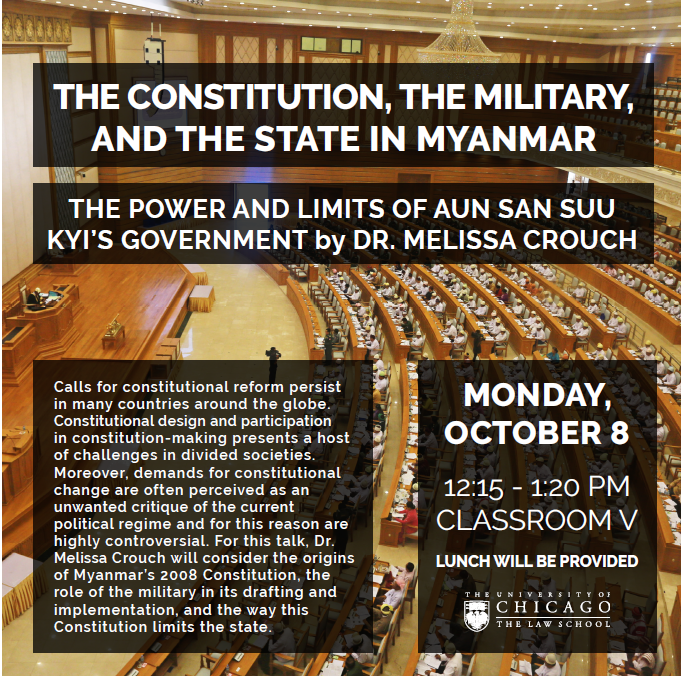
The Constitution, the Military and the State in Myanmar

On 8 October I will give a talk at the University of Chicago on “The Constitution, the Military and the State in Myanmar: The Power and Limits of Aung San Suu Kyi’s Government

Calls for constitutional reform persist in many countries around the global. Constitutional design and participation in constitution-making presents a host of challenges in divided societies. Demands for constitutional change are often perceived as an unwanted critique of the current political regime and for this reason are highly controversial. My presentation will consider the origins of Myanmar’s 2008 Constitution, the role of the military in its drafting and implementation, and the way this Constitution limits the state. In doing so, I will examine the principles and ideas that animate the Constitution and affect what Aung San Suu Kyi’s government can do. This is critically important given the ongoing crisis in northern Rakhine State. Contrary to analysis that priorities personalities and power plays, I suggest that Myanmar also needs to be understood through the lens of the Constitution and the structures and rules it embodies. I argue that the 2008 Constitution is an important part of the ‘military-state’ in Myanmar. This military-state has three components as evident from the text and from constitutional practice: the leading role of the military in national politics; the ideology of the three meta principles of military constitutional governance; and the concept of cooperative centralism that uses ‘disciplined’ democracy to control and contain the Union. This presentation is based on my forthcoming book, The Constitution of Myanmar (Hart, 2019). I demonstrate the new lines of inquiry that Myanmar can open up in the field of comparative constitutional law and politics, and the way that constitutional law in Myanmar calls us to pay greater attention to constitutional legacies

Time: 12:15-1:30pm

Venue: University of Chicago Law School, Room V, 1111 East 60th Street, Chicago, Illinois 60637

Seminar at Buffett Institute’s Global Politics and Religion Faculty Research Group

On 5 October 2018, I will give a talk at Northwestern’s Buffet Institute Global Politics and Religion Faculty Research Group, at the Evanston campus, US. 

The topic of my talk is “States of Interpretive Denial in Myanmar: How the Rohingya Lost the Right to Vote and Why it Matters

Abstract of the talk: The international community celebrated the 2015 Myanmar elections and the success of the National League for Democracy and Aung San Suu Kyi. It was even more remarkable that the NLD was then allowed to take power, given the history of the NLD being denied the right to form a government after the 1990 elections. Yet this was only part of the story. The global community by and large missed the legal act of excluding the Rohingya from the political community through disenfranchisement. This act of interpretive denial was executed by parliament, the courts and the administration through the deliberate denial of the right to vote or run for political office for those who held temporary identity cards. Building on Cohen’s theory of States of Denial, I examine ways in which law is a key tool in the process of interpretive denial. I trace two movements throughout Myanmar’s political history. The first was a territorial move, the constitutional creation of Rakhine State in 1974 and the making of the Rohingya as an invisible minority at the sub-national level. The second is a political move, the removal of the right to vote and run for office in 2015. As the global community struggles with how to respond to the crisis of genocide, I suggest that there is a need to understand the acts of interpretive denial that led to this crisis, beyond the issue of citizenship. 
Time: 12-1:30pm
Venue: Scott Hall, 212, 601 University Place, Evanston, IL 60208