Talk: Constitutional Reform in Authoritarian Regimes

Next week I will be speaking at the Law Faculty, University of Otago, New Zealand, on ‘Constitutional Reform in Authoritarian Regimes: Writs as Weapons in Myanmar?’

The role and function of constitutions in authoritarian regimes has always been something of an anomaly for scholars. Yet a new body of scholarship has emerged in an effort to explore and explain the role that constitutions can and do play in authoritarian regimes. In Myanmar, the transition from complete military rule to a quasi-civilian government has taken place within the framework of the Constitution of 2008. The case of Myanmar therefore provides a relevant site from which to explore questions about the significance of constitutional change in authoritarian regimes. In this presentation I will focus on one particular aspect of the Myanmar Constitution 2008: the reintroduction of the right of individuals to bring applications for constitutional writs to the Union Supreme Court. I explore the meaning of the Constitution 2008 for ordinary citizens. That is, can a document drafted over 20 years in a process controlled and directed by the military regime take on new meanings for its citizens? To address these questions, I examine the development and foundation of constitutional writs in Myanmar during the period of parliamentary democracy (1948-1962), identify its common law foundations and the emphasis on the protection of individual rights. I then turn to the implications of the reintroduction in 2011 of the constitutional writs, after decades of socialist and then military rule. Several hundred writ applications have been lodged in the past five years, yet few cases have actually been decided on issues of rights protected in the Constitution, and only a handful of cases have been reported. Through this presentation, I suggest that administrative law is one test of the nature of constitutionalism in authoritarian regimes, and forms a key part of the process of building constitutionalism in the future.

Constitutional Writs and Human Rights Workshop

On 8-9 August 2015, I participated in a workshop on the ‘Constitutional Writs and Human Rights’ in Yangon, Myanmar. The workshop was organised by the United Nations High Commissioner for Refugees (UNHCR) and the Public Legal Aid Network (PLAN) Myanmar. 
The workshop was attended by a wide range of participants from across Myanmar, many of whom were lawyers while others were members of parliament, civil society activists and former judges. 
The workshop was an important forum to discuss strategies for constitutional writ cases as an avenue to review government decisions, and the potential for such cases to protect rights under the Myanmar Constitution 2008. It included discussion of the current challenges and opportunities for constitutional writ cases in the Supreme Court, which has been part of the court’s jurisdiction since 2011.

Law and Conflict in Myanmar

Legal and constitutional reform often occurs at moments of political conflict, crisis and change. This is the case in Myanmar today.The general assumption is that law has not played a significant role in Myanmar in the past, but that in the post-2011 transition from military to semi-civilian rule, law can and will take on a more important role in its contribution to the reform process. This assumes law will help, and not hinder.However, in Myanmar, while law has at times been used to manage and avoid conflict, it can also exacerbate it.This is evident when looking at three areas of legal reform between 2010 and 2015: structural, economic and social reforms.Structural reforms established the country’s new constitutional and legal system. Many of these laws were intended to avoid conflict between institutions, primarily by giving the President and the executive significant control, including over the courts.And while many offices and institutions may sound new, they are rather old institutions or positions that have been rebranded, such as references to the former chairman of the State Peace and Development Council (SPDC) being replaced with the President.Further, the new laws passed since 2010 continue to subordinate the courts to executive and parliamentary control. In fact, the courts are the branch of the government that has been least affected by the transition process.Meanwhile, Myanmar’s economic reforms have been geared towards greater foreign investment and the market economy, including the banking sector, the establishment of special economic zones, and potential reform of the Company Law.These economic reforms generally prevent individuals from challenging government decisions in court, and have also generated conflict between local stakeholders and foreign investors. One of the first and most significant laws passed in terms of economic reforms was the Foreign Investment Law. This raised tension between local and foreign interests include rights to land use, tax concessions, and standards in terms of labour requirements for skilled positions.Another major area of economic reform has been legislation passed to regulate the establishment of Special Economic Zones, although the concept itself is not new in Myanmar. The law grants slightly more advantageous conditions to investors, in relation to tax exemptions and land lease, although labour requirements for skilled labour are more stringent.Overall, these economic reforms build on the legislative foundation initially laid after 1988. While they attempt to manage local and foreign interests, they inevitably remain a source of tension and conflict.Finally, social reforms have had an impact on the role and position of civil society, and the position of individuals in relation to the state, including labor law, media, religion, education and the right to peaceful assembly. These laws have also given rise to new forms of conflict between the state and individuals, and between social groups.Central to these reforms have been the right to organise and freedom of speech. This has included important reforms in the area of labour organisations and dispute settlement that have allowed for greater protection of the rights of workers compared to the past. A new law on freedom to demonstrate and protest has been enacted, although many people are still jailed under this law.Strong anti-Muslim sentiment and conflict since 2012 has also led to law reform. Specifically, this has seen the proposal of four bills that address inter-religious relations and allegedly seek to ‘protect’ race and religion, that is, Burmans and Buddhists. Yet many of these bills have antecedents in previous debates and long-held prejudices. For example, the Buddhist Women’s Special Marriage Bill is not new and would simply revise and update an existing lawWhat these bills may potentially do is to further entrench discrimination and the marginalisation of certain groups, particularly Muslims. This is a particularly overt example of the way law engenders and exacerbates conflict.Across these areas of reform – structural, economic and social – three patterns have emerged in the way laws have been designed to avoid and manage conflict, while also at times exacerbating conflict between different institutions or between individuals and the state.First, these laws evince a common pattern of providing for the formation of a committee to oversee certain administrative processes, such as the consideration of an application for an investment permit or licence to use land. These committees usually have no independence and are given extremely broad discretion under these laws to manage disputes without accountability.Second, there is a tendency to exclude courts from reviewing executive decisions to keep complaints against government bodies out of court. Many decisions are said to be ‘final and conclusive’ – as an attempt to remove the jurisdiction of the court to hear these cases. Legislative reform has limited the potential role of the courts because few executive decisions are able to be challenged.Third, there have been greater levels of participation and transparency in law-making than in the past. This has facilitated a strategy of managing conflict, in terms of taking into account different perspectives and at times revising draft laws on the recommendations of various civil society groups.Yet it has also led to local concerns of unwarranted foreign influence in the drafting process, resulting in new forms of conflict and tension.As such Myanmar’s law reform process is more a reflection of past patterns in law-making, and therefore maintains continuity in how law is used to manage and avoid conflict. Law reform has also exacerbated conflict between individuals, or between individuals and the state.Constitutional and legal reform is an inherently uncertain process, and law reform in any country is never easy. Law reform during times of political transition is even more fraught. The legislative agenda over the past few years in Myanmar is one indication of deep uncertainty in society and a pervasive sense of insecurity about the future.Melissa Crouch (2015) Law and Conflict in Myanmar, New Mandala, 11 AugustThis article is based on a talk by Melissa Crouch presented at the 2015 Myanmar/Burma Update held at the Australian National University. Listen to podcasts from the conference on Soundcloud.

Asian Law and Policy Forum

On 6 August at 1 -2 PM Professor Colin Picker and I will hold an meeting in the staff common room to discuss the idea of creating a regular forum on Asian Law and Policy. 

Please join us if you are currently doing research (or are interested in doing such research in the future) in relation to any part of the Asia-Pacific region (across all areas of law  – public law, private law, international law, law and society, etc.). At the meeting we will discuss current and potential future projects and other activities that could be carried out by this forum.   

Lunch will be provided but please rsvp for catering purposes. If you are unable to attend the event but would like to be kept informed please email me.

Australia Myanmar Constitutional Democracy Workshops

Myanmar is currently at a pivotal moment in its political and legal history. The Australia-Myanmar Constitutional Democracy Project (AMCDP), a consortium of law schools devoted to generating understanding and support for constitutional democracy in Myanmar, have just returned from a series of two workshops.

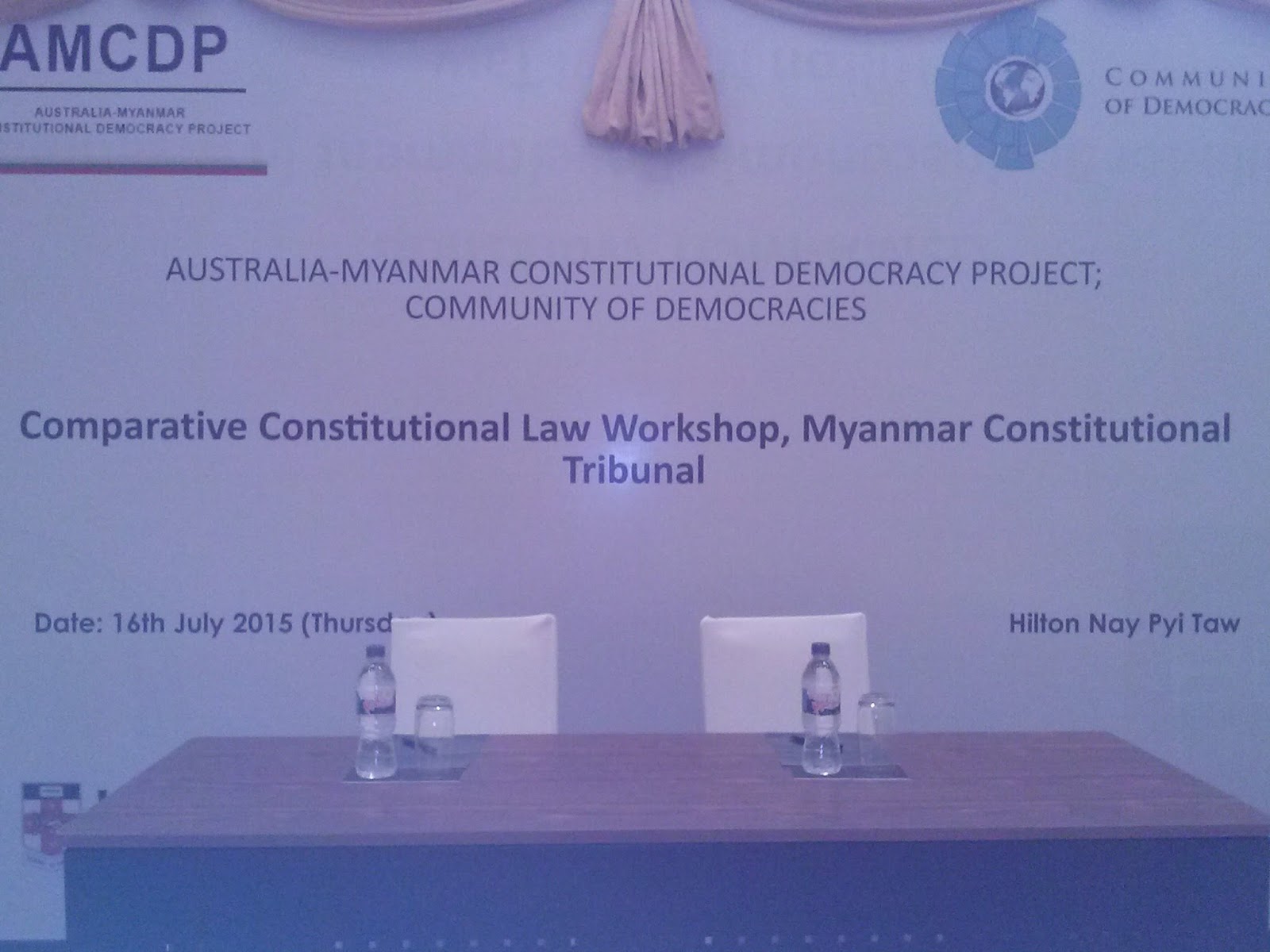
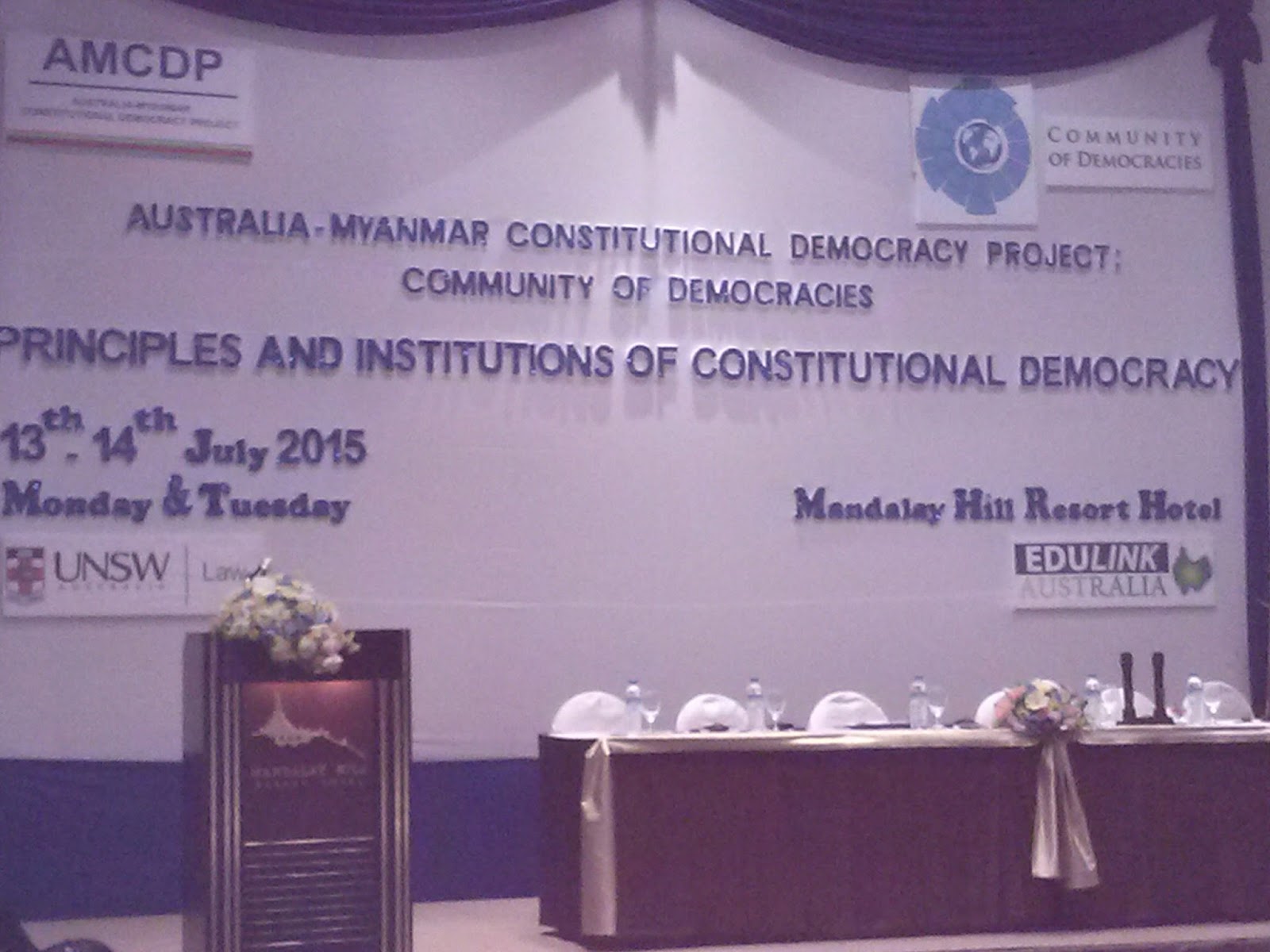
The workshops commenced in Mandalay for two days from 13-14 July, followed by a workshop on 16 July in the capital, Nay Pyi Daw. The AMCDP is currently led by two UNSW Law Professors, Martin Krygier and Theunis Roux. Other UNSW Law participants included Dr Melissa Crouch and Associate Professor Adam Czarnota. UNSW Law staff were joined in Myanmar by Dr Nick Cheesman of ANU and Janelle Saffin, former member of Australian State and Federal Parliaments and a leading specialist on the politics of Myanmar. 

The most recent workshops were run in co-operation with the leading inter-governmental institution, the Community of Democracies, with funding provided by the foreign ministry of the Republic of Korea. Local participants in the first workshop included representatives of the regional government, the Union (national) Parliament, the Union Electoral Commission, a wide range of political parties, including ethnic representatives from several war-torn regions, five universities and higher education institutions, NGOs and CSOs, women’s organisations, as well as lawyers’ organisations and sole practitioners. 


The Nay Pyi Taw workshop was smaller and devoted to just one organisation, the Constitutional Tribunal. The purpose of this workshop was to explore the relevance of comparative constitutional law to the Tribunal. Theunis Roux led the discussion speaking on ideas of judicial empowerment – the process through which constitutional courts build their institutional legitimacy and become effective players in national politics. These ideas were then illustrated through discussion of the Indian and Indonesian experience. In the afternoon session, Dr Melissa Crouch talked about how constitutional courts elsewhere have used foreign law to inform and lend authority to their decisions. 
For the full article see UNSW webpage here.

Special Issue on Religion in Myanmar

The Review of Faith and International Affairs will soon publish a special issue on religion in Myanmar. The volume includes contributions on a range of topics by several Burma Studies scholars.

My own contribution is on the ‘The Construction of Religion by Law in Myanmar‘. The abstract is as follows:

Mosque in Moulemein, July 2015.

This article provides an overview of the broader shifts in state-religion relations in terms of constitutional and legislative changes in Myanmar since independence. This article examines the relation between religion and law in Myanmar more broadly, and questions how law has been used by the state to construct the idea of religion and ‘acceptable’ religious practise. It seeks to demonstrate that law has influenced the way religion is practised and understood in Myanmar, shaping both relations between religious communities and the state, and relations between Buddhist and non-Buddhist communities. It highlights three areas where law has been used to regulate and limit religious life and practise in Myanmar since independence. The first aspect is personal law and inter-religious relations as regulated by statute and case law. The second aspect is constitutional law and the role of religion in public life. The third aspect is the control of the Sangha through the legal regulation of disputes and education, and the application of criminal law. The way in which the state has engaged with each of these issues has changed over time and been tightened by successive socialist and military regimes. This has led to an instrumental relationship between law and religion in contemporary Myanmar. I demonstrate that the emphasis on the use of law as a control on religious affairs promotes a religion of legality, while law continually seeks to define the parameters and legality of religion in Myanmar.

Book review: Opposing the Rule of Law

Every now and then, a book comes along that offers a fresh take on a topic that has become commonplace. The rule of law is a ubiquitous theme running through the law and development landscape and the way we think about law reform in this era. The empire that has become the rule of law has few limits, and is bolstered by endless programmes, videos, fact sheets, checklists, reports, measures and metrics. Yet a new book by Nick Cheesman, Opposing the Rule of Law: How Myanmar’s Courts Make Law and Order (CUP, 2015) challenges current conceptions of the political and legal ideal of the rule of law, and takes the conversation in an entirely new direction. This is a book of “firsts” in many respects, not least because it is the first major study of courts in Myanmar and the first to do so drawing primarily on Burmese-language documentation. Given the centrality of Myanmar to the current global rule of law project, the contribution and timing of Cheesman’s study on the rule of law in Myanmar is fitting.

            The rule of law literature is daunting both due to its sheer size and the complexity of the debates, which range from the theoretical to the practical. Tackling this literature by going beyond the tired conceptions of the rule of law, Cheesman instead chooses to approach the rule of law through the notion of opposing ideas as a way of illuminating the elements of a concept (pp. 7-8). This theoretical orientation is then supported and reinforced with a methodology that is impressive in its empirical breadth and depth, encompassing a wide range of primary and secondary legal materials from the colonial period to the present. The appendix provides an exemplary model of a rigorous, socio-legal approach, fitting for this Cambridge Studies in Law and Society series.Throughout, Cheesman’s primary argument is that, “law and order” as a concept is opposed to the rule of law, and yet these two ideas have become conflated. He associates the rule of law with the central role of the judiciary, and the transparency and predictability of law. On the other hand, the notion of ‘law and order’ is associated with arbitrary executive action, and therefore stands in contrast to the ideal of the rule of law.   His argument is that not only have global ideas of the rule of law become confused with the concept of law and order, but that in Myanmar the two terms are semantically confused and conflated. This leads to the situation today, where the rule of law in Myanmar has been hollowed out by the government to simply mean law and order. .Further, in this age of the global, Cheesman’s book is a challenge to take the local seriously.  He insists that “the rule of law does everywhere become embedded in local ideas, language and practices, and takes on meanings that adhere to those settings”. (p. 260). The book therefore is an implicit warning to cultural outsiders involved in rule of law projects to slow down, put their rule of law tools aside for a moment, and spend some time to understand the local context.

            Legal systems in Southeast Asia and other developing contexts are often too easily dismissed because they fail to meet international standards. However, Cheesman is clear that his purpose is not to show that Myanmar does not have the rule of law, but rather to take the study of the politics of courts in Myanmar seriously. Cheesman demonstrates that law has been a core part of the toolkit of successive regimes, despite the fact that English-language scholarship has largely ignored the legal system until recently.Chapter 1 sets out the conceptual arguments on the rule of law as opposed to law and order, and gets to the heart of the linguistic distinction in Myanmar. Chapter 2 provides a careful rethink of the colonial legal apparatus and the legacy of criminal law in British India. Cheesman’s characterization of Bentham’s influence on the criminal law  is an approach that resonates with the work of the late Professor Andrew Huxley. Chapter 3 turns to the post-independence era and considers the creeping use of policy and how courts became fused with the executive, particularly during the socialist regime. Chapter 4 advances three ways in which the rule of law as an idea became equated with law and order after 1988. This includes the draining of meaning from legal principles; the mutual equivalence of all forms of laws and rules; and the predominance of executive administration over the legal system. Chapter 5 deals with the power of the sovereign and focuses on the police and their use of “judicial torture”. The three final chapters deal with particular elements of this “law and order” paradigm: the routinized and orderly nature of corruption in courts (Chapter 6); executive and judicial responses to unauthorized public assembly (Chapter 7); and the way those rendered powerless before the military regime of law and order have used complaints against government to advocate for the rule of law (Chapter 8).Cheesman concludes this exploration of one opposing concept to the rule of law — law and order— still holding on tight to the rule of law itself and affirming its value as a political ideal. In a similar way that Benedict Anderson offered a new understanding of the concept of nationalism with reference to Southeast Asia in his seminal book Imagined Communities, in the same way Cheesman has enhanced our understanding of a core political ideal of our age —the rule of law— through a close and careful study of the Myanmar legal context.This book will appeal to scholars from a wide range of disciplines in the social sciences, but legal scholars and practitioners working in the global “industry” of the rule of law need to read this book in particular. It is a call to put aside the trumpets announcing the rule of law, and instead put our ear to the ground, to understand the rule of law currents that already exist in local contexts, and importantly the ideas that may run counter to the rule of law. Cheesman’s book is an invaluable and lasting contribution to scholarship on the rule of law, and an exemplary reminder of how the study of Southeast Asia can illuminate our understanding of the key political ideals of our time.
Citation: Melissa Crouch, (2015) ‘Book Review: Opposing the Rule of Law’ Contemporary Southeast Asia, Vol 2, August. 

Electives on Southeast Asia at UNSW Law

Next year I will be offering two new electives at UNSW Law Faculty. The idea for electives came out of a survey I conducted of law students in the faculty, via the Law Student Society. Out of 52 respondents, 95% said they agreed that there should be more subjects on Asian law offered in the curriculum. I believe that there is a real need for our students to have the opportunity to study about legal systems in Southeast Asia, our regional neighbours. These courses will fit within and expand on the Law School’s existing engagement in the Asia Pacific region. They will equip students to understand core debates on the rule of law and law reform in Southeast Asia, and enable students to develop an informed appreciation for the legal systems and traditions in Southeast Asia.


Islamic Law and Society
This course will provide students with an introduction to Islamic law and society in Southeast Asia. The region of Southeast Asia provides a fascinating and complex site to consider many of the broader issues and debates facing the Muslim world. Countries that will be covered include Indonesia, Malaysia, Thailand, Philippines, Singapore and Myanmar. The aim of the course is to explore contemporary issues and debates on Islamic law in its social, political and cultural context. Key themes of the course include Islam and Constitutionalism; the role of religious authorities; Muslim legal professionals; women and Islam; Muslims and conflict; state regulation of religion; and Islamic courts. This is a research-intensive subject. This course would appeal to students who are interested in deepening their understanding of Islamic law and exploring debates concerning secularism; the significance of religion to legal traditions in Asia, and the interaction between Islam and democracy in the region. The course will equip students going into legal practice or into other sectors with a broad knowledge of Islamic legal traditions in the region, its relevance to contemporary global debates on Islam, and a deep appreciation for the importance and complexity of plural legal systems. The course may include guest speakers. Students are encouraged to take Law in the Global Context prior to or simultaneously with this course. This subject is open to both undergraduate and JD students.
Assessment
Research assignment 70%
Research proposal 10%
Class participation 10%

Learning outcomes:

  • ·    Display a clear knowledge of the principles of Islamic law principles of Islamic law and the extent to which this has influenced state regulation and legal institutions in Southeast Asia
  • ·    Evidence an advanced understanding of the substance of Islamic law, an awareness of the different policy approaches to state regulation of religion, and the consequences for religion/state relations and democracy
  • ·    Navigate and apply constitutional provisions and statutes on Islamic law in Southeast Asia
  • ·    Engage in advanced critical analysis of the role and function of Islamic courts and Muslim legal professionals in Southeast Asia
  • ·    Demonstrate effective oral communication skills by discussing and debating course concepts in a scholarly, reflective and respectful manner
  • ·    Demonstrate the timely composition of effective and sophisticated written communication for a specialist audience

The Rule of Law in Southeast AsiaThis course will provide students with an introduction to legal systems and traditions of Southeast Asia through a focus on the development and promotion of the ideal of the rule of law. The rule of law is now commonly promoted by scholars, politicians and legal professions as essential to political and democratic reform in regions around the world, including in Southeast Asia. The rule of law is however an inherently contested concept, and there is vigorous debate over its substance, content and practical value. This course will provide an opportunity for students to reflect on law reform in number of countries in Southeast Asia, including Indonesia, Malaysia, Singapore and Myanmar. Core themes of the course include: law reform in authoritarian states; constitutional law; democratisation; the courts; the role of judicial review; human rights institutions; religion-state relations; and legal education. This is a research-intensive subject. This would course appeal to students with a wide range of interests who may be considering careers in: global law firms with branches in Southeast Asia; government; international organisations and development agencies, among others. This subject is open to both undergraduate and JD students.


Assessment
Research assignment 70%
Research proposal 10%
Class participation 10%


Learning outcomes:

  • Display a clear knowledge of the history and development of legal traditions in Southeast Asia, and understanding of contemporary legal issues relevant to the region
  • Evidence an advanced understanding of the rule of law and how this principle has been promoted and developed in legal systems in Southeast Asia
  • Navigate and apply constitutional provisions and statutes in both civil and common law countries in Southeast Asia
  • Engage in critical analysis of the role and function of constitutions and courts in Southeast Asia
  • Demonstrate effective oral communication skills by discussing and debating course concepts in a scholarly, reflective and respectful manner
  • Demonstrate the timely composition of effective and sophisticated written communication for a specialist audience 

Why Myanmar needs constitutional review

Last week there was debate in the Pyidaungsu Hluttaw, or Union Parliament, over the future of the Constitutional Tribunal, one of the new institutions established under the 2008 constitution. In discussions over proposed constitutional amendments, it was suggested that the Constitutional Tribunal should be abolished.


This proposal has been made with reference to claims that many common law systems around the world allow cases for constitutional review to be heard by the highest court in the general court system, rather than a separate judicial institution. Those in favour of this proposal have also emphasised the fact that it is civil law countries, rather than common law countries, that have established a separate institution to hear constitutional review matters.

While both of these statements are true, these are not necessarily arguments for abolishing the Constitutional Tribunal. No country today is a “pure” common law or civil law system. It is true that the Supreme Court in the parliamentary era had limited jurisdiction to hear cases for constitutional review. Even though Myanmar identifies as a common law country, the reality is it has a Constitutional Tribunal that is similar to the model in some civil law countries.

A debate about whether to retain the Constitutional Tribunal must be informed by several realities. First, in the past few decades there has been a clear trend around the world in favour of judicial review. This global phenomenon has been particularly true in countries that are seeking to make a transition from military rule to democracy. For example, in neighbouring Indonesia the Constitutional Court has been critical to the democratisation process. In particular, it has allowed individuals and non-government organisations plenty of opportunity to bring cases for review to the court. This does not mean that the court and its decisions has been without controversy.

It is also the case that around the world, constitutional courts inevitably face significant challenges as they are required to decide upon issues that have real political implications. Constitutional courts have some measure of choice as to how they will respond strategically to these challenges. This is never an easy process. Many constitutional courts have had to struggle for their existence, particularly in the early years. In these formative stages of a new legal institution, it is particularly important for the court to establish a longer-term basis of support to legitimise its role.

Given that cases for constitutional review have real political implications, this also means that the role and approach of a constitutional court will inevitably change over time as the political system changes. The challenge is for a constitutional court to establish a solid base of legitimacy and adapt strategically to these changes to ensure it can withstand any interference by the parliament or executive.

Of course, independence from the executive and parliament is crucial to the legitimacy and success of any constitutional court. Such independence should be reflected in the selection and appointment process for judges, and in the decisions of the court.

In the case of Myanmar, the debate should be about which institution is best suited to hear cases for constitutional review and who should have access to bring a case for review, not whether constitutional review is necessary in the first place.

Around the world, the practice of judicial review has come to be a critical part of the process of democratisation in many countries. The need to support the development of an impartial institution that can determine the constitutionality of legislation and hear disputes between different levels of government is equally important in Myanmar.


This article first appeared in The Myanmar Times, Wednesday 15 July 2015.

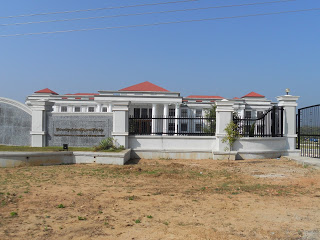
The Supreme Court and Constitutional Tribunal, Naypyidaw 2013

UNSW Law – Myanmar events

UNSW is contributing to a number of events happening in Myanmar in July together with partners in Myanmar. On 9-10th July, Professor Brendan Edgeworth and myself will teach at the Law Department at Mandalay University, as part of the MOU between UNSW Law and Mandalay University. My talk with focus on academic research skills and method in the context of comparative constitutional law.

On 13-14th July 2015, the Australia Myanmar ConstitutionalDemocracy Project will host a constitutional law workshop in Mandalay. This is a follow-on from events held in 2013 and 2014, but will be the first time it is run in Mandalay. The event is being funded by the Community of Democracies network. This event is organised by Professor Martin Krygier and Professor Theunis Roux.

Then on 16th July 2015, Professor Theunis Roux, Ms Janelle Saffin and myself will run a comparative constitutional law workshop for the Constitutional Tribunal in Naypyidaw. 

Also, later in the year, I will be organising a workshop on The Business of Transition in Myanmar, to be held at UNSW Law.

Visit to Sittwe University Law Department, June 2015