Seminar on Islam and the State in Myanmar

Political and Social Change Seminar
Topic
Islam and the State in Myanmar: Understanding the Politics of Belonging
Speaker
Melissa Crouch
Date & Venue1
–2.30pm, Wednesday 1 April, 2015
Coombs Extension, Room 1.04
HC Coombs Extension Bldg #8, Fellows Rd
The Australian National University


Abstract
The recent anti-Muslim violence in Myanmar has exposed a serious gap in knowledge of Muslim communities and how they interact with the state in Myanmar.This talk will focus on the politics of belonging in Myanmar with a focus on deepening our understanding of the diverse Muslim communities there. It will demonstrate the need to move away from rigid ethnic-based assumptions of Muslims in Myanmar and reframe our understanding to include how Muslim identity is shaped by their relations with the state. It will identify several themes critical to the politics of belonging: the history of the Muslim community; Muslim political engagement; Muslims in times of crisis; and the practise of Islam. In order to reconceptualise the politics of belonging, and expand our understanding of the relation between Muslims and the state in Myanmar, I suggest that we need to make two movements. First, we need to move away from characterising Islam in Myanmar as violent, hostile and strange. To place Islam on an equal footing with other religions in Myanmar will inevitably require displacing Buddhism from its perceived position as a ‘non-violent’ religion. Second, the study of Islam in Myanmar needs to be acknowledged and welcomed into wider academic discussions on Islam and the state. That is, rather than studying Muslims in Myanmar as an isolated anomaly, in this era of transnational Islam we need to reposition the study of Muslims in Myanmar as an important ‘Islamic crossroad’ between Central, South and Southeast Asia.

About the Speaker
Dr Melissa Crouch is a Lecturer at the Law Faculty, the University of New South Wales, Sydney. 

Details of forthcoming and recent PSC seminars, workshops and conferences can be found http://ips.cap.anu.edu.au/psc/events

Law Reform in Myanmar Beyond 2015

You are invited to attend an evening panel discussion on what lies ahead for the law reform process in Myanmar. This event is co-hosted by the Gilbert + Tobin Centre of Public Law and the Australian-Myanmar Constitutional Democracy Project. It builds on legal education and constitutional law initiatives already established by several UNSW Law School faculty members who engage with Myanmar.

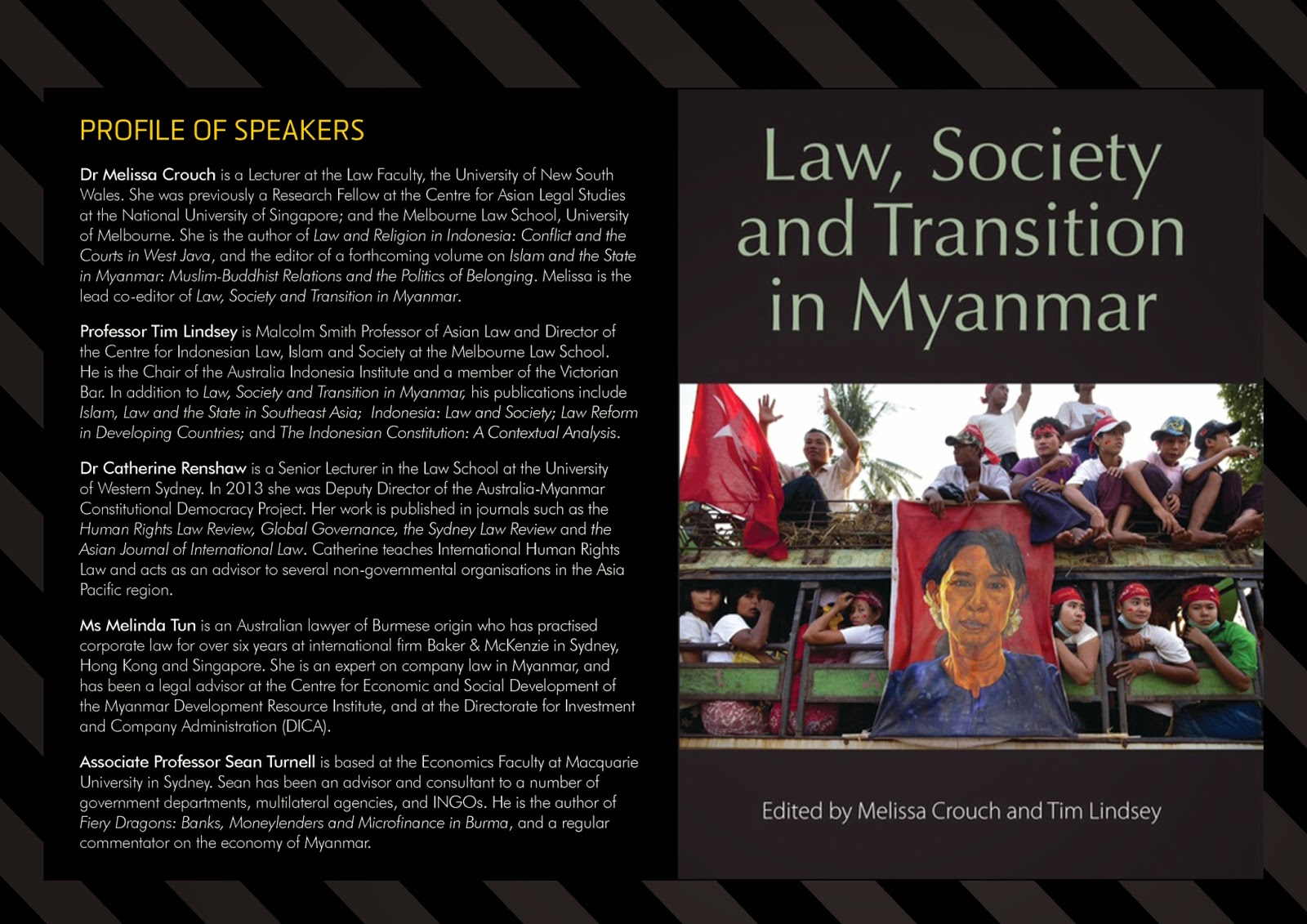
The speakers are all contributors to a recently published book ‘Law, Society and Transition in Myanmar’ (Hart Publishing, 2014), the first book to explore the dynamics of Myanmar’s legal reform process in their social, historical and political context. 
The panel will be chaired by the book’s co-editor, Professor Tim Lindsey of the University of Melbourne, and will include presentations by the other co-editor, Dr Melissa Crouch of UNSW; and contributors Associate Professor Sean Turnell of the Economics Faculty at Macquarie University, Dr Catherine Renshaw of the Law Faculty at UWS, and Melinda Tun of Baker & McKenzie, Sydney. They will address contemporary issues in constitutional reform, economic reform, corporate law reform and Myanmar’s role in regional networks. Professor David Dixon, Dean of UNSW Law, will launch the book after the panel discussion. A drinks reception will follow.
The event is free but registration is essential. Registration can be completed online here
See the website or  event flier for more details
Registration inquiries should be addressed to Belinda McDonald, Administrator at the Gilbert + Tobin Centre of Public Law on 02 9385 2257 or gtcentre@unsw.edu.au.

And just a note on the availability of the book:

Copies will be available for purchase at the event. It can be ordered online at Hart Publishing. It will be available at the UNSW bookshop. 

In terms of in Myanmar, it is available through Monument Books, and the Myanmar Book Centre, Yangon

Seminar on Law in a Changing Myanmar

The UNSW Network for Interdisciplinary Studies of Law invites you to attend an evening seminar on ‘ Law in a Changing Myanmar”


The guest speakers are Professor Nu Nu Yi and Professor Tin Htay Ei, who are visiting UNSW from 2-5 March 2015.


Professor Nu Nu Yi is Pro-Rector and former Head of Department of Law, University of Mandalay. Her expertise lies in intellectual property, business law and customary law. 


Professor Tin Htay Ei was until 2014 Head of Department of Law, University of Mandalay, and is currently Professor in the Department of Law at the Yangon University of Distance Education. Her primary areas of expertise are international environmental law and customary law. 


Event date: Tuesday, 3 March 2015
Location: Dean’s Board Room, 2nd Floor
UNSW LAW SCHOOL, Kensington, Sydney
Time: 5.30 – 8pmPlease rsvp to Martin Krygier (m.krygier@unsw.edu.au) know ahead of time.

UNSW Engagement in Myanmar/Burma

Since moving to UNSW, I have been interested to learn more about the various initiatives related to Myanmar that the Law Faculty has ongoing. There are three main areas: the Australia-Myanmar Constitutional Democracy Project; legal education; and the Diplomacy Training Program.

Australia Myanmar Constitutional Democracy ProjectIn 2013, the Australia-Myanmar Constitutional Democracy Workshop was established and originally directed by Professor Wojciech Sadurski of the University of Sydney, in cooperation with a network of scholars from UNSW, ANU and NUS. Professor Martin Kruyger and Professor Adam Czarnota of UNSW participated with other academics in a workshop held in Yangon in May 2013. The workshop was sponsored by the Australian embassy, Rotary International, Konrad Adenauer Foundation and the respective universities. The workshop was attended by a wide range of civil society organisations, lawyers, judges, and politicians. See report on proceedings here, and media release here and here.
InFebruary 2014, Martin Krygier and Theunis Roux organised a forum on constitutional reform in Myanmar ‘Stumbling Towards Democracy?’ at UNSW Law school. Guest speakers included U Htay Oo, National League for Democracy (NLD); U Thein Than Oo, Myanmar Lawyers Network; and Janelle Saffin, lawyer and former federal MP. See here.
In 2014, Martin Krygier and Theunis Roux took over as facilitators of the Australia Myanmar Constitutional Democracy Project, in collaboration with the networks of academics from Sydney, ANU and NUS centrally involved. In November 2014, workshops were held in Yangon and Naypyidaw. It was sponsored by Australian embassy, Rotary International, Konrad Adenauer Foundation. See report on proceedings here, and here. There are plans for this project to continue and the project (thanks to the hard work of Catherine Renshaw, Martin Krygier and Theunis Roux) has received a grant that will support the Australian-Myanmar Constitutional Democracy Project in 2015-2016.

Legal EducationIn 2014, UNSW Law School signed an MOU with Mandalay Law Department. This was the initiative of Professor Carolyn Penfold and Professor Brendon Edgeworth, who visited the Law Department at Mandalay University last year.
In late February 2015, several law professors from the Law Department at Mandalay University will visit the UNSW Law School.

Diplomacy Training Program (DTP)The Diplomacy Training Program is a unique initiative that is affiliated with the UNSW Law School and has a strong history of capacity building in the region. In May 2014, the Diplomacy Training Program (DTP), led by Patrick Earle,  held its first human rights training program in Yangon, Myanmar. Australia’s Ambassador to Myanmar, Bronte Moules, hosted a reception for the participants and for DTP’s alumni. U Win Mra, the chairperson of the Myanmar Human Rights Commission participated in the closing ceremony and the awarding of UNSW certificates. See here for more information.
In November 2014,the 24th Annual Regional Human Rights and Peoples’ Diplomacy TrainingProgram was held in Kathmandu, Nepal in partnership with INSEC, and some participants from Myanmar attended the program.

Further collaboration with partners from Myanmar is anticipated for 2015.

University of Mandalay, 2013

Campaigns for Constitutional Reform in Myanmar

Sometimes its useful to look back in order to move forward. Last year while on field research I observed some of the rallies for constitutional amendment in Myanmar. This is my reflection on one of them.


The morning was humid, the traffic crowded, crawling by. I arrived in a beat-up taxi at Bo Sein Hman sports ground in Tamwe Township, Yangon. The rally was due to start at 8:30am, and the sports ground was already crammed full of people when I arrived. They must have arrived very early, as people were already sitting on the ground, huddled close together, knee to knee. The crowd were a mixed group of people, young and old and in-between, with the odd journalist and foreigner here and there. I wondered if members of the Special Investigation Branch were also here, probably.


The sports ground sloped down to one end where a large platform had been erected. The crowd all faced the large platform, and behind the platform was an enormous sign proclaiming the reason for the demonstration: the National League for Democracy (NLD) and the 88 Generation had joined forces to call on the government to amend section 436 of the Constitution. Section 436 contains the amendment procedure to change the 2008 Constitution. This has to be one of the most constitutionally literate people in the world, I thought to myself. In how many other countries (apart from the US) would this many people know or care about the amendment provision of their Constitution?


The gates to the ground were closed by the time I arrived, so people had spilled out onto the surrounding dirt roads, peering through the iron fence. To the left of the grounds a number of small food stalls had popped up. The food vendors were clustered around some card tables where people handed out NLD pamphlets and fliers, and encouraged people to sign the petition to amend the Constitution. Many people in the crowd proudly displayed their political allegiance by wearing NLD paraphernalia – t-shirts, headbands, and arm bands. At the road to the back of the grounds, some people had climbed trees while others stood on the back of a ute parked on the side road, in an attempt to get the best view of the stage. To the right side of the stage, a particularly large group of people had gathered, because that spot offered the best vantage point from which to see the stage. Some young NLD volunteers who wore security badges formed a human chain around the crowd in an attempt to keep people off the road and allow the traffic to get through. The traffic crawled by slowly but patiently, car fumes choking the early air morning.


On stage sat the Lady, Daw Aung San Suu Kyi, member of parliament and the NLD. With her sat U Tin Oo, founder of the NLD, and Min Ko Naing, 88 Generation leader. All three had been political prisoners for their pro-democracy activities during the post-1988 military period. While Daw Aung San Suu Kyi was clearly the favourite, the crowd listened with the same rapture and respect for all speakers. I wondered how many rallies this was now for Daw Aung San Suu Kyi – from the weekly talks that she gave outside her gate in the early 1990s, to the talks she has given around the country when released from country arrest, particularly since 2010.


One of the most unusual aspects of the rally was the silence that prevailed when the speeches were being made. The atmosphere was surreal. There were thousands of people around me, and yet I could not see anyone talking or whispering to each other, nor was anyone on their phone.


Some media reports later estimated the event to have drawn a crowd as big as 20,000 people. Even though it was still early morning, the heat was oppressive and stifling, yet few people moved. All eyes were glued to the stage, as if their life depended on the words of the speakers. At times when one of the speakers made a particularly impassioned plea on the necessity of constitutional amendment, the crowd would cheer and applaud, but then it would inevitably fall respectfully silent again. It was perhaps the most orderly and controlled rally that I have ever been to, a far cry from the government’s claim that such a rally could necessitate a state of emergency.

Constitutional amendment rally in May 2014

I reflect more on this incident in a forthcoming chapter ‘Emergency Powers in Times of Transition: Between the Constitution and the Criminal Procedure Code in Myanmar’, in Andrew Harding (ed) (forthcoming) Constitutional Change and Law Reform in Myanmar. Hart Publishing

Looking back

At the start of a New Year, its always useful to look back to see where we have been and where we have directed our efforts. I have been fortunate to be involved in various initiatives in Myanmar over the past few years, but particularly while I was at National University of Singapore (2012-2014). Here is a recap on events 


October 2012: Workshop on Directions and Determinants in Law Reform in Myanmar – held at NUS, organised by Professor Andrew Harding. Harding has summarised the discussions from this workshop in a chapter Law, Society and Transition in Myanmar.


Semester 1, 2012:Asian Legal Studies Colloquium (2012), I contributed to two ofProf Andrew Harding’s classes on the legal system of Myanmar.


April 2013: Roundtable on Human Rights and Responsible Business in Myanmar, I gave an update on the legal system at a roundtable organised by Melbourne Law School.


May 2013:Australia-Myanmar Constitutional Law Workshop, – I gave a talk on emergency powers and the relationship between the military and the Constitution. The workshop was facilitated by the Sydney Law School in Yangon.


May 2013: Training Assessment Workshop for the Union Attorney General’s Office, Naypyidaw. This was a preliminary workshop with a range of donors, law schools and law officers from the AG’s office about the future training needs of the Attorney General’s Office. Dr Melissa Crouch attended on behalf of CALS.


June 2013:Annual ATLAS Agora June 2013, Prof Andrew Harding and I gave a seminar on legal reform in Myanmar held at the Law Faculty, NUS.


August 2013: Ministry of Law (Singapore) delegation to University of Yangon and Mandalay University Law Departments. I represented NUS on this trip. The focus was on legal education and possible future cooperation between NUS and the two Law Departments in Myanmar. [MOUs were signed in early 2014]


October 2013: Seminar on ‘Prospects and Challenges for Constitutional Reform in Myanmar’, which I gave at the Asian Law Centre, Melbourne Law School, University of Melbourne.
October 2013: Rule of Law in Asia LLM course: I taught in the Masters course at the Melbourne Law School, the University of Melbourne. The class was on ‘The Rule of Law in Myanmar’.


January – April 2014 (sem 2): Transition and the Rule of Law in Myanmar elective, I taught anew elective course for LLB/LLM/PhD students at the Law Faculty, NUS.


January 2014:Workshop on Islam, Law and the State in Myanmar, which I organised. The edited volume Islam and the State in Myanmar: Muslim-Buddhist Relations and the Politics of Belonging is forthcoming.


February 2014:Workshop on Constitutionalism and Law Reform in Myanmar, was held at NUS, organised by Professor Andrew Harding, which I also assisted with. I gave a talk on The Constitutional Writs in Myanmar.


April 2014: Seminar at UNSW: I gave a talk on Constitutionalism in Transition: The Writs as a Litmus Test for Law Reform in Myanmar, at the Law Faculty, University of New South Wales, Sydney.


June 2014: Workshop on Legal Education with Myanmar Japan Legal Resource Centre and the University of Yangon, Yangon. I attended on behalf of National University of Singapore.


July 2014: Law Department Review as part of the Social Science Curriculum Working Group Meeting, hosted by the Open Society Foundation, the University of Yangon and Mandalay University, Yangon.


1-3 August 2014: Bi-annual Burma Studies Group Conference: This was an inter-disciplinary academic event organised in collaboration with the Faculty of Arts and Social Sciences, the Lee Kwan Yew School of Public Policy, and the Law Faculty, the National University of Singapore. The panel I organised was on Religion, Identity and Politics in Myanmar.


August 2014:USAID/Promoting the Rule of Law Project – I participated in a project on Administrative Justice in Myanmar. This including giving a lecture at Mandalay University Law Department.


October 2014:Parliamentary Resource Centre, Naypyidaw: I gave a talk on Administrative Law at the National Democratic Institute in Naypyidaw to Members of Parliament. I also gave a talk in Yangon to lawyers and civil society.


November 2014Australia-Myanmar Constitutional Democracy Workshop. I contributed to a panel on The Rule of Law, focusing specifically on the issues for the rule of law that are raised in a state of emergency.

It has been a dynamic and fascinating experience. Now I have moved to UNSW, I am becoming involved in initiatives here. I’ll post more on these soon.

Workshop on the Indonesian Constitutional Court

For those in Sydney, a workshop on the Indonesian Constitutional Court will be held today and tomorrow. Details below:
Workshop on “The Constitutional Court & Democracy in Indonesia: Judging the First Decade”


11-12 December 2014
Sydney
Presented by the Gilbert + Tobin Centre of Public Law, UNSW Law Faculty and Centre for Asian and Pacific Law, Sydney law School

Draft Program
11 December, UNSW Faculty of Law

4-5.30pm           
Opening Plenary (Law School Theatre) – Panel Discussion with
Prof. Dr. Jimly Asshiddiqie, SH, founding Chief Justice of the Constitutional Court
Prof. Dr. Denny Indrayana, SH, former Deputy Minister for Justice

Chairs:  Professor Rosalind Dixon and A/Prof Simon Butt

5.30-7pm           
Opening Reception – UNSW Staff Seminar Room, Level 2

12 December, University of Sydney Faculty of Law

Venue: Sydney Law School, Room 446

Welcome

9.30-9:40am     Dean’s Welcome (Professor Joellen Riley)

9:40-10am         Introducing participants and conference themes (A/P Simon Butt)

10-11.30am       Workshop Session 1: The Court, the Constitution & Democratic Consolidation
Fritz Siregar (UNSW), The Creation & Consolidation of the Constitutional Court
Dr Stefanus Hendrianto (Santa Clara), ‘Who are We Now? Political Liberalism and the Indonesian Constitutional Court’
Commentators:  Prof. Dr. Denny Indrayana, Mark Tushnet (Harvard Law)
Chair: Professor Rosalind Dixon (UNSW)


11.30-11.45am     
Morning Tea
11.45-1.15pm 
Workshop Session 2: The Constitutional Court, Islam & Democracy                                                                                                   
Dr Melissa Crouch, Islam and the Constitutional Court
Dr Nadirsyah Hosen (Wollongong) The Constitutional Court & ‘Islamic’ Judges
Commentators:   Prof. Dr. Jimly Asshiddiqie, SH, Simon Butt (Sydney)
Chair:    Dr Lucas Lixinski (UNSW)
1.15-2.00pm     
Lunch
2.00-3.30pm     
Workshop Session 3 Case Studies
Professor Tim Lindsey(Melbourne), Hatta, Art 33 and the Constitutional Court
Dr Arskal Salim (UWS), Piety and Penalty in the Practice of Charity in Indonesia: A Judicial Review of Law 23 of 2011 on Zakat
Commentators:               Pan Faiz (UQ), Joel Harrison (Macqaurie)
Chair:                                  Professor Theunis Roux (UNSW)

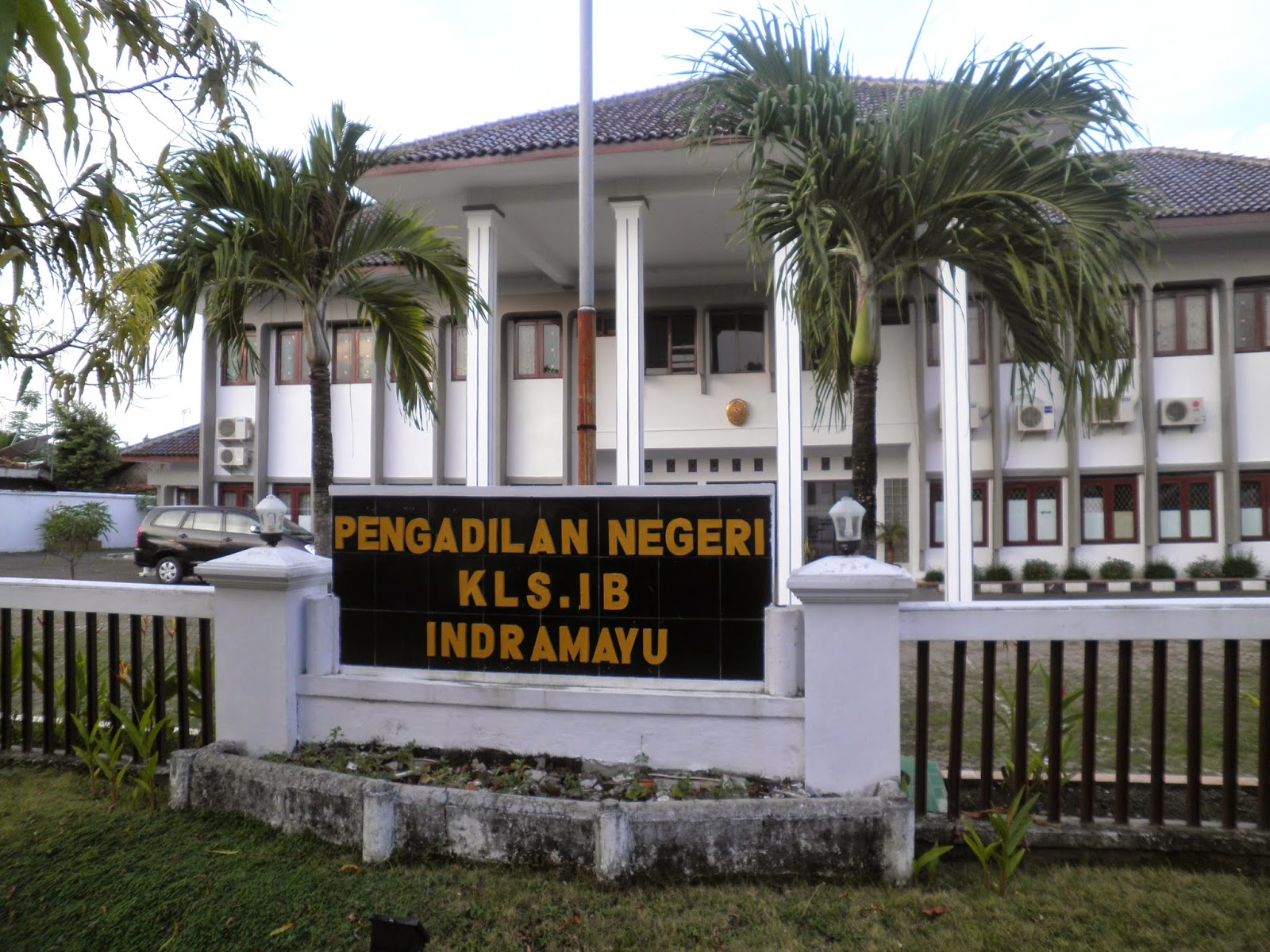
Court in Indramayu, West Java, 2010.

Remembering the work of the late Professor Andrew Huxley

Remembering the work of the late Professor Andrew Huxley


It is with sadness I heard this week of the passing of Professor Andrew Huxley of the School of Oriental and African Studies (SOAS) London. I had never met Professor Huxley, but I did have email correspondence with him in relation to his recent contribution ‘Is Burmese Law Buddhist?’.[1]


He was also kind enough to read and comment on some of my own work via email, even though he had never met me. I was extremely grateful for his generous comments and feedback. I want to use this post to reflect back on some of his publications that have made a significant contribution to the study of law in Myanmar/Burma.
Professor Huxley spent part of his academic career expanding our understanding of Burmese Buddhist law and locating it in the context of the literature on Buddhist law in Southeast Asia.[2] For readers looking for a concise overview of the literature on Burmese Buddhist law published from the 1980s to 2001, his review offers an excellent introduction.[3]


Professor Huxley highlighted the way in which the dhammathats are evidence of the important role that law played under the kings, and that it was not the British who first introduced the rule of law in Burma.[4] He argued that Burmese Buddhist law is relevant and needs to be understood by historians, Pali scholars and lawyers, because it remains the source of personal law for most Buddhists in Myanmar. His work has advocated for the view that the legal system that existed in Burma prior to colonialism was well-developed. 
Professor Huxley addressed the works of prominent colonial figures, such as John Jardine (1844–1919) who held the position of Judicial Commissioner of British Burma and is well-known for his Notes on Buddhist Law (1882–83); and Em Forchhammer (1851–90), a Government Archaeologist of British Burma who wrote The Jardine Prize: An Essay 1885. For example, on Forchhammer, Professor Huxley questioned his argument that the dhammathat literature of 1880s was derived from a single Mon work, and suggests instead that Mon influence varied depending on place and overtime.[5]


Professor Huxley provided an insightful overview of government policies towards religion and towards the sangha in particular,[6] which is accessible to readers from a common law background with its comparative approach to the conceptualization of religion and the state in England and Burma. He identified three shared concerns: who can oversee religious organisations, which texts are recognised as authoritative, and how the state deals with non-conformists. He highlighted the way in which Buddhist ecclesiastical law was applied in the courts from annexation up until 1918, but after that time declined as judges demonstrated a preference for dhammathat over vinaya. Overall, he demonstrated the way in which the position of the sangha has changed dramatically since independence when the sangha and the vinaya were encouraged and recognised, to the other extreme of excessive legislative control over the sangha.


Professor Huxley often wrote as a comparative law scholar, as evident in his comparison of sixteenth-century Burmese legalism with Western European approaches to law and kingship.[7]


Professor Huxley’s most recent chapter was written at the time of his retirement and constitutes a reflection on the broader socio-political and legal changes that took place after independence and are now taking place at the sixty-fifth anniversary of the country, combined with detailed discussion of the dhammathats.[8] He argued that prior to 1885, Burmese law was distinctly Buddhist; however this year marked not only the end of Burmese rule and the beginning of colonialism across the country, but also the replacement of codified Burmese law with case law. A unique feature of Professor Huxley’s work is the way in which he deftly speaks across legal cultures and families, drawing parallels and contrasts with common and civil law contexts, as well as both Western and Asian legal traditions.


Here is a link to a list of Professor Huxley’s work, which he sent to me several months ago. His work will remain a legacy for scholars of Burmese Buddhist law and Myanmar legal studies generally.
This article is taken from a broader literature review of Myanmar law that can be accessed here.

This article was first posted at New Mandala, 8 December 2014.


[1] Andrew Huxley (2014) ‘Is Burmese Law Buddhist?’ in Melissa Crouch and Tim Lindsey (eds) Law, Society and Transition in Myanmar. Hart Publishing.
[2] For his guide to legal literature on Buddhist law in Southeast Asia, see Andrew Huxley (1997) Studying Theravada Legal Literature, 20 J. Int’l Ass’n Buddhist Stud. 63.
[3] Andrew Huxley (2001), Pre-Colonial Burmese Law: Conical Hat and Shoulder Bag, 25 Int’l Inst. Asian Stud. Online News. available at http://www.iias.nl/iiasn/25/theme/25T7.html.
[4] Andrew Huxley (1997) The Importance of the Dhammathats in Burmese Law and Culture, 1 J. Burma Stud. 1, 15.
[5] Andrew Huxley, Thai, Mon & Burmese Dhammathats: Who Influenced Whom?, in Andrew Huxley (1996) Thai Law: Buddhist Law Essays on the Legal History of Thailand, Laos and Burma 81, 105-09.
[6] Andrew Huxley (2001) Positivists and Buddhists: The Rise and Fall of Anglo-Burmese Ecclesiastical Law, 143 L. Soc. Inquiry 113.
[7] Andrew Huxley (2012) Lord Kyaw Thu’s Precedent: A Sixteenth-Century Burmese Law Reportin Paul Dresch & Hannah Skoda (ed) Legalism, Anthropology and History 309-10.
[8] Andrew Huxley (2014) ‘Is Burmese Law Buddhist?’ in Melissa Crouch and Tim Lindsey (eds) Law, Society and Transition in Myanmar. Hart Publishing.

Australia-Myanmar Constitutional Workshop

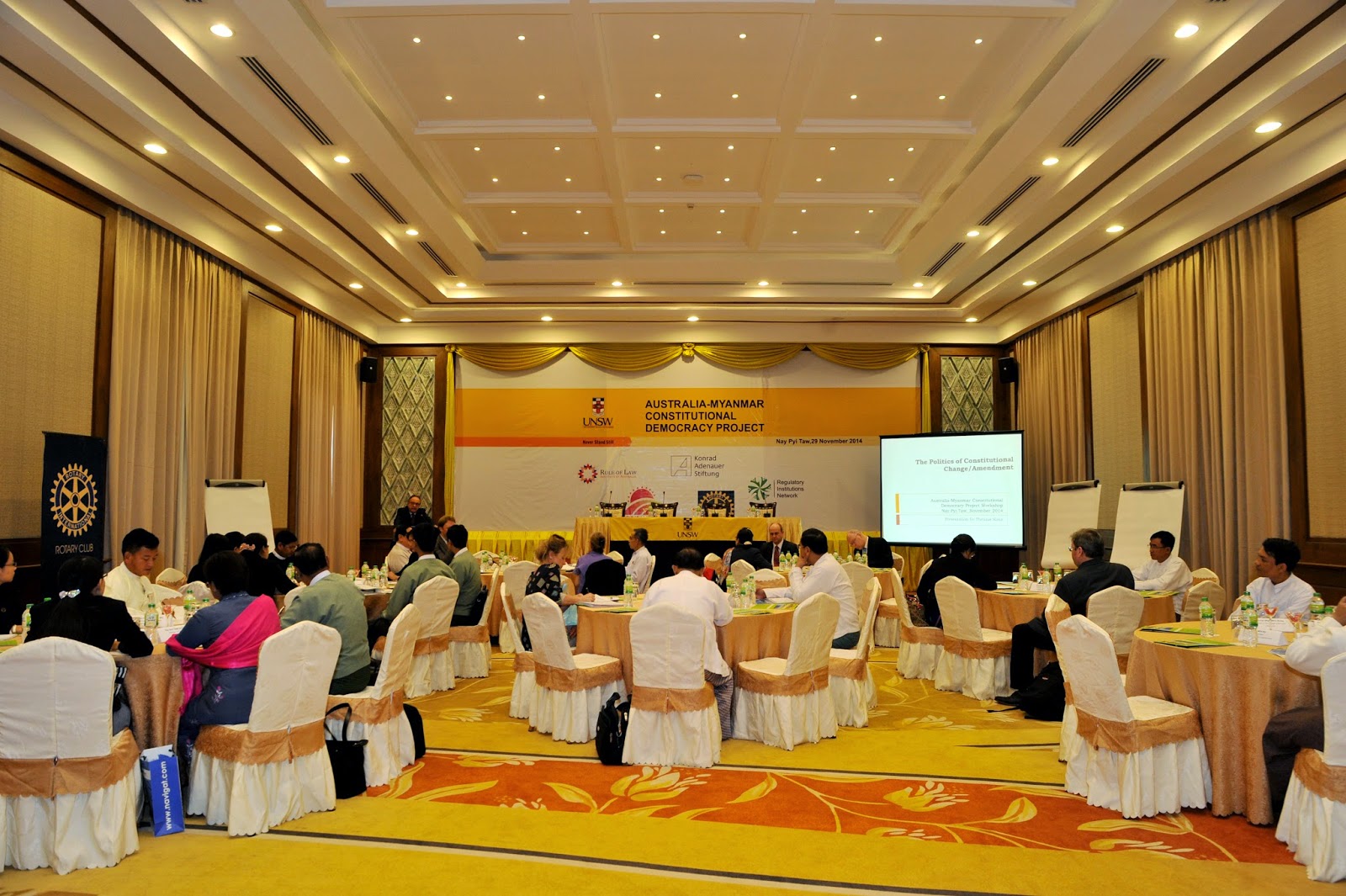
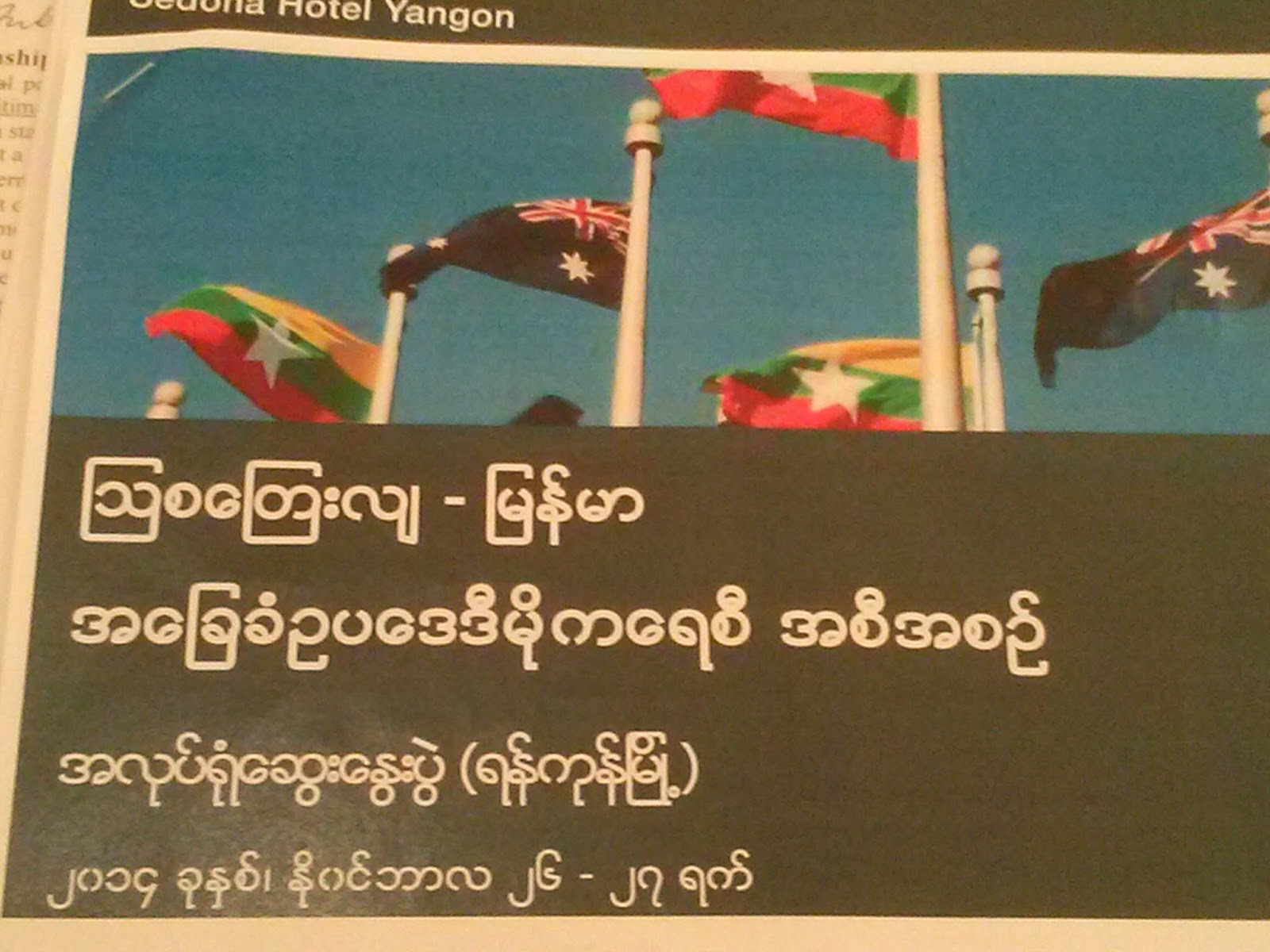
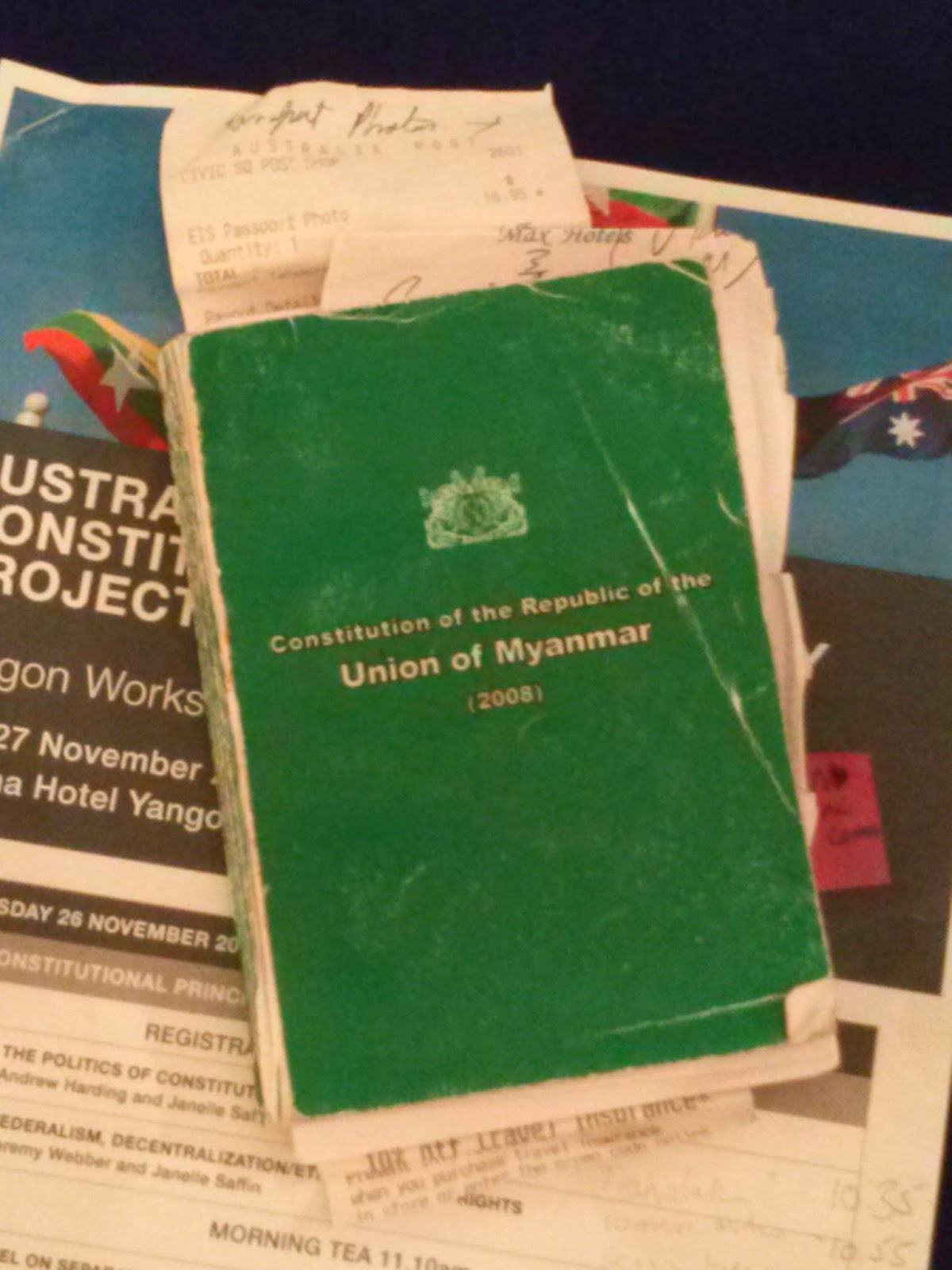
On 26-27 November 2014, the Australia-Myanmar Constitutional Democracy Workshop was held at Sedona Hotel in Yangon. Building on the constitutional law workshop held in 2013, this workshop had a particular focus on constitutional principles and institutions. The workshop was hosted by the University of New South Wales, and also included academics from NUS, ANU, Canada and Germany. The workshop was attended by a range of lawyers, legal professionals and NGOs in Yangon. 

I contributed to a panel on the separation of powers, and focused specifically on states of emergency. The constitutional power of the executive to declare a state of emergency continues to present a challenge to the rule of law around the world. For example, in 2014, states of emergency were declared by the governments in Liberia, Sierra Leone and Nigeria respectively, in response to the serious health risk presented by the Ebola virus. Other states of emergency are more controversial and have been declared in response to internal unrest. For example, in August 2014, the Governor of Missouri (United States) declared a state of emergency in the city of Ferguson, after the shooting of an unarmed black teenager by the police led to peaceful protests that at times resulting in vandalism. 

I emphasised that while each emergency may be unique to the local context, they raise similar questions about the limits on this power; the definition of an emergency; and the role of the military. In Myanmar, over the past two years, we have already seen at least nine separate orders issued under section 144 of the Criminal Procedure Code by the General Administration Department that have imposed restrictions on freedom of movement and association. I suggested that this should raise issues of concern because section 144 is supposed to be a judicial power, not an executive power; the General Administration Department is under the Minister of Home Affairs, who is selected by the Commander-in-Chief; and an order under section 144 seems to be a precondition to a constitutional state of emergency. I concluded by suggesting that while the constitutional powers to declare a state of emergency are still of serious concern, that the more immediate issue is the exercise of similar powers under section 144.