Constitution-making in Divided Societies: The Case of Myanmar

On 13 September 2018 I will be speaking at the Center for Constitutional Democracy, Indiana University Maurer School of Law, Indianapolis, on “Constitution-Making in Divided Societies”.


Calls for constitutional reform persist in many countries around the global. Constitutional design and participation in constitution-making presents particular challenges in divided societies. Demands for constitutional change are often perceived as an unwanted critique of the current political regime and for this reason are highly controversial, even deadly. This is the case in Myanmar, where in January 2017, the most prominent lawyer and advocate for constitutional reform, U Ko Ni, was brutally assassinated. His death is an illustration of the intense struggle for constitutionalism in Myanmar. My presentation will consider how and why Myanmar’s 2008 Constitution was drafted, and how it has been implemented. In doing so, I will examine the principles and ideas that animate the Constitution. Contrary to analysis that priorities personalities and power plays, I suggest that Myanmar also needs to be understood through the lens of the 2008 Constitution and the structures and rules it embodies.  This presentation is based on my forthcoming book, The Constitution of Myanmar (Hart, 2019). I demonstrate the new lines of inquiry that Myanmar can open up in the field of comparative constitutional law and the way that Myanmar’s Constitution in particular calls us to pay greater attention to constitutional legacies.

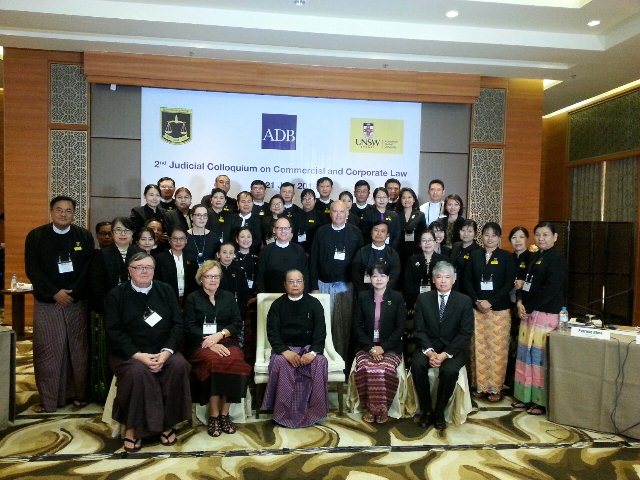
Myanmar Judicial Colloquium

The 2nd Judicial Colloquium on Commercial Law is being held this week with the Union Supreme Court of Myanmar. The Colloquium is part of a project by UNSW Law and the Asian Development Bank to support the handling and adjudication of commercial disputes by the courts. We are delighted to have Justice Reyes, Justice Bergin and Justice Heath contribute, as well as insolvency practitioners John Martin and Scott Atkins.

Association of Mainland Southeast Asia Scholars events

Next week there are several events organised by the Association of Mainland Southeast Asia Scholars, at the Asian Studies Association of Australia conference at the University of Sydney

See the full program, but note the following AMSEAS events

Tuesday 3 July 2018

5:00-5:45pm AMSEAS Subregional Keynote with Professor Katherine Bowie, room ABS LT 2080; 

5:45-6:30pm AMSEAS AGM, same room; 

followed by AMSEAS Drinks – The Rose Hotel on Cleveland St across from the Seymour Centre; 

Dinner – Thai Tha Hai restaurant, a block up on Cleveland St

Constitutional Law in Asia: Special Issue

The International Journal of Constitutional Law has recently published a special issue on constitutional law in Asia, and the articles are free to download online. It includes:


Directive principles and the expressive accommodation of ideological dissentersTarunabh Khaitan
Dictators, democrats, and constitutional dialogue: Myanmar’s constitutional tribunalMelissa Crouch
Judging socio-economic rights in Hong KongMichael Ramsden
Constitutionalizing administrative law in the Indian Supreme Court: Natural justice and fundamental rightsRaeesa Vakil
A storm of unprecedented ferocity: The shrinking space of the right to political participation, peaceful demonstration, and judicial independence in Hong KongJohannes Chan

And more….download here.

The Army and the Indonesian Genocide

In Indonesia, the massacre of approximately one million unarmed civilians in 1965-66 has been depicted as the outcome of a spontaneous uprising against people believed to be communist party members or associates. Dr Jess Melvin has used documents from the former Indonesian Intelligence Agency’s archives in Banda Aceh to shatter the official propaganda account of the mass killings and prove the military’s agency behind the events. Her book, The Army and the Indonesian Genocide: Mechanics of Mass Murder, tells the story of the 3,000 pages of top-secret documents that comprise the “Indonesian genocide files,” along with the previously unheard stories of 70 survivors, perpetrators, and eyewitness of the genocide in Aceh.

Date: 27 June 2018

Time: 1-2pm, UNSW Law School

Register for the event here


About the Speaker

Jess Melvin completed her PhD, ‘Mechanics of Mass Murder: How the Indonesian Military Initiated and Implemented the Indonesian Genocide, the Case of Aceh’ at the University of Melbourne in 2015. She was Rice Faculty Fellow in Southeast Asian Studies and Postdoctoral Associate in Genocide Studies at Yale University in 2016-2017. She is currently a Postdoctoral Associate with the Sydney Southeast Asia Centre at the University of Sydney. Dr Melvin is the author of The Army and the Indonesian Genocide: Mechanics of Mass Murder (Routledge, 2018).

The Politics of Courts and Legal Culture

Law and Society Association Panel 2018


Panel Title: The Politics of Courts and Legal Culture: Indonesia’s Judiciary and the Legacy of Dan S Lev


This panel presents a series of related papers around the broader theme of legal culture and the role and function of courts in Indonesia. Twenty years on from Indonesia’s democratic transition, and there has not yet been a thoroughly analysis of how and why Indonesia’s courts have changed, and what this says about the contested concept of legal culture today. A true pioneer in this area is the late Professor Dan S Lev. His work was grounded in a socio-legal approach to the study of law, and his work spans an impressive range of themes related to courts, judges, lawyers and politics in Indonesia from the 1960s to 2000s. The three papers in this panel seek to reinvigorate and affirm the importance of Lev’s work for the study of courts in Indonesia today. Offering new and empirically informed perspectives on important developments in the courts, this panel seeks to bring the study of Indonesian courts into the broader view of literature and debates on the politics of courts.


Chair: Professor Frank Munger, New York Law School

Paper 1: Judges, Courts and Legal Culture in Indonesia: The Legacy of Dan S Lev

Abstract: Indonesia’s extensive court system supports the world’s third largest democracy and a growing economy. The court system in Indonesia has changed and expanded rapidly since 1998, with the introduction of a wide range of specialized courts. My paper reflects broadly on this phenomenon through the seminal and groundbreaking work of the late Professor Dan Lev. Lev’s work offers important foundational theories in the study of lawyers and the legal profession in Indonesia; legal aid and the role of activists against the state; the role of judges and the courts; and the importance of understanding the politics of law more broadly. While I suggest that these themes offer an important baseline for the study of courts in Indonesia, the judicial landscape has clearly changed dramatically with the creation of a specialized Constitutional Court, Tax Court, Human Rights Court, Fisheries Court, Anti-corruption Court, Commercial Court and Industrial Relations Court. These specialized courts often seek to disrupt existing pathologies with the general court system in an attempt to circumvent the cycles of corruption, such as by appointing a majority of ad hoc judges (from outside the career judiciary) to the bench. They also seek to promote and maintain specialized expertise within the judiciary. question the extent to which Lev’s work can help us understand this phenomenon. I argue that his methodological and theoretical approach to Indonesian law remain of relevance to the study of courts, and that many of his formative ideas can be built upon and extended in a way that enhances understanding of the role of courts in contemporary Indonesia.


Author: Dr Melissa Crouch is a Senior Lecturer at the Law Faculty, the University of New South Wales, Sydney. Her research contributes to the field of Asian Legal Studies, with a concentration on Law and Development; Constitutional Change; and Law and Religion. Her research has a particular focus on Indonesia and Southeast Asia, where she has conducted extensive socio-legal field research. Melissa is the author of Law and Religion in Indonesia: Conflict and the Courts in West Java (Routledge, 2014). She is the editor of The Business of Transition (Cambridge University Press, 2017);  ‘Islam and the State in Myanmar‘ (Oxford University Press, 2016); and Law, Society and Transition in Myanmar (2014, Hart Publishing). Melissa has published in a range of peer-reviewed journals, including International Journal of Constitutional Law, Sydney Law Review and Asian Legal Studies

Paper 2: The District Courts in Indonesia

Abstract: This chapter is divided into two parts: first, an introductory section describing the civil and criminal jurisdiction, procedural framework, judicial personnel and legal development of Indonesia’s District Courts (Pengadilan Negeri) since the fall of Suharto in 1998.  The chapter’s second part will comprise an empirical study of the determinants of sentence severity in murder cases in Jakarta’s District Courts.  Indonesia is a civil law jurisdiction within which trial judges are afforded an exceedingly wide sentencing discretion in murder cases.  It is commonly assumed that sentences in Indonesian murder cases are more severe, extending to the death penalty, when the case involves sadistic and unnatural acts, a repeat offender, multiple victims, public opprobrium, or separatist motivation (Haryoso, 1997).  This chapter’s case study, based on online case law data collection from Jakarta’s four District Courts (Central, East, South and West), together with interviews with several judges from those institutions to be conducted in February 2018, aims to ascertain the determinants of sentencing severity in post-1998 Jakarta murder cases, to confirm or deny existing assumptions about the operative criteria, and within the broader aims of the edited volume, to determine what District Court sentencing patterns reveal about Indonesia’s broader judicial culture.


Author: Dr Daniel Pascoe is an Assistant Professor at the School of Law, City University of Hong Kong.  He received his undergraduate degrees in Law and in Asian Studies (Indonesian) from the Australian National University, and his Master of Philosophy in Criminology and Criminal Justice and Doctor of Philosophy in Law degrees from the University of Oxford, where he was the Keith Murray Graduate Scholar at Lincoln College.  Daniel has published on crime and punishment in a number of Southeast Asian jurisdictions, including Indonesia.  His first monograph, entitled ‘Last Chance for Clemency: Clemency in Southeast Asian Death Penalty Cases’ is forthcoming with Oxford University Press.

Paper 3: Indonesia’s Industrial Relations Courts

Abstract:  How should we approach the study of the various special courts that have proliferated in Indonesia since the fall of the New Order? In particular, can we see the new special industrial relations courts as successfully having judicialized labor rights? Building on a thorough examination of their historical antecedents, legal origins and structure, this article focuses on a careful review of cases brought before the industrial relations court. This chapter provides a critical reflection and assessment of labor rights protection and litigation in Indonesia today.

Author: Dr William Hurst works on labor politics, contentious politics, political economy, and the politics of law and legal institutions, principally in China and Indonesia.  He is currently completing a book manuscript on the comparative politics of law and legal institutions in China and Indonesia since 1949.  For this work he has completed more than one year of fieldwork in each country since 2006. Before coming to Northwestern in 2013, he was a postdoctoral fellow at Oxford and an assistant professor at the Universities of Texas and Toronto. He is an active participant in the department’s strength areas on Asian Politics and Law & Politics.


Paper 4: Legal institutions as an approach: the theoretical importance of Dan Lev’s work

Dan Lev is mainly remembered as an inspiring Indonesianist, a member of the legendary Cornell-group established by George McTurnan Kahin in the 1950s.  Outside of Indonesianist circles his name is not often mentioned and his work seldom referenced. Yet, the approach Lev used to look at the Indonesian legal system has all the characteristics of a law and society scholarship that is universally applicable and that deserves to be more widely recognised. This paper explores these characteristics of Lev’s work, locates them in the broader field of law and society approaches developed by his contemporaries, and critically discusses what their use is. It will argue that the main reason for the relative ignorance of Lev’s work is the fact that he never articulated his approach very explicitly, that he thought of himself primarily as a political scientist, and, in the end, that he was happy to be an Indonesianist.


Bio: Adriaan Bedner is KITLV Professor of Law & Society in Indonesia at the Van Vollenhoven Institute for Law, Governance and Society, Leiden University. His research has a particular focus on access to justice, dispute resolution and the judiciary. This has led to publications on a wide variety of subjects, ranging from administrative courts and environmental litigation to human rights promotion in marriage law regimes and Indonesian legal education.
Politics in Southeast Asia 2018

Missed Sydney’s Southeast Asia event on Politics in Action 2018? Videos of the talks are available here:

Southeast Asia: Authoritarian Advances and Limits, Professor Gary Rodan
Philippines: Recent Trends and the War on Drugs, Dr Jayeel Serrano Cornelio from Ateneo de Manila University. 
Indonesia: Hypernationalism and pilkada, Dr Charlotte Setijadi, ISEAS
Malaysia: New Malaysia, GE14 and Beyond, Associate Professor Bridget Welsh, John Cabot University
Laos: Authoritarian Nation-Building and Sovereignty, Dr Keith Barney, ANU
Southeast Asia: A Review of 2018, Dr Melissa Crouch, UNSW

Criticising Judges and the Courts

The Gilbert + Tobin Centre of Public Law is hosting a Public Lecture on criticising judges and the courts by the Hon Geoffrey Ma, Chief Justice of the Hong Kong Court of Final Appeal on Thursday 24 May at 6.30 pm. This will be followed by a reception with drinks and canapés. see link for more.


The Basic Law of Hong Kong brought about a new constitutional order in 1997 based on the idea of ‘one country, two systems’. The Court of Final Appeal was established as Hong Kong’s highest appellate court and has a significant case load in public law. It operates in what its current Chief Justice has called an established common law jurisdiction that has been in place for nearly 180 years. Some of Australia’s most distinguished jurists have served as overseas non-permanent judges of the Court: Sir Anthony Mason, Sir Gerard Brennan, Murray Gleeson AC, Robert French AC, James Spigelman AC, Sir Daryl Dawson, Michael McHugh AC and William Gummow AC.


Abstract: ‘Criticising Judges and the Courts: Overstepping the Crease’: 
During the Second World War, as London was being bombed, Winston Churchill asked, ‘Are the courts functioning?’ and when he was told they were he exclaimed, ‘Thank God. If the courts are working, nothing can go wrong.’ This was perhaps a direct reference to the protection of individual and community rights, a responsibility that courts are expected to discharge. Rights include the freedom of speech and other rights such as access to the courts. When the judicial system, which includes the work of the courts and judges, is criticised from the point of view of rights, how do the courts deal with this, for there can be said to be possible conflicts of interest? And what are the limits of the criticism that can be levelled at courts and judges? In this talk, the speaker will address these questions chiefly from experiences gained in Hong Kong, but in truth the questions can well apply to the legal system in most jurisdictions.

Chief Justice Ma was born in Hong Kong in 1956. He studied law and graduated with an LLB from Birmingham University in 1977. After completing the Bar Finals in 1978, he was called to the English Bar (Gray’s Inn) in 1978, the Hong Kong Bar in 1980, the Bar of the State of Victoria in Australia in 1983 and the Bar of Singapore in 1990. He was appointed Queen’s Counsel in 1993. He became an Honorary Bencher of Gray’s Inn in 2004. In 2011, he was admitted to the degree of Doctor of Laws (honoris causa) by the University of Birmingham. In 2012, he became an Honorary Fellow of Harris Manchester College, Oxford.  In 2016, he became an Honorary Bencher of the Middle Temple and was admitted to the degree of Doctor of Laws (honoris causa) by the Chinese University of Hong Kong.

Chief Justice Ma was appointed a Recorder of the Court of First Instance from 2000 to 2001 before his appointment as a Judge of the Court of First Instance in 2001. He was appointed a Justice of Appeal in 2002, and became Chief Judge of the High Court in 2003. Chief Justice Ma was appointed Chief Justice of the Court of Final Appeal on 1 September 2010. Chief Justice Ma is a Patron of the Bingham Centre for the Rule of Law; he is also a Patron of the International Advocacy Training Council. He was awarded the Grand Bauhinia Medal in June 2012.