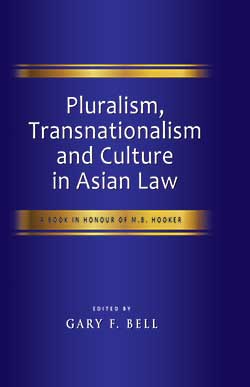
New book Pluralism, Transnationalism and Culture

Professor Gary Bell has recently published an edited volume on “Pluralism, Transnationalism and Culture in Asian Law” (2017) in honor of M B Hooker, a scholar whose work left a significant legacy in the field of Southeast Asian law. It was a privilege to be a part of the international workshop held in 2012. More details of the book can be found here.

The abstract of the book is as follows: “To honour this great scholar, this book gathers essays from admirers and friends who add their own contributions on legal pluralism, transnationalism and culture in Asia. The book opens with an account of M.B. Hooker colourful and prolific career. The authors then approach legal pluralism through legal theory, legal anthropology, comparative law, law and religion, constitutional law, even Islamic art, thus reflecting the broad approaches of Professor Hooker’s scholarship. While most of the book focuses mainly on Southeast Asia, it also reaches out to all of Asia up to Israel, and even includes a chapter comparing Indonesia and Egypt.”

Podcast on Islam and the State

The ANU Myanmar Research Centre has initiated a Myanmar Musings podcast series, led by Luke Corbin.
I recently appeared on the program to discuss my book “Islam and the State in Myanmar.” The podcast is available here .
A range of other great podcasts are available, including recent podcasts with Nick Cheesman (ANU) on his book Opposing the Rule of Law, and with Jane Ferguson on Making Sense of the Census.

UAGO Trainings in Myanmar

On 8-11 May 2017, UNSW Law together with the Asian Development Bank hosted a workshop on Commercial Law for law officers of the Attorney General’s Office and selected government ministries in Naypyidaw, Myanmar. In collaboration with lawyers from Baker & McKenzie and Allen & Overy, the trainings covered Major Projects, Project Finance and International Investment Agreements. This training is part of a larger project on Professional Legal Education in Commercial and Corporate Law in Myanmar.

Ahok, Indonesia’s ‘Nemo’, sent to jail

This article was first published in The Policy Forum, 10 May 2017
What do Nemo, the Archangel Gabriel, a martial arts teacher, and a man who whistled during prayers have in common? They have all been convicted by a court for blasphemy in Indonesia.

Yesterday the global community was shocked by the court verdict in Jakarta, the teeming capital city of the world’s largest Muslim-majority democracy. The outgoing Governor of Jakarta who referred to himself as ‘Nemo’, Basuki Tjahaja Purnama (Ahok), was found guilty of blaspheming Islam.

So not only did Ahok lose an election that he was originally expected to win, but he also lost the biggest blasphemy court case in the history of Indonesia.

Many have commented on the fact that Ahok is a Chinese-Christian. Yet Ahok is not the first Chinese Indonesian, nor the first Christian, to be found guilty of blaspheming Islam, as my book on Law and Religion in Indonesia explains.

In 1997, a Chinese-Indonesian man and his wife were found guilty of blaspheming Islam after they confronted youths in a mosque about the level of noise from the call for prayer. In 2007, a group of 41 Christians were found guilty of blaspheming Islam after stepping on the Qur’an, among other offensive actions.

Ahok, though, takes the crown for the most high profile blasphemy case, and sets a record as the first Governor of Jakarta to be convicted of blasphemy.
The trial had become something of a circus, with the proceedings streamed live on national television.

The reason the legal outcome was so surprising to some is that the judges ignored the recommendations of the prosecution. When the court case recommenced the day after the elections, the prosecution had requested that the court convict Ahok for the lesser offence of expressing hostility towards the Muslim community under section 156 of the Penal Code and impose a suspended sentence of two years. Instead, the court found Ahok guilty of the more serious offence of blasphemy under section 156a, and sentenced him to two years in jail.
There have been volumes of commentary on the political dimensions of the recent Jakarta elections for governor. Yet the legal dimensions and the role that the courts have had to play in Ahok’s downfall has surprisingly been overlooked and largely ignored.

The criminal accusations of blasphemy against Ahok were part of a broader legal battle in Indonesia between the courts and the executive, and between religious authorities and the state.
First, the battle between the courts and the executive is evident in the courts’ blatant disregard for the prosecution’s submission. It is unusual that more has not been said about the prosecution’s recommendations for conviction under section 156, rather than 156a, and the two year suspended sentence. This request appeared like a rather convenient concession to Ahok, the day after his resounding defeat at the polls.

The courts, it seems, were not having any of this. That anyone thought that the courts might simply accept the prosecution’s suggestion demonstrates the lack of understanding of the nature of judicial ‘independence’, or what I call judicial defiance, in Indonesia.
Indonesia’s judges are fiercely protective of their independence to a point that it now borders on a gross lack of accountability. On one hand, many commentators have lauded Indonesia’s structural changes in the early years of the transition that introduced ‘one roof’ reforms. These reforms transferred all judicial powers and functions to the Supreme Court, away from the Ministry of Law.

This was supposed to be a move to enhance judicial independence. However, given the numerous attacks against the Judicial Commission, a body designed to balance judicial independence with judicial accountability, judicial ‘independence’ has come out trumps. Judges have used the idea of judicial independence to defy any real or perceived efforts by the executive and legislature to keep them accountable and limit their discretion.

This judicial defiance manifests itself in a range of ways, such as the refusal of some judges to impose a legislative mandatory minimum sentence. These judges reason that no one should be able to tell them what to do. Judges know best with sentencing, they claim, and neither parliament nor the prosecution can limit their freedom in this regard. The judiciary in Ahok’s case clearly seemed to have little regard for the prosecution.

The second legal battle that has taken place is one between religious authorities and the courts. The courts have had to tread a delicate line when it comes to religious-related crimes. In blasphemy cases, the courts have adopted what I call an attitude of ‘religious deference’. That is, the courts will generally acquiesce to the demands of a religious group, preferring not to have to decide on the thorny religious issues themselves. 

In Ahok’s case, even firebrand Islamist Rizieq Shihab was called as an ‘expert witness’ during the trial. That the court was willing to entertain such an inflammatory character should have been a cause for alarm. Further, its verdict appears to affirm the controversial claims by a fringe group of Muslim religious authorities that Ahok’s words had blasphemed Islam.

Ahok has already indicated that he will appeal. While many political analysts assumed that the show was over after Election Day, it seems that in fact the show has only just begun.

It’s not all gloom ahead for Ahok. There have been blasphemy cases where the accused has been successful on appeal. In fact, in the blasphemy case of the staff of a controversial Islamic drug and cancer rehabilitation centre, they were acquitted on appeal. Ahok may not be so lucky.

There is one difference though between the Archangel Gabriel, a martial arts teacher, a man who whistled during prayers, and Ahok. The difference is that Ahok is probably the most well-resourced person (in terms of money, legal connections and political influence) to be convicted for blasphemy. So rather than just feeling sorry for Ahok, spare a thought for all the other Nemos who have discovered the high legal price of swimming against the tide in Indonesia.

Dr Melissa Crouch is a Senior Lecturer in the Law Faculty at the University of New South Wales. She is the author of Law and Religion in Indonesia (Routledge 2014).
Elections in Jakarta a fight to the end

Residents of Jakarta go to the polls tomorrow (19 April) to choose a governor in one of the closest and most controversial elections Indonesia has seen.
Here are some of my recent pieces on the issues plaguing Ahok, the current governor, and his bid for election.
What do blasphemy charges mean for Ahok? Indonesia@Melbourne
Blasphemy charges against Ahok a triumph for Islamists in Indonesia, East Asia Forum
Islamist Rule by Law in Indonesia, Policy Forum

The future of justice sector reform in Myanmar

On Friday 31 March 2017, I gave a talk at the World Bank office in Yangon on The Future of Justice Sector Reform in Myanmar. I reflected on the progress that has been made under the Thein Sein government and then the first year of the NLD, as well as areas in which progress still needs to be made. Unlike other regions of the world such as Latin America, where law and development support has evolved over many decades and gone through stages of judicial reform, access to justice, rule of law and informal justice focus, in Myanmar support for various aspects of the justice sector is occurring in an incredibly short space of time. I reflected upon the assassination of U Ko Ni as a potential turning point for the law reform process and for issues of conflict and state fragility. He was also an example of a lawyer who had contributed greatly to many justice sector projects and was able to bridge old and new ways of practicing law in Myanmar. Emerging areas of law such as commercial and corporate practice are likely to continue to change dramatically with the recent introduction of the new investment regulations 2017, and the forthcoming revisions to the Company Act. A range of other draft corporate and commercial laws remains in progress, including a draft patent law, copyright law, anti-dumping law, information technology law, and insolvency law. There is a need to ensure support and education both for government ministries that will be in charge of administering these lawyers, as well as for the new generation and pioneers of commercial legal practice in Myanmar.

Myanmar’s Advocate for Constitutional Reform

‘Saya’ U Ko Ni: Myanmar’s Advocate for Constitutional Reform

On 29 January 2017, U Ko Ni, a prominent lawyer and legal advisor to the National League for Democracy (NLD), was brutally assassinated at Yangon International Airport. He was returning from a trip to Indonesia with the Information Minister, U Pe Myint. His untimely death is an unspeakable loss for the country.

Great potential as well as great dangers have been unleased in Myanmar following its political and legal transition away from military dictatorship since 2011. As the reform process gained momentum in 2012, U Ko Ni became an outspoken advocate for reform of the Constitution, and was well-known as a legal advisor to the National League for Democracy (NLD). He was also one of the few well-known public figures who are Muslim in majority-Buddhist Myanmar.


In this article, I offer a modest tribute to a man who must be remembered for many years to come for his role as Myanmar’s advocate for constitutional reform. U Ko Ni was a cause lawyer whose advocacy was for law itself, which is a critical cause in contemporary Myanmar. As Cheesman and Kyaw Min San have shown, the role of such cause lawyers in Myanmar is to insist ‘that legal norms ought to matter, despite empirical facts suggesting otherwise’….

The full article can be downloaded for free at SSRN: Melissa Crouch (2017), Saya U Ko Ni, Myanmar’s Advocate for Constitutional Reform, 17(1) Australian Journal of Asian Law.

Supreme Court visits UNSW Law

On Monday 20 March 2017, a delegation from the Union Supreme Court of Myanmar visited the University of New South Wales Law faculty in Kensington, Sydney.
UNSW Law is currently partnering with the Supreme Court to collaborate on a Judicial Colloquium on Commercial and Corporate Law.
Daw Yin Myo Suu, an officer of the Union Attorney General’s Office and a current LLM student at the University of New South Wales, shared her experience of studying law in Australia.

UNSW Event Sydney: Dr Thant on publication trends and books in Myanmar

Upcoming event at UNSW on books in Myanmar

There is now more opportunities than ever before to promote education and knowledge through public libraries in Myanmar. Yet because it has been closed for so long to the outside world, Myanmar is facing numerous challenges ranging from the lack of infrastructure to human resource capacity. This presentation will focus on recent trends in the publication of books published in Myanmar in both English and Burmese. The presentation will cover reading promotion efforts by two of the main local NGOs; Myanmar Book Aid and Preservation Foundation and the Daw Khin Kyi Foundation which is chaired by Ms Aung San Suu Kyi.

Bio of Speaker: Dr Thant Thaw Kaung is CEO and founder of Myanmar’s leading book importer and distributor, the Myanmar Book Centre. He also founded and is Executive Director of the Myanmar Book Aid and Preservation Foundation. This NGO has so far donated over one million books to over 900 libraries in Myanmar as well as preserving old and rare palm leaves, paper manuscripts, books and other documents on Myanmar. Dr Thant Thaw Kaung’s other positions include, Executive Director of the Yangon Heritage Trust, Executive Committee member of the Daw Khin Kyi foundation.

Australia-Myanmar Constitutional Democracy Project, organizer of UNSW Event Sydney: Dr Thant on publication trends and books in Myanmar. The Australia Myanmar Constitutional Democracy Project is currently facilitated by UNSW Law and, since 2013, has run nine high level constitutional literacy workshops in Myanmar

Fri, March 3, 2017, 6:00 PM – 7:30 PM        
Location: Staff common room, Level 2
Law Building, F8, Kensington Campus
UNSW Sydney, Sydney, NSW 2052

Register here