Podcast updates on Southeast Asia

Missed the Sydney Southeast Asia Centre conference on Politics in Asia?

Podcasts by each of the speakers are now available online

Allen Hicken on Southeast Asian Politics
Mark Thompson on the Philippines
Melissa Crouch on Myanmar
Michael Barr on Singapore
Jacqui Baker on Indonesia
Aderito Soares on East Timor
Jonathan Bogais on Cambodia
Meredith Weiss on Malaysia
Aim Sinpeng on Thailand

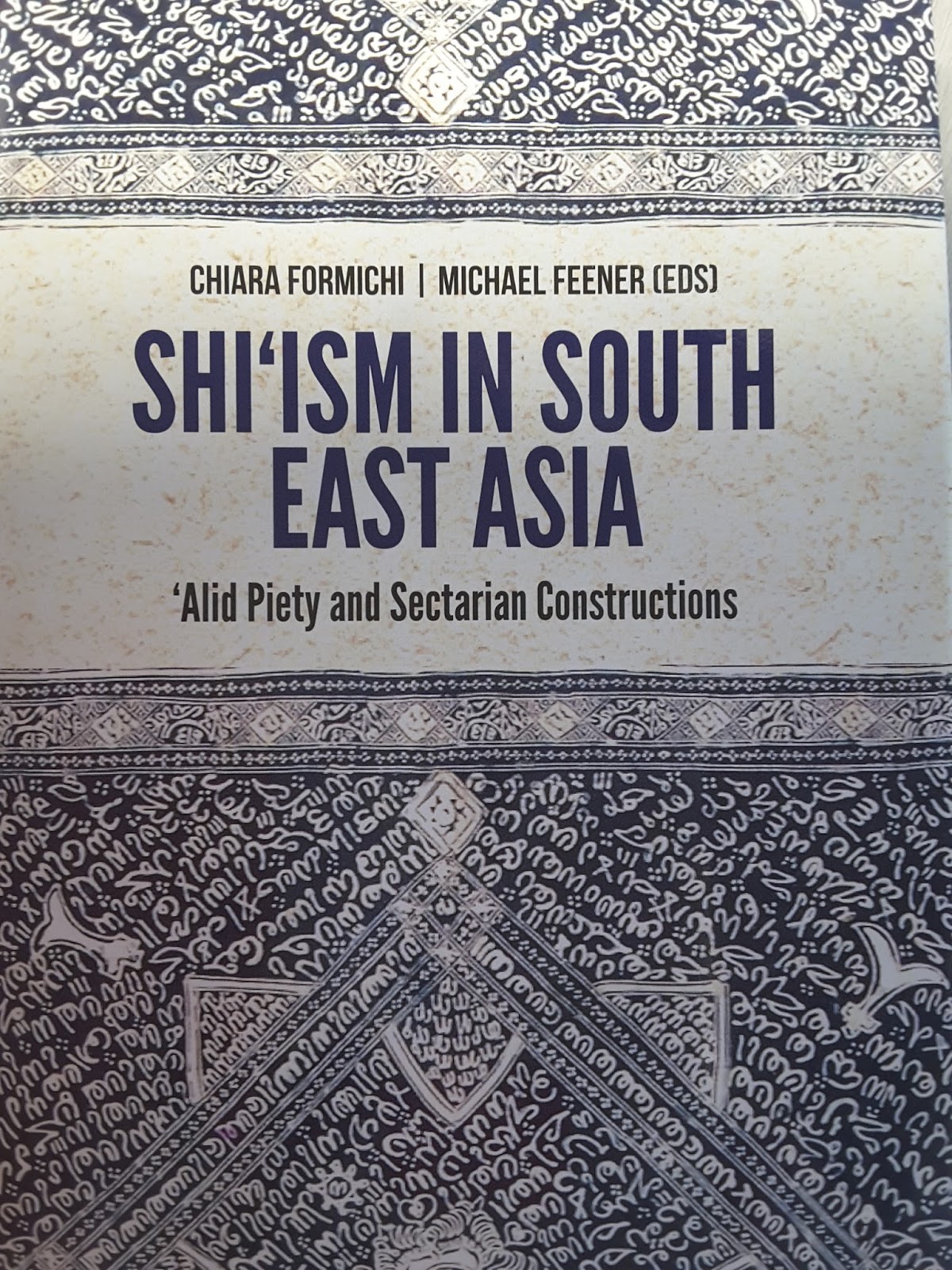
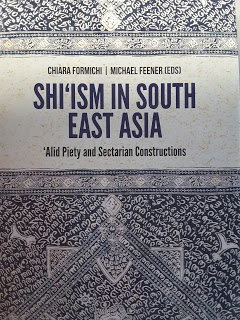
Book Review: Shi’ism in Southeast Asia

Shi’ism in Southeast Asia: ‘Alid Piety and Sectarian Constructions. Edited by Chiara Formichi and R. Michael Feener, 2015. Oxford University Press, 2015. 397 pages. $65.00 (hardcover), $36.99 (e-book)


This book review was first published online in the Journal of the American Academy of Religion (2016). The article is available for free in pdf download from that site.


In 2013, a major case was brought to the Indonesian Constitutional Court challenging the Blasphemy Law, which has often been used over the past decade to imprison people who are found to offend the orthodox teachings of Sunni Islam. This court case was brought by several Shi’ites, some of whom had been convicted for blaspheming Sunni Islamic teachings. The court case came in the wake of a recent rise in religious intolerance, condemnation, criminal convictions, and violence against the Shi’ite community in Sunni-majority Indonesia. Although the applicants were unsuccessful in their petition to the Constitutional Court, the broader claims that Shi’ites are part of the Muslim community and religious fabric in Indonesia were unmistakably clear. Yet despite both the contemporary relevance and historical significance of Shi’ism to the region, the Shi’ite community and its influence on religious practice past and present is understudied in the academic sphere.


The book Shi’ism in Southeast Asia pioneers new scholarship in the field of Islamic studies, history, and religious studies by offering a thoughtful collection of essays on Shi’ite Muslims in Southeast Asia. The book is the outcome of a conference organized by the Religion and Globalisation cluster at the Asia Research Institute (ARI) of the National University of Singapore. For the past seven years (2009-2015), scholars at ARI have been forging new research ground under the leadership of Professor Michael R. Feener (now at Oxford University). This volume is the outcome of a project led by Chiara Formichi (formerly a research fellow at ARI, now of Cornell University) and Feener. In the volume, Formichi and Feener bring together experts in the fields of Islamic studies, history, comparative literature, anthropology, and the humanities who are located at institutions from Australia, the United States, Asia, and Europe. Their contributions offer a rich and historically informed analysis that seeks to set a new agenda for research in this area.


This book is of direct relevance to religious studies scholars who are interested in the study of religious sects in general and Islam in particular. Most studies of Shi’ism to date are geographically focused on the Middle East. Much has been written on the 1979 Iranian Revolution and its broader influence in the Muslim world. Studies of Shi’ism often position Shi’ism in direct contrast to Sunni Islam, and focus on the Imami or Twelver Branch of Shi’ism as the largest sect within Shi’ism. In contrast, this book helps to widen the focus in three ways.


First, it broadens the locational focus beyond the Middle East to Southeast Asia and ranges in its geographic coverage from Thailand and Malaysia to Singapore and Indonesia. Yet the region is not studied in isolation; rather the deep historical connections to the regions that we know today as South Asia, Central Asia, and the Middle East are also considered.Second, the book extends far back to retrace the historical legacy and influence of Shi’ism in Southeast Asia, emphasizing both its deep historical past, the way it has changed over time, and its contemporary relevance. It stresses the historical importance of Shi’ism to the region, such as the evidence of references to Ali and Fatima in various manuscripts that were written in languages common to Southeast Asia. By bringing this historical legacy into the present contemporary era, it is ambitious in its breadth and scope.


Third, the volume is concerned with the highly pluralistic manifestations of Shi’ism in Southeast Asia and the way in which it has influenced, and been influenced by, local cultures and traditions. As this volume points out, the syncretic and pluralist nature of Shi’ism in Southeast Asia has long been recognized. In doing so, the book cautions against the modern tendency to view Shi’ism in contrast to Sunni Islam in a polemic way. Instead Formichi and Feener advocate for a deeper appreciation of the past legacy of Shi’ism in the region and attention to both the points of change and continuity that mark the Islamic community today.


As a way of uniting the chapters, the book is centered around the concept of ‘Alid piety as a means “to understand the importance of the Prophet’s family (Ar. ahl al-bayt) as they appear in diverse religious, literary and cultural expressions of Islam” (4). The volume is structured into four parts: historical foundations, literary legacies, cultural expressions in the modern period, and contemporary developments. This structure helps to tie together chapters that share common themes. This volume marks an important beginning of a new trace of research in this area.


The impression this book leaves is of the significant legacy of Shi’ism in religious texts and in local ritual practice. This legacy defies the overly simplistic divide between Sunni and Shi’ite Muslims and should cause scholars in the field to rethink the conventional concepts so often employed in this area. In this way, it represents a challenge to existing orthodoxies of knowledge in Islamic studies. Shi’ism in Southeast Asia will provide a basis and platform for future scholarly debate in the field. This is important because, as the recent Constitutional Court case concerning Shi’ite Muslims in Indonesia demonstrates, the need to understand the Shi’ite community, its origins, and its influence on Islamic thought in the region, remains of vital concern. 

UI UNSW Scholars Dialogue

On Monday, August 1, 2016, Universitas Indonesia and University of New South Wales (UNSW) Australia held a collaborative scholars dialogue at Auditorium Soemadipradja & Taher (SnT), Faculty of Law, UI Campus, Depok. Twenty-four prominent scholars from UNSW and UI delivered their field of expertise at the event. The event was organized to implement the MOU between UI and UNSW. For UI’s write up on the visit, see here.

The Rise in Religious Intolerance in Indonesia

From Wednesday 24 August to Friday 26 August 2016, a workshop will be held in Jakarta on the broader theme of  ‘The rise in religious intolerance in contemporary Indonesia’. The workshop is organised and funded by the Indonesia Studies programme at the S Rajaratnam School of International Studies (RSIS), Nanyang Technological University, Singapore. The workshop will be attended by a range of local and international academics, including key advocates from organisations such as Setara Institute and Wahid Institute.

The program for the conference is as follows:
First Session: Intolerance in General Context

Paper Title : “Blaspheming Islam: The Courts and Fatwa in Indonesia”Speaker : Dr. Melissa Crouch (Senior Lecturer at Faculty of Law, University of New South Wales, Sydney, Australia)


Paper Title : Faith and Friendship: Religious Bridging and Religious Tolerancein the Muslim World

Speaker : Nathanael Gratias Sumaktoyo (Ph.D Candidate at Department of Political Science, University of Notre Dame, US)


Paper Title : “Jihads of the Pen: Histories of Islamist Intolerance in Modern Indonesia

Speaker : Dr. Teren Sevea (Assistant Professor, Department of South Asian Studies, University of Pennsylvania Visiting Fellow at Nalanda Sriwijaya Centre ISEAS-Yusof Ishak Institute, Singapore)


Paper Title : “Religious Intolerance as a Reflection of Governance Failure”Speaker : Dr. Airlangga Pribadi Kusman (Lecturer at School of Social and Political Sciences, Universitas Airlangga)


Second Session: Local Traditions and Beliefs

Paper Title : TBA

Speaker : Syafiq Hasyim (Deputy Chairman of Lembaga Perguruan Tinggi Nahdlatul Ulama)


Paper Title : The State’s Paradoxical Policies on (Indigenous) Religions: Praised, but Discriminated

Speaker : Dr. Samsul Maarif (Secretary and Lecturer of Center for Religious and Cross-cultural Studies (CRCS) Gadjah Mada University (UGM))


Paper Title : “Rising of the Neo-Padri in West SumatraSpeaker : Adri Wanto (Associate Research Fellow at the Indonesia Programme, IDSS, RSIS Singapore)


Third Session: Cases of Institutionalized Intolerance

Paper Title: Practicing What It Preaches? Understanding the Contradictions between Pluralist Theology and Religious Intolerance within Indonesia’s Nahdlatul Ulama”

Speaker : Dr. Alexander R. Arifianto ( Research Fellow at the Indonesia Programme, IDSS, RSIS Singapore)


Paper Title: “Between Conflict and Harmony: Localising the Spectrum of Religious Intolerance on Shia Muslims in Indonesia: Case Study on Sampang and Jepara”


Speaker : Hertasning Ichlas (Lecturer at Faculty of Law, Universitas Pelita Harapan; Executive Director of Yayasan Lembaga Bantuan Hukum Universalia) 

The constitutional implications of Myanmar’s peace process

This article was commissioned by International IDEA and was originally posted on ConstitutionNet, IDEA’s online knowledge platform supporting constitution builders globally. Read more

The National League for Democracy (NLD) is leading a major peace process that could see not only an end to decades of conflict against armed ethnic groups, but also a way forward for the future. If an agreement can be reached, this will undermine the military’s efforts to block constitutional reform.


Peace remains an elusive goal in Myanmar. Conflict with armed ethnic groups continues in parts of Shan State and Arakan State. This is one of the biggest challenges facing the new NLD government. The revamped peace process is a critical part of the NLD’s agenda and an important step to possible constitutional reform.


As part of the peace process, the NLD has announced there will be a 21st Century Panglong Conference, the first of which is planned for August 2016. The Panglong Conference is seen as a crucial process in the ongoing negotiations with ethnic armed groups. The NLD government considers the peace and reconciliation process as a precondition to constitutional reform, while some ethnic groups have emphasized the necessity of reform for reconciliation.


Given the diverse ethnic composition of Myanmar with eight main ethnic groups (the Burmans, Shan, Kachin, Chin, Karen, Kayah, Mon and Rakhine) and the long history of ethnic armed opposition against the military regime, an agreement among these groups is vital. The success of the peace process requires serious reconsideration of notions of ethnic identity. Historical exclusions and rigid and inaccurate classifications underlie the current forms of special recognition. The arrangements in the 2008 Constitution privileging certain ethnic groups over others, crucial to the past military regime’s attempt to maintain legitimacy, are unsustainable.


Panglong and the 1947 Constitution

If you take a visit to the sprawling Defence Services Museum in Naypyidaw, you will find hanging on the wall a copy of the Panglong agreement. The Panglong agreement occupies a special place in the history of the nation. In many respects, it was the main written form of recognition for certain ethnic groups in the lead up to independence.


The 1947 conference at Panglong in Shan State was a meeting between General Aung San, leader of the independence movement, and father of current State Counsellor Daw Aung San Suu Kyi, with representatives of the Shan, Kachin and Chin ethnic groups. The conference resulted in the signing of an agreement that was a crucial step towards Burma’s independence from colonial rule. One of the key aspects of the agreement was the recognition of the “full autonomy” of the ethnic groups in the administration of their internal affairs.  


While there are many myths that surround the legacy of Panglong, it is widely recognised as an important and historic moment in the founding of the nation. Several months after the signing of the agreement, General Aung San’s political party met to put together a preliminary draft Constitution. The draft was submitted to the Constituent Assembly for discussion, debate and revision. The assassination of General Aung San and other members of cabinet disrupted the process, and significant changes to the draft constitution were made after his death.


In its final form, the 1947 Constitution recognised special arrangements for certain ethnic groups. Shan State and Kachin State were created. Kawthulay (Karen) Region was a provisional arrangement, in anticipation that a commission would consider the creation of a Karen State. Karenni State was also formed (although at the time it was anticipated this may merge with Karen State). The Constitution also established Chin Division. There was a constitutional option of secession after 10 years for some of these groups, a provision that generated significant controversy at the time.


Despite these forms of recognition, some ethnic groups later criticized the 1947 Constitution because it differed from the original draft in ways that they felt compromised the initial aspirations for a truly federal system. Further, in 1948-49, the Arakan, Karen, Karenni and Mon ethnic armed groups rose up against the government, which led to a period of serious instability.


Around the same time, the government established a Regional Autonomy Inquiry Committee to discuss the constitutional possibility of creating new states under section 199 of the Constitution. In 1951, after recommendations from the Committee, an amendment to the Constitution granted the Karen the full status of a state, but in turn removed its right to secession.

The Committee declined to recommend the creation of a Mon State or Arakan State, although attempts to establish these states remained ongoing in the 1950s-60s. There was significant opposition in parliament from Muslim minority groups in these areas, who feared the consequences of being ruled by a Mon or Arakan majority. In the end, it was Prime Minister U Nu’s decision not to create more states that stalled the conversation. The ensuing 1962 coup led by General Ne Win was partly a result of concerns over federal aspirations and fears of secession.


Today, the 2008 Constitution expressly prohibits the creation of new states or secession from the Union. But it does create new forms of recognition for certain ethnic groups. These need to be reevaluated in the process of considering options for reform.


Ethnic groups under the 2008 Constitution

Almost 70 years since the first agreement, the 21st Century Panglong conference comes in the wake of shifting government policies on the recognition of ethnic claims. The debate is no longer about secession, although many ethnic groups still demand greater recognition. In considering a way forward, any constitutional proposal as a result of the peace process needs to evaluate the forms of recognition inherent in the 2008 Constitution.


First, the 2008 Constitution retains ethnic-based States corresponding to the seven largest minority nationalities (Karen, Shan, Mon, Kachin, Kayah, Rakhine, Chin), and seven Regions that are majority Burman. Despite the appellation, both states and regions are the same level of government with the same powers. This division of power and territory was first fully crystalised by General Ne Win’s socialist regime in the 1974 Constitution. The recognition of these states and regions is therefore not self-evident, but should rather be seen as a relatively recent construct. In many ways, the linking of certain ethnic identities with territorial claims obscures more than it explains, particularly as ethnic demographics do not map neatly onto state boundaries.

At any rate, the legal and de facto centralization and concentration of power in the Union government under the 2008 Constitution means that the state and regional parliaments have little substantive power. There are no demands for changes to the territorial boundaries of the states and regions or for the creation of new states. There is demand for greater decentralization of power to the states and regions. For example, there have been calls to reform the presidential appointment of the head (chief minister) of the states and regions so that the head is chosen from among the elected representatives of the state/region parliament.


Second, the 2008 Constitution creates the new and unprecedented category of Self-Administered Zones and Divisions. This may have drawn inspiration from the original draft constitution proposed by Aung San and its ideas of differentiated ethnic recognition.  In the 1990s, this idea came to prominence in the drafting of what was to become the 2008 Constitution, at a time when the military regime was offering generous concessions to certain ethnic armed groups who were willing to enter into ceasefire agreements.  There was fierce debate over which ethnic groups would get such recognition. Only six of the 16 ethnic groups that applied were successful. Five of the six areas are in Shan State. Four of the six areas (Pa-o, Palaung, Wa and Kokang) were clearly part of concessions to ethnic armed groups who agreed to enter ceasefire agreements with the military.


How meaningful the new designation is remains debatable, but it may be difficult to take away such status now. Part of the original criteria to become a Zone or Division was based on population and township location, yet the current status is based on old census data. If the Zones were to be reconsidered once the 2014 census data on ethnicity is released, this may potentially lead to demands for the creation of new zones.


Third, the 2008 Constitution provides for Ministers for National Race Affairs at the state and region level if a population has more than 0.1 percent of the population in a state or region. The role and position of these Ministers is somewhat opaque and has been the subject of several constitutional challenges. Initially, the government was going to pay them less than other Ministers, but after a constitutional challenge, it was held that these Ministers are equal in status to other Ministers and should receive the same wage and benefits.


A second controversy arose over ethnic groups trying to assert their dominance in the state parliament. In a separate Constitutional Tribunal case, Kachin political leaders tried to argue these Ministerial positions should only be for the eight main ethnic groups. That is, they suggested groups such as the Lisu and Rawun are merely “sub-groups” of the Kachin, rather than distinct groups. This was a blatant attempt by the Kachin to assert their dominance over minority groups in their area by denying them representation in state parliament. The Constitutional Tribunal held that the Union Election Commission has responsibility on this issue, which effectively affirmed the right of the Lisu and Rawun to representation.


What all three forms of recognition have in common is that they reinforce the military’s idea of a set number of races, a rigid concept of identity and the recognition of a few to the denial of others. The figure of “135 races” is often mentioned, although this number has been hotly debated in recent years. Many ethnic groups have raised concerns that they have been wrongly categorized. Other groups are not even recognised at all.


The constitutional implications of a Panglong Agreement

Concepts of ethnicity remain deeply contested in Myanmar. What is clear is that there is a need to consolidate the peace process. The 21st Century Panglong Conference has broad acceptance in many quarters, despite the questions on who gets to attend, what the agenda will be and whether agreement will be possible.


The primary goal of the peace process is a lasting national ceasefire. At the very least, a tangible agreement would give Daw Suu and the NLD further evidence for their claims that their mandate comes from the people.


The peace process may also lead to important conversations for constitutional reform regarding federalism, the decentralization of power and the recognition of ethnic claims. Yet the military still retains a veto on any constitutional amendment and so any proposal for change will require its support. In the meantime, the NLD may also resort to other legal mechanisms to address certain ethnic demands, as they did by creating the position of State Counsellor to circumvent the presidential requirements. Indeed, the NLD has already created a new Ministry for Ethnic Affairs.


Finally, it is vital that any efforts at reform on ethnic recognition are frank about the current artificial construction of constitutional recognition for ethnic groups and the way that certain groups have not only benefited from but exploited the system. The NLD must facilitate honest discussion on constitutional reform in a way that shifts the conversation from demands for hegemonic ethnic privilege to the need for greater recognition of the diverse and multicultural foundations of the nation.

Dr Melissa Crouch is a Senior Lecturer at the University of New South Wales, Australia. She may be contacted at melissa.crouch@unsw.edu.au
How to succeed in law school

UNSW law faculty is offering two lunchtime workshops for international students studying law at UNSW. They are designed to offer additional support and tips for students who wish to improve their skills in class preparation and class participation. The workshops are an opportunity to also ask questions and discuss strategies to achieve your best in your degree.


How to succeed in law school as an international student workshop 1: class preparation

This workshop will address the importance of developing skills necessary to prepare you for class, including critical reading, note-taking and understanding different types of legal text. Good preparation will ensure that you enhance the time you have to read the cases and articles required for your course, and equip you for class. 

Date: Wednesday 10 August 12-1pm

Location: Staff common room, level 2

Register: here


How to succeed in law school as an international student workshop 2: class participation

This workshop will address skills such as critical note-taking, and identify key ways to engage in class. Class participation is also a real opportunity for you to consolidate your learning throughout the course.

Date: Friday 19 August, 1-2pm

Location: Staff common room, level 2

Register: here


These workshops will be run by Melissa Crouch, the International Student Academic Support Officer. A light lunch will be provided.


Please RSVP on eventbrite, indicating your name, ID number and whether you have any specific dietary restrictions as prompted to in the form.

Seminar: What is Buddhist Constitutionalism?

On 13 September, UNSW Law will host a seminar by Dr Ben Schonthal on ‘What is Buddhist Constitutionalism?’

His paper argues that there is a unique form of theocratic constitutionalism that appears in the Buddhist-majority countries of South and Southeast Asia and that scholars of constitutional law ought to pay attention to it. Taking insights from existing work on Islamic constitutionalism, this paper insists that this form of constitutionalism –which he calls Buddhist constitutionalism – can be analysed in terms of the core regulatory dilemmas that define it.  At the center of Buddhist constitutionalism are not questions about the links between sacred and secular injunctions (as is the case in Islamic constitutionalism), but questions about the relationship between state officials and Buddhist monks, civil authority and ecclesiastical authority. Through detailed, comparative analysis of Sri Lanka and Thailand, his article explores the histories of Buddhist constitutionalism in South and Southeast Asia, as well as the divergent forms that it has taken.  He also reflects on how particular forms of Buddhist constitutionalism have contributed to the perpetuation of certain types of regulatory conflicts over religion.
Biography of Speaker Ben Schonthal is Senior Lecturer in Buddhism and Asian Religions at the University of Otago, in New Zealand. He received his Ph.D. in the field of History of Religions at the University of Chicago, where his dissertation recieved the 2013 Law & Society Association Dissertation Award. Ben’s research examines the intersections of religion, law and politics in late-colonial and contemporary Southern Asia, with a particular focus on Buddhism and law in Sri Lanka. Ben’s first book, Buddhism, Politics and the Limits of Law, is due to be published with Cambridge University Press in September of this year. In July, Ben received the Otago University Early Career Award for Distinction in Research. His current research project, supported by the Marsden Fund of the Royal Society of New Zealand, examines the lived practices of monastic law in contemporary Sri Lanka and their links with state-legal structures. 
Please rsvp for the event at Eventbrite
The seminar will be held from 4-5pm in the staff common room, level 2, Law School, UNSW, Kensington campus, Sydney.

Roundtable on Political Islam and International Law

On 28 July 2016, the Laureate Research Program in International Law is hosting a roundtable on Political Islam and International Law at Melbourne Law School. The roundtable will be convened by Anne Orford, and feature two distinguished visitors: Naz Modirzadeh (Director, Harvard Law School Program on International Law and Armed Conflict) and Andrew March (Political Science, Yale). The aim of the roundtable is to explore some of the challenges posed by the rise of militant forms of political Islam to existing international law governing the use of force, armed conflict, foreign fighters, and state responsibility. Questions to be discussed will include whether and how a better understanding of the ideological and normative aspects of political Islam might inform international responses to the civil wars taking place throughout the Middle East and North Africa, what challenges are posed by political Islam to the dominant liberal conceptions of the state that inform many of the projects and principles of international law, which histories of international engagement with the region provide the appropriate context for making sense of foreign involvement in these civil wars, what forms of internationalism or international law are being developed within political Islam, and how international lawyers might better engage with those rival internationalisms.


My abstract for the event is as follows: 

Title: States beyond International Law: Myanmar and the Exclusion of Muslims from Politics


Abstract: Many observers have praised Myanmar’s transition from direct military rule to semi-military rule since 2011. Yet this has not benefited all, and Muslims have in effect been the scapegoats of the reform process. My paper will draw attention to the need for the international community to move beyond conceptions of political Islam in the Middle East, and acknowledge the often precarious potion of Muslim communities in Buddhist-majority contexts. Myanmar is a majority Buddhist country with a highly diverse Muslim minority. Although not widely known, there is a long history of Muslim political participation in Myanmar. In the past there have been a number of Muslim-based political parties active in the 1990 election and 2010 election, and from 2011 there were 3 sitting members of parliament at the national level who were Muslim. These political parties, unlike in neighbouring Malaysia or Indonesia, are not Islamist political parties (that is, they do not advocate for Islamic law, nor for any form of Islamic state). However the recent 2015 elections were marred by significant negative sentiment towards Muslims and corresponding political action to restrict their political participation. This led the government to enact measures that meant ‘white card holders’ (those with temporary forms of citizenship, most of whom are Muslims from Rakhine State, also known as the ‘Rohingya’) could not vote or run for political office. This had a serious impact on the ability of many Muslims to participate peacefully in politics and in the future democratisation of their country. There is a need to recover and reaffirm the past positive contributions of Muslims to public life and to the state in Buddhist-majority Myanmar.  

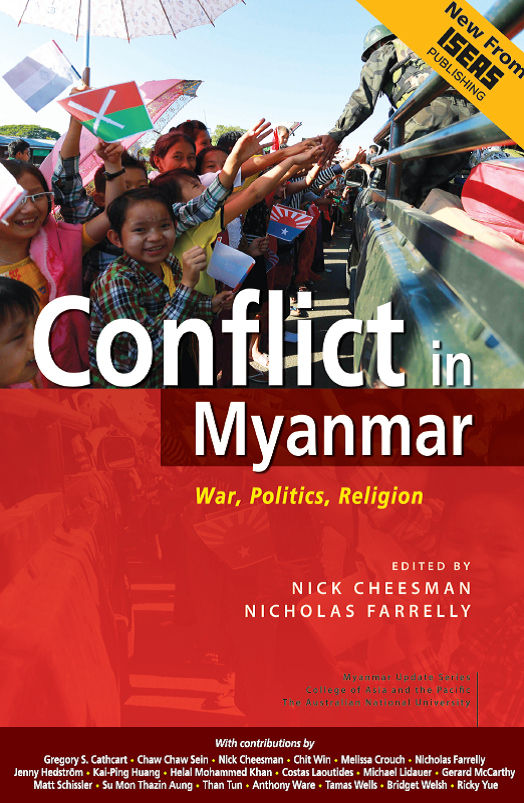
Conflict in Myanmar: War, Politics, Religion

Nick Cheesman and Nicholas Farrelly have a new edited volume coming out on Conflict in Myanmar. The volume is the outcome of the 2015 ANU Myanmar/Burma Update.

The abstract for the book is as follows: As Myanmar’s military adjusts to life with its former opponents holding elected office, Conflict in Myanmar showcases innovative research by a rising generation of scholars, analysts and practitioners about the past five years of political transformation. Each of its seventeen chapters, from participants in the 2015 Myanmar Update conference held at the Australian National University, builds on theoretically informed, evidence-based research to grapple with significant questions about ongoing violence and political contention. The authors offer a variety of fresh views on the most intractable and controversial aspects of Myanmar’s long-running civil wars, fractious politics and religious tensions. This latest volume in the Myanmar Update Series from the ANU College of Asia and the Pacific continues and deepens a tradition of intense, critical engagement with political, economic and social questions that matter to both the inhabitants and neighbours of one of Southeast Asia’s most complicated and fascinating countries.
See here for the flier with more details, or the ISEAS website for the publishers details.

UNSW Indonesia Research Roadshow

In the first week of August 2016, ten scholars from UNSW will be heading to Indonesia. We will be visiting the University of Indonesia (Jakarata), Indonesian Institute of Sciences (LIPI) and the University of Gajah Madah (Yogyakarta). The trip will be an opportunity to share ongoing research projects and explore opportunities for future research collaboration.

I am commencing a project with Dr Fritz Siregar of the University of Indonesia on ‘Administrative Justice in Indonesia’. In 2015, one of the last efforts of Chan and Sukumaran prior to their death sentence was an attempt to challenge the presidents’ decision not to issue a pardon in the State Administrative Courts (PTUN). While this case failed, it highlighted the little that is known about the role of the PTUN in such highly political and important cases. This project is therefore of importance to Australia and will inform academics, students, public policy makers and a wider audience on the functioning of the PTUN. In addition, this project will be of direct relevance to Indonesia because it will offer the first major evaluation of the PTUN in the post-1998 era and demonstrate how the PTUN have been a central component of the democratization process.