Last Friday 27 November, UNSW Law hosted a workshop on The Business of Transition in Myanmar, coordinated by UNSW Law’s Dr Melissa Crouch.
The workshop brought together leading scholars from UNSW, and from institutions around Australia and overseas. This timely workshop not only addressed a key issue facing Myanmar, but one that is of direct relevance to Australia: how will the mix of humanitarian aid, economic diplomacy and foreign investment contribute to Myanmar’s reform process? Dr Crouch noted, “Myanmar offers an opportunity for us to reflect on the importance of aid, economic diplomacy and foreign investment, and the challenges of making this work in the interests of local communities.”
The success of the National League for Democracy (NLD) in the recent 2015 elections in Myanmar will inevitably increase the level of aid, trade and foreign investment. Yet as the NLD prepares to take office in 2016, it will confront a bewildering arrange of economic and social issues – from the legacy of ill-advised special economic zones, to serious issues in enforcing labour standards, the challenge of addressing land rights, and a waiting list of potential business laws on the legislative agenda.
The workshop considered the transformative potential of social enterprises, steps forward in a national minimum wage, the challenges of secured lending, and the innovative strategies of civil society organisations as they strive to make the reform process work for local communities.
Following the workshop, Dr Crouch confirmed, “An edited volume to be published from the workshop papers will inform the contemporary political and economic reform process, and identify broader lessons that can be learnt from the case of Myanmar.”
This article first appeared in UNSW Law news December 2015
The debate on asylum seekers from Myanmar in Australia is ill-informed and skewed. The Australian government and international community must realise that refugee status is first of all not about ethnicity or identity, but about a well-founded fear of persecution. Reports that a man who has been moved by Australia to Cambodia may have been misidentified as Rohingya misses the point. Even if the man is not Rohingya, it is still possible that he has a well-founded fear of persecution as a Muslim fleeing from Myanmar. Since 2012, the anti-Muslim violence has affected a range of Muslim communities in towns right across Myanmar. The violence has not just affected Muslims who may identify as Rohingya. Muslim businesses have been targeted. Mosques burnt down, damaged and closed. Homes of Muslim families destroyed. Many Muslims have been injured and some killed. Muslims face discrimination in educational and employment opportunities. This is not new, but has a long history in Myanmar. At times, monks have been clearly implicated in this anti-Muslim violence. It is true that Muslims in Rakhine State, some of whom identify as Rohingya, are certainly among the worst off and these communities have faced large-scale displacement and marginalisation. The humanitarian crisis is severe In addition, the recent Myanmar elections were the first time that temporary identity card holders, many of whom are Muslim, were not allowed to vote nor to run for political office. This was a serious step backward in terms of political participation, given that temporary card holders were allowed to vote and run for office in the 1990 and 2008 elections. I spent most of election day in downtown Yangon, in an area with a large Muslim community. While most of these people did have identity cards and were able to vote, fear and security concerns were paramount. Many did not turn out to vote, some said for fear of the consequences. Muslims are concerned that if more violence does break out, they will be the first targets. This violence and anti-Muslim sentiment has taken place in Myanmar as a majority-Buddhism country. Headlines of “monks turn violent” in Myanmar suggest this is something unusual and new. This is not the case, and denies the fact that monks have been linked as instigators and perpetrators of violence against Muslims in the past. Western perceptions of Buddhism in Myanmar are still largely blinded by the shiny golden mirage of the pagodas, and the assumption that Buddhists must be peaceful, loving and good. The teachings of Buddhism are one thing, the actions of Buddhists and monks are at times another. Taking a realistic look around the region at Buddhist-majority countries – from Sri Lanka to Thailand to Myanmar – would dispel the myth that violence is somehow unusual to Buddhism. In each of these Buddhist-majority countries, the minority Muslim community has faced tension and violence. Yet the West does not see this. Global concerns of the so-called Islamic State play into the stereotypes that Islam is violent and bad, and that in contrast Buddhism is perceived as peaceful and good. This is a stereotype that must be challenged. In addition, the reports on the Rohingya are ignorant of the fact that a large number of Burmese Muslims (not Rohingya) have settled in Australia since 2005. The Australian government significantly increased its intake of refugees from the Thai-Burma border since 2005, where up to 20 percent of the refugee camps are populated by Burmese Muslims. These Muslims had their claims processed by UNHCR and were found to be legitimate refugees. In fact from 2007 to 2013, refugees from Myanmar were consistently among the top two nationalities accepted as part of the Australian government’s offshore humanitarian program (the other country consistently in the top two being Iraq). Since the precarious transition to democracy, Muslim communities in Myanmar have been the primary targets of persecution. Australia has accepted significant numbers of refugees from Myanmar in the past, it is time to do so again. Dr Melissa Crouch is a Lecturer at UNSW Law School, and the editor of Islam and the State in Myanmar. This article first appeared in The Sydney Morning Herald, 3 December 2015,
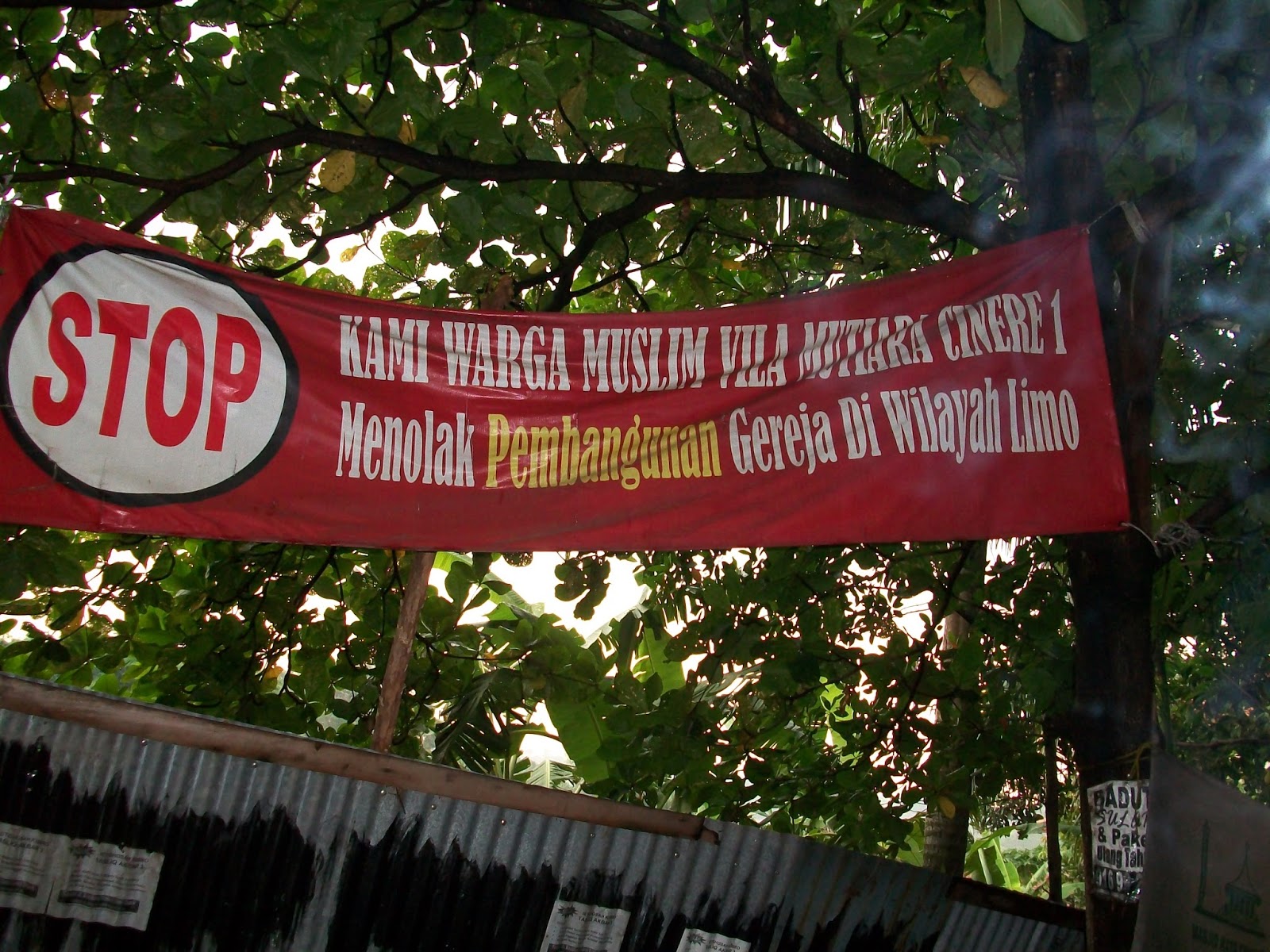
Indonesia has struggled with religious violence in the democratic era. The problem was highlighted once again in October, with an attack on a Christian community in Aceh Singkil(link is external). Following the attack, Religious Affairs Minister Lukman Hakim Saifuddin acknowledged that there were problems with current regulations on the construction of houses of worship and said that there was a need to evaluate the policy. Dr Melissa Crouch has examined this policy, and others, in her book Law and Religion in Indonesia: Conflict and the Courts in West Java(link is external), published by Routledge in 2014. Indonesia at Melbourne spoke to Melissa about the state of religious freedom in the country.
Last month, the Setara Institute released a list of the most tolerant – and intolerant(link is external) – cities in Indonesia. Many of the most intolerant cities were located in West Java, and the province consistently tops the nation for the highest numbers of violations of religious freedom.Is there anything in particular about West Java that makes it more intolerant?My book focuses on West Java because it has a large number of court cases concerning religious groups in the post-1998 era. The province has a high population of Muslims, a small minority of whom have advocated an Islamic state, at times through violent and illegal means. The question my book addresses is why religious groups are increasingly using the courts to address disputes between religious communities. I identify three key issues. First, since 1998 the transition to democracy has led to greater freedom of expression and association. In the absence of a strong state, radical Islamic groups have been able to exploit this freedom. Second, the push to decentralisation has increased the politicisation of religion at the local level. Third, the history of Muslim-Christian relations in Indonesia and the tensions over proselytisation continue to fuel suspicions between the two communities. A consideration of each of these factors is necessary to understand when and how intolerance arises in Indonesia, and, in particular, West Java.
The 2006 Joint Ministerial Regulation on the Construction of Houses of Worship is consistently identified as a factor in promoting religious conflict. Do you believe that the law should be reformed?There are some aspects of the regulation that are highly restrictive for minority religious communities and open to manipulation, such as the requirement to collect signatures from 90 members of that religious group and 60 local residents to obtain a permit for a building. The regulation also establishes Religious Harmony Forums (FKUB). These are committees of local religious leaders from the five main religious groups in Indonesia that play a role in deciding on applications to build places of worship. In areas with a large religious majority, the Forum is likely to consist primarily of leaders from that religious group. In majority-Muslim areas like West Java, this means it can be difficult for small Christian communities to obtain a permit for a church, as the local Forum will be dominated by Muslims. Likewise, in majority-Christian regions, such as Papua, Muslim communities may face similar difficulties to obtain a permit for a mosque. But the focus should be primarily on addressing misuses of the law rather than reforming it. Often communities are able to fulfil the formal requirements of the law, but either the Forum wrongly feels it must make a decision in line with objections from radical groups, or the Forum issues a permit but radical groups prevent the religious community from being able to build. When faced with intimidation and violence from radical groups, and in the absence of a strong state, legal institutions become powerless to enforce the law. Local politicians may also see it as politically expedient to support, or at least not challenge, the demands of radical Islamic groups in their efforts to prevent construction of religious buildings. Religion is misused for political gain. A broader challenge is the role and influence of law in the post-Soeharto state. While significant constitutional and legal reforms have been introduced in Indonesia since 1998, in many areas, state law has little real influence.
Is use of the law by hard-line groups a new phenomenon? Have minority groups also used the law in their defence?Since 1998, there has been an increasing resort to law by hard-line groups, as well as the continuation of intimidation and violence. We can say that if law is the language of democracy, then hard-line groups have learned to speak in the language of law in an attempt to justify their position. When churches have gone to court in order to obtain a permit, their victory in court has sometimes been hollow because of ongoing violence and intimidation from radical Islamic groups. Churches have therefore approached the Ombudsman and the media to resolve the situation and have the church decision enforced. This suggests that courts in Indonesia don’t have the final say or authority in these kinds of disputes.
How else have religious groups used the courts to address religious disputes?In addition to church construction permits and the use of the Administrative Courts to try and resolve conflict, the courts have also been used to criminalise and condemn certain behaviour, making scapegoats of minority religious communities. The issue of blasphemy is a good example. Law No. 1/PNPS of 1965 makes it an offence to blaspheme a religion in Indonesia. This law was rarely used under former President Soeharto, but since 1998, there have been increasing instances of reports made to police against minority religious groups that are perceived to be blaspheming Islam. Accusations of blasphemy intersect with the politics and fear of religious conversion. In regions such as West Java often the people charged with blasphemy have left Islam, or belong to groups that are perceived to distort the teachings of Islam. The Blasphemy Law has been challenged in the Indonesian Constitutional Court as being inconsistent with the right to religious freedom. The court, however, upheld the law as valid and in line with the policy of regulating religion in Indonesia.
Your research looked at “shari’a-inspired” regulations enacted at the local level that have discriminated against minorities. The Ministry of Home Affairs has historically been reluctant to repeal these regulations, even though the regulation of religion is the domain of the central government. Has the Ministry ever cancelled any of these regulations?I don’t know of any religious-based regulations that have been addressed or cancelled by the Ministry of Home Affairs. The national government has the power to regulate matters of religion but local government officials have enacted religious-based laws that, for example, enforce Islamic dress codes, enforce a curfew for women, regulate the fasting month, and other such practices. A significant challenge is that no court has the authority to review local-level laws to consider whether they are in line with the Constitution. For example, Aceh has implemented a new Islamic Criminal Code(link is external) that extends shari’a law to non-Muslims. Because this law takes the form of a local-level regulation the Constitutional Court cannot review it – the Constitutional Court’s jurisdiction is limited to statutes passed by the House of Representatives (DPR). Likewise, although the Supreme Court can review local-level regulations it cannot review them for constitutional validity. In these circumstances, it comes back to Ministry of Home Affairs. Unfortunately, the Ministry has shown no interest in cancelling regulations on religion issued by local governments.
To what extent do you believe the positions of groups like the Indonesian Council of Ulama (MUI), Muhammadiyah and Nahdlatul Ulama affect intolerance and violence?Ahmadiyah, a minority group that calls itself a branch of Islam, is considered to be ‘deviant’ in Indonesia. Organisations such as MUI have issued fatwa against the teachings of the group. The fatwa of these organisations are not legally binding but they do have influence over state practices and, in particular, the Ministry of Religious Affairs. Fatwa may also be used in individual prosecutions for blasphemy as evidence that a person follows deviant teachings. Fatwa issued by MUI are more often ignored by individuals – such as the fatwa prohibiting smoking or the use of Facebook. The Shi’a community has also been the subject of a condemnatory fatwa by MUI but NU and Muhammadiyah have been more public in their affirmation of the Shi’a as part of the broader Muslim community. The Ahmadiyah, meanwhile, are seen as quite different and their teachings more at odds with orthodox Islamic teachings. More broadly, the difference between attitudes towards the Ahmadiyah and Shi’a followers points to the way in which religious tolerance in Indonesia has historically and contextually specific limits. It is important to recognise these cultural boundaries to make sense of the fault lines in public debates on religious inclusion and exclusion in contemporary Indonesia.
This coming Friday and Saturday UNSW Law and HKU Law will be holding a research symposium at UNSW Kensington Campus, Sydney.
A session on ‘Comparative Constitutional Interpretation: Asia & Beyond‘ will be held on Friday morning together with Rosalind Dixon (UNSW), Melissa Crouch (UNSW), Theunis Roux (UNSW), Po-Jen Yap (HKU) and Jianlin Chen (HKU).
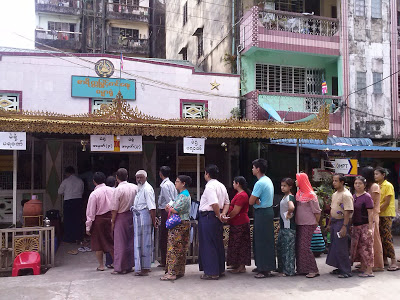
Queue to vote on election day, downtown Yangon, 8 Nov 2015
I spent most of the day of the elections in downtown Yangon and visited about 20 polling stations. The area I was staying in has a very diverse population and a large Muslim community. Polling booths opened at 6am, many people turned out early. Most polling stations I saw were not too busy although some had queues, and there were a lot of police about.
By midday many people on the list as registered to vote had not yet turned up to the polling station to vote. Some people said they may be afraid to vote and expressed concerns of violence. There was only one incident I witnessed in which several voters who turned up to a polling station to vote found their names were not on the list. This was followed by a long and heated discussion. Later, an NLD member of parliament turned up and they vented their frustration at not being able to vote at her.
In the days since the election there has been many celebrations, with emotions and excitement running high. Each day as more seats are confirmed by the UEC, hopes for change continue to grow. Yet there is inevitably a long road ahead, with the current parliament set to meet again on Monday 16 November, in what will no doubt be an interesting final parliamentary session for the outgoing government.
On Monday 19th October a panel event will be hosted at UNSW. The details are below:
About the event: On 8 November 2015, elections for the national parliament and regional parliaments will be held in Myanmar. While significant reform has taken place since 2011, the military still retains 25 percent of all seats in parliament. In recent months several developments have been a serious cause of concern, including restrictions on who can vote and run for election. This recently prompted nine foreign embassies, including the Australian embassy, to issue a strong warning to the Myanmar government that the elections must be free and fair, and that religion must not be misused for political gain. This is a critical juncture in Myanmar’s political history, and Australia’s future engagement with Myanmar will in part depend on the outcome of the elections.
This panel event will shed light on political, economic and legal developments leading up to, and potentially affected by, the national elections. Dr Nicholas Farrelly will consider the political line-up for the elections and the potential challenges and opportunities for political parties and candidates. Associate Professor Sean Turnell will discuss the economic implications of the elections. Dr Melissa Crouch will explain what law and religion has to do with the elections, and why religion has become a central issue.
This event is supported by the Australia Myanmar Constitutional Democracy Project directed by Professor Martin Krygier and Professor Theunis Roux of UNSW. It is also part of the Asia-Pacific Law and Policy Forum at UNSW Law.
Panel: Associate Professor Sean Turnell, Macquarie UniversityDr Nicholas Farrelly, Director of the Myanmar Research Centre, ANUDr Melissa Crouch, Law Faculty, UNSW
Date: Monday 19 October 2015Venue: Boardroom, level 2, Law BuildingUniversity of New South Wales, Kensington Campus, Sydney
Time: 4:00-5:30pm Please RSVP to: melissa.crouch@unsw.edu.au
Associate Professor Sean Turnell, is based at the Economics Faculty at Macquarie University in Sydney. Sean is widely regarded as the leading expert on Myanmar’s economy. Sean has been an advisor and consultant to a number of government departments, multilateral agencies, and INGOs. He is the author of Fiery Dragons: Banks, Moneylenders and Microfinance in Burma (2009), author of numerous articles and book chapters, and a regular commentator on the economy of Myanmar.
Dr Nicholas Farrelly is Director of the Myanmar Research Centre at the Australian National University. After his undergraduate degree in Southeast Asian Studies at the ANU, Nicholas completed his doctorate at the University of Oxford where he was a Rhodes Scholar. In 2006, while still a graduate student, he co-founded New Mandala, which has become a prominent academic website offering analysis of social and political issues in Myanmar and neighbouring countries. Alongside his long-standing interest in understanding ethnic conflict, Nicholas is currently completing a major project based on extensive field research in Naypyitaw. He also writes a weekly newspaper column for The Myanmar Times and is a partner at Glenloch Advisory.
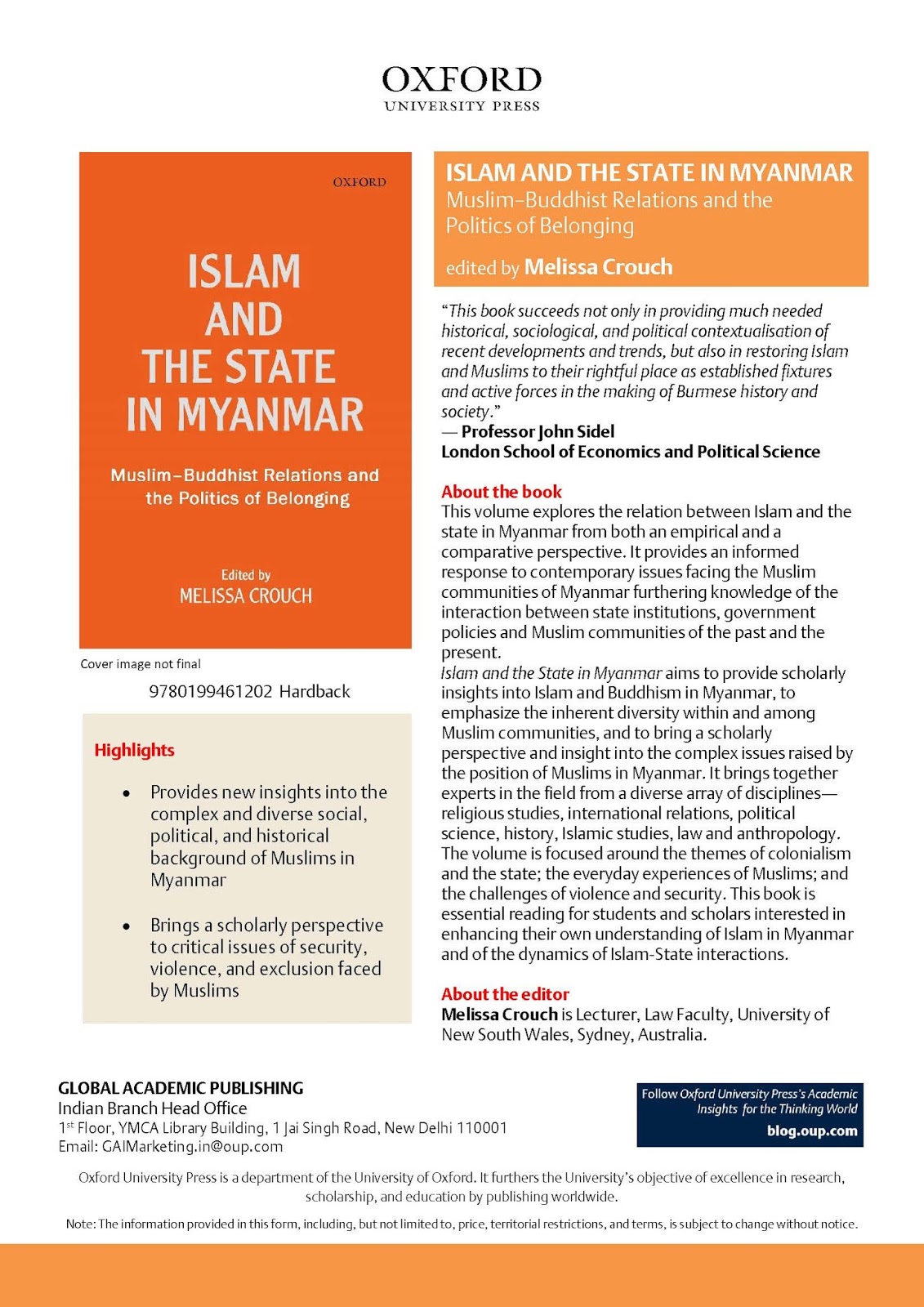
Dr Melissa Crouch is a Lecturer at the Law Faculty, the University of New South Wales. Her research focuses on the legal systems of Southeast Asia, and she teaches in the areas of constitutional and administrative law, comparative law and Islamic law. She is the author of Law and Religion in Indonesia: Conflict and the Courts in West Java (Routledge, 2013), the co-editor (with Tim Lindsey) of Law, Society and Transition in Myanmar (2014, Hart Publishing); and editor of Islam and the State in Myanmar (forthcoming 2015, Oxford University Press).
Constitutional Change in Myanmar: The Role of Courts in Authoritarian Regimes
Seminar date: Tuesday 6 October 2015 Time: 1-2pm To register and for more information see here.
Seminar abstract: National elections are due to be held in Myanmar in November 2015. This follows in the wake of several years of significant political reforms. The transition since 2011 from complete military rule to a quasi-civilian government has taken place within the framework of the Constitution of 2008. Yet this intensive period of legal reform has not seen major changes to the role and structure of the judiciary. This raises the issue of the future role of the courts in contributing to constitutional and democratic change in Myanmar
Union Supreme Court and Constitutional Tribunal, 2013
One shift that has taken place is the reintroduction of the Supreme Court’s jurisdiction to hear cases from citizens to challenge administrative decisions. In this seminar, I focus on the constitutional writs, as set out in the Constitution of 2008, and its potential as an avenue for citizens to bring cases against government officials to the courts. I question whether the Constitution, as a document drafted over a period of 20 years in a process controlled and directed by the military regime, can take on new meanings and significance for its citizens. To address this, I examine the development and foundation of constitutional writs in Myanmar during the period of parliamentary democracy (1948-1962), identify its common law foundations and the emphasis on the protection of individual rights. I then turn to the implications of the reintroduction in 2011 of the constitutional writs, after decades of socialist and then military rule. Several hundred writ applications have been lodged with the Supreme Court in the past five years, yet few cases have actually been decided on issues of rights protected in the Constitution. Through this presentation, I demonstrate that administrative law is one test of the progress, nature and shape of constitutionalism in authoritarian regimes. The Supreme Court primarily acts to keep the lower courts, rather than the executive, in line; yet there remains potential for the Court to build constitutionalism through writs applications in the future.
Upcoming seminar: October 5, 2015, 10.00 a.m. to 11.00 a.m.
Where: Isaac Brown Room (ground floor bld. 55, next to busloop), Clayton Campus, Monash University, Centre of Southeast Asia Studies
Abstract: In the lead up to the Myanmar elections in November 2015, one issue has stood out: the precarious position of Muslims. From the recently enacted four laws that restrict inter-religious marriage, conversion and polygamy, to the disenfranchisement of those who do not hold full citizenship (many of whom are Muslims), opposition towards Islam has become a tool to garner political support. The dominant representation that emerges from these developments is the stereotype that Muslims do not belong in Myanmar. This presentation seeks to unpack recent developments and counter these perceptions by identifying ways in which Muslims in Burma have constructed a ‘Burmese Muslim’ identity.
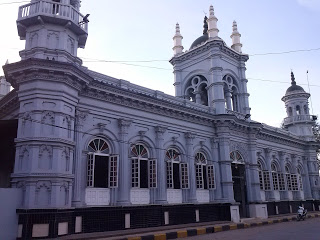
Mosque in Moulemein, 2015
In this talk I demonstrate that the primary response of Muslims to the resistance they have faced has been to promote a ‘Burmese Muslim’ identity that emphasises the ‘localised’ nature of Islam as a way of reaffirming their sense of belonging to the state. In contrast to the trend of Islamisation around the world since the 1970s, the existence and practises of Muslims in Myanmar primarily demonstrate a deep affiliation to local traditions. In focusing on the lived experiences of Muslims in Myanmar in historical context, I demonstrate the diversity within and among Muslim communities in Myanmar and the efforts Muslim communities have gone to in order to ‘fit in’ to this majority-Buddhist society. In particular, I identify three facets of the Burmese Muslim identity and the ways in which this identity is reiterated and reinforced in response to such challenges. First, Muslims have been active participants in political life in Myanmar as a way of demonstrating their commitment to the state. Second, the debates among the different Muslim communities on Islamic education have primarily affirmed the use of Burmese language. Third, the insistence that Burmese Muslim women should be free to wear traditional Burmese dress is a visible representation of the position of the Islamic community. In each of these ways, Muslims stand out for the remarkable lengths they have gone to in order to affirm their belonging to the Buddhist-majority state. The construction and reinforcement of the idea of a ‘Burmese Muslim’ is therefore key to understanding how Muslims have responded to the resistance they face in Myanmar.


 Melissa Crouch
