Re-reading Dan S Lev on the politics of Indonesian courts

At UNSW Law we are taking time to re-read the work of the late political scientists and Indonesian law scholar, Professor Dan S Lev. The reading group will run over the following week


Wednesday 9th May 12pm

Daniel S Lev, ‘Judicial Institutions and Legal Culture in Indonesia’, in Claire Holt, Culture and Politics in Indonesia. (2007, Equinox Publishing). pp 246-318


Wednesday 16th May 12pm

Daniel S Lev ‘Conceptual Filters and Obfuscation in the Study of Indonesian Politics’ (2005) 29:4, Asian Studies Review


Monday 4 June 12pm

Daniel S Lev (1978) ‘Judicial Authority and the Struggle for an Indonesian Rechtsstaat’ 13(1) Law & Society Review 37-71.


Tuesday 26 June 12pm

Daniel S Lev (1965) “The Politics of Judicial Development in Indonesia,” Comparative Studies in Society and History (January)

Religion, Politics and Law: Blasphemy in Indonesia

Indonesia’s blasphemy legislation gained global attention during the trial of former Jakarta Governor Basuki “Ahok” Tjahaja Purnama in 2017. But apart from Ahok, many other Indonesians have also faced blasphemy charges in recent years, even though the constitutionality of the law has been challenged repeatedly.

Why is blasphemy such a serious offence in Indonesia? What do recent blasphemy cases have in common and where do they differ? And how do they fit into broader legal developments and political trends in Indonesia? In Talking Indonesia this week, Dr Dirk Tomsa discusses these issues with Dr Melissa Crouch, Kathleen Fitzpatrick Visiting Fellow at the Melbourne Law School, and a Senior Lecturer at the Law Faculty of the University of New South Wales in Sydney.

Why Religious Supremacy Clauses dont work: Seminar

On Friday 6 July, UNSW Law will host Dr Benjamin Schonthal to speak on “Why Religious Supremacy Clauses Don’t Work: Buddhism, Secularism and the Pyrrhic Constitutionalism of Sri Lanka”

Recent scholarship on religion and constitutional law tends to characterize religious supremacy clauses – clauses that give special status or protections to one or more religions – as either regressive or unjust. They are considered regressive because they seem to refuse the presumed secularity of modern law; they are considered unjust because they seem to give unfair political or economic advantages to members of the preferred religious group(s). Yet, are these characterisations accurate? Are religious supremacy clauses always unequivocal boons for the majority religious groups? Moreover, when it comes to religion, do religiously preferential constitutions function differently from non-preferential ones? Drawing on my recent book, and ongoing research, I explore these questions in the context of Sri Lanka—a country that, for the last four decades, has given Buddhism special constitutional status. Though an analysis of Buddhist doctrine, monastic practices, legal theory and methodological trends in comparative constitutional scholarship, the speaker hopes to complicate existing wisdom about the effects of religious supremacy clauses and to challenge the assumed binary opposition between secular constitutions and religious preferential ones. 

Benjamin Schonthal is Associate Professor of Buddhism and Asian Religions at the University of Otago, in New Zealand. His research examines the intersections of religion, law and politics in late-colonial and contemporary Southern Asia, with a particular focus on Buddhism and law in Sri Lanka. His work appears in The Journal of Asian Studies, Modern Asian Studies,theInternational Journal of Constitutional Law and other places. Ben’s first book,Buddhism, Politics and the Limits of Law, appeared with Cambridge University Press in 2016. His current project, supported by the Marsden Fund of the Royal Society of New Zealand, examines the lived practices of monastic law in contemporary Sri Lanka and their links with state-legal structures. 

Registration details are available here

Politics in Action in Southeast Asia

On 18 May, Sydney will again hold its flagship annual event, “Politics in Action in Southeast Asia”.

When: 9.30am-4.30pm, 18 May 2018
Where: Education Lecture Theatre 351, Education Building A35

Invited experts will provide an analysis of the political situation in Cambodia, Indonesia, Laos, Malaysia, Myanmar and the Philippines and discuss the broader implications of events in these countries for our region. Drawing upon expertise from around the world, these presentations will keep you up-to-date with developments in Southeast Asia. This event is open to academics and non-academics alike. In 2018, the forum will focus on: Cambodia; Indonesia; Laos; Malaysia; Myanmar; Philippines. Our exciting line-up of speakers confirmed for the day include:        

  • Professor Garry Rodan (Murdoch University)
  • Associate Professor Bridget Welsh (John Cabot University, Italy)
  • Dr Su Mon Thazin Aung (Institute of Strategy and Policy, Myanmar)
  • Dr Keith Barney (Australian National University)
  • Dr Melissa Crouch (University of New South Wales)
  • Dr Jayeel Serrano Cornelio (Ateneo de Manila University)
    Dr Lee Morgenbesser  (Griffith University)
  • Dr Charlotte Setijadi (Institute for Southeast Asia Studies- Yusof Ishak Institute, Singapore)

For more see Sydney’s SSEAC website

Courts, Power and Legal Process in Indonesia

This workshop on “Courts, Power and Legal Process in Indonesia” will reflect on the growth in the role and function of courts in Indonesia. 20 years on from Indonesia’s democratic transition, there has not yet been a thorough analysis of how and why Indonesia’s courts have changed, and what this says about power and legal culture today. The common theoretical point of reference for this workshop is the seminal work of the late Professor Dan S Lev, a pioneer in the study of courts and legal process in Indonesia. Lev’s work was grounded in a socio-legal approach to the study of law, and his work spans an impressive range of themes related to courts, judges, lawyers and politics in Indonesia from the 1960s to 2000s. The papers in this workshop seek to reinvigorate and affirm the importance of Lev’s work for the study of courts in Indonesia today. Offering new and empirically informed perspectives on important developments in the courts, this panel seeks to bring the study of Indonesian courts into the broader view of literature and debates on the politics of courts. While there are new trends in courts in Indonesia – such as the marked tendency towards the creation of specialised courts – our working presumption is that many of the broader ideas articulated by Lev are still of relevance.

Each chapter will include vital background analysis of the establishment, powers and function of a court or legal institution. The chapters will also offer original, substantive analysis of how and why the court is used today, and how it fits into the broader judicial system and legal culture in Indonesia. That is, what role do the courts play in Indonesia today, and how has this shaped legal culture? After a broader overview of each court, the authors may use a case study on an aspect of the courts’ caseload or a particularly topical issue that illustrates how the court works and what role it plays in contemporary Indonesia.

Date: Mon. 2 July 2018, 9:30 am – 5:00 pm AEST

Location: Staff Boardroom, Level 2, Building F8, UNSW Law Faculty, Kensington Campus, University of New South Wales, Sydney, Australia

Register


9:30 -10:45 – Session 1

Courts and Legal Culture in Indonesia – Melissa Crouch, UNSW

Anti-corruption Courts – Simon Butt, Sydney University


11:00-12:00 – Session 2

Human Rights Courts – Ken Setiawan, University of Melbourne

The Media and the Courts – Ross Tapsell, ANU

1:30-2:30 – Session 3

The Supreme Court and Reformasi: The Struggle for Power, Status and Authority – Rifqi S Assegaf, University of MelbourneThe District Courts – Daniel Pascoe, City University of Hong Kong


2:30-3:30 – Session 4

The Fisheries Court – Indri Saptaningrum, UNSW

The Constitutional Court – Fritz Siregar, Jentera Law School

Brownbag: Charting the Future of Constitutionalism in Myanmar

On 10 April 2018  I will give a brownbag seminar as a Kathleen Fitzpatrick Visiting Fellow of the Centre for Comparative Constitutional Studies, the University of Melbourne. 

The talk is based on the first chapter of the book manuscript, The Constitution of Myanmar, which is part of Hart’s Constitutions of the World series.


Abstract: This timely and accessible book is the first to provide a thorough analysis of the 2008 Constitution of Myanmar (Burma) in its historical, political and social context. The book offers an in-depth exploration of the key elements of the 2008 Constitution in theory and practice. The book considers the historical foundations of the 2008 Constitution and the critical issue of legitimacy raised by the past process of constitution-making. The book identifies and articulates the constitutional principles of the 2008 Constitution, based on an analysis of legal and political process since 2011. It highlights critical constitutional contestations that have taken place over fundamental principles such as democracy, federalism, presidentialism, judicial independence and the role of the military. The book argues that the 2008 Constitution is a unique hybrid system, blending remnants of past liberal democratic and socialist constitutions with an agenda of military legality. The vision of military constitutional rule embedded in the constitutional text assumes faithfulness and conformity from the people. Already, this constitutional vision and its surrounding structure has been the subject of fierce contestation. Central to the future direction of constitutionalism in Myanmar is the issue of the role of the military in governance, and the extent to which the country will shift from a highly centralised system to a federal or decentralised system of governance.

Keynote address for the Association of Mainland Southeast Asia Scholars

Politics and Religion: Kruba Srivichai, the Saint in the Storms of Modern Thailand
Professor Katherine Bowie, University of Wisconsin-Madison

Keynote address for the Association of Mainland Southeast Asia Scholars (AMSEAS)
Asian Studies Association of Australia biennial conference
5-5.45pm, 3 July 2018, University of Sydney

Kruba Srivichai (1878-1939) is the most famous monk of northern Thailand.  Born during a stormy night, northerners came to believe that he was a tonbun, a saintly precursor of Maitreya.  Able to mobilize popular support on an unprecedented scale, Srivichai was involved in the building or restoration of over 100 temples throughout the northern region.  By contrast the Bangkok court viewed him as a rebel leading a millenarian revolt against central Thai authority.  During his lifetime he was detained until temple arrest multiple times.  He was sent to Bangkok for investigation in 1920 and again in 1935-36, the latter arrest leading to the forcible disrobing of some 400 monks and novices.  Prevailing scholarship has attributed his temple arrests to his failure to abide by the Sangha Act of 1902;  however the Sangha Act did not apply to the northern region until 1924.  Even less scholarly attention has paid to the causes underlying his second detention in Bangkok, shortly after the coup of 1932 which established a constitutional monarchy.  My research suggests that the implementation of the Military Conscription Act and the Education Act, each important elements in the process of modern nation-state formation, underlay Srivichai’s arrests.  Srivichai continues to be a political force to the present day.  My discussion will place Srivichai’s controversial biography in the context of the pressures of Thai nation-state formation.

Keynote proudly sponsored by the ANU Southeast Asia Institute & the Sydney Southeast Asia Centre


For further details visit the conference website:
https://sydney.edu.au/sydney-southeast-asia-centre/events/Asian-Studies-Association-of-Australia-Conference-2018.html

The Politics of Courts and Legal Culture

Law and Society Association Panel 2018


Panel Title: The Politics of Courts and Legal Culture: Indonesia’s Judiciary and the Legacy of Dan S Lev


On Friday 8 June, as part of the Law and Society Association Annual conference, I am looking forward to being part of this panel on the politics of courts and legal culture. 

This panel presents a series of related papers around the broader theme of legal culture and the role and function of courts in Indonesia. Twenty years on from Indonesia’s democratic transition, and there has not yet been a thoroughly analysis of how and why Indonesia’s courts have changed, and what this says about the contested concept of legal culture today. A true pioneer in this area is the late Professor Dan S Lev. His work was grounded in a socio-legal approach to the study of law, and his work spans an impressive range of themes related to courts, judges, lawyers and politics in Indonesia from the 1960s to 2000s. The three papers in this panel seek to reinvigorate and affirm the importance of Lev’s work for the study of courts in Indonesia today. Offering new and empirically informed perspectives on important developments in the courts, this panel seeks to bring the study of Indonesian courts into the broader view of literature and debates on the politics of courts.


Paper 1: Judges, Courts and Legal Culture in Indonesia: The Legacy of Dan S Lev

Abstract: Indonesia’s extensive court system supports the world’s third largest democracy and a growing economy. The court system in Indonesia has changed and expanded rapidly since 1998, with the introduction of a wide range of specialized courts. My paper reflects broadly on this phenomenon through the seminal and groundbreaking work of the late Professor Dan Lev. Lev’s work offers important foundational theories in the study of lawyers and the legal profession in Indonesia; legal aid and the role of activists against the state; the role of judges and the courts; and the importance of understanding the politics of law more broadly. While I suggest that these themes offer an important baseline for the study of courts in Indonesia, the judicial landscape has clearly changed dramatically with the creation of a specialized Constitutional Court, Tax Court, Human Rights Court, Fisheries Court, Anti-corruption Court, Commercial Court and Industrial Relations Court. These specialized courts often seek to disrupt existing pathologies with the general court system in an attempt to circumvent the cycles of corruption, such as by appointing a majority of ad hoc judges (from outside the career judiciary) to the bench. They also seek to promote and maintain specialized expertise within the judiciary. question the extent to which Lev’s work can help us understand this phenomenon. I argue that his methodological and theoretical approach to Indonesian law remain of relevance to the study of courts, and that many of his formative ideas can be built upon and extended in a way that enhances understanding of the role of courts in contemporary Indonesia.


Author: Dr Melissa Crouch is a Senior Lecturer at the Law Faculty, the University of New South Wales, Sydney. Her research contributes to the field of Asian Legal Studies, with a concentration on Law and Development; Constitutional Change; and Law and Religion. Her research has a particular focus on Indonesia and Southeast Asia, where she has conducted extensive socio-legal field research. Melissa is the author of Law and Religion in Indonesia: Conflict and the Courts in West Java (Routledge, 2014). She is the editor of The Business of Transition: Law Reform, Development and Economics in Myanmar (Cambridge University Press, 2017);  ‘Islam and the State in Myanmar: Muslim-Buddhist Relations and the Politics of Belonging‘ (Oxford University Press, 2016); and Law, Society and Transition in Myanmar (2014, Hart Publishing). Melissa has published in a range of peer-reviewed journals, including International Journal of Constitutional Law, Sydney Law Review and Asian Legal Studies


Paper 2: The District Courts in Indonesia

Abstract: This chapter is divided into two parts: first, an introductory section describing the civil and criminal jurisdiction, procedural framework, judicial personnel and legal development of Indonesia’s District Courts (Pengadilan Negeri) since the fall of Suharto in 1998.  The chapter’s second part will comprise an empirical study of the determinants of sentence severity in murder cases in Jakarta’s District Courts.  Indonesia is a civil law jurisdiction within which trial judges are afforded an exceedingly wide sentencing discretion in murder cases.  It is commonly assumed that sentences in Indonesian murder cases are more severe, extending to the death penalty, when the case involves sadistic and unnatural acts, a repeat offender, multiple victims, public opprobrium, or separatist motivation (Haryoso, 1997).  This chapter’s case study, based on online case law data collection from Jakarta’s four District Courts (Central, East, South and West), together with interviews with several judges from those institutions to be conducted in February 2018, aims to ascertain the determinants of sentencing severity in post-1998 Jakarta murder cases, to confirm or deny existing assumptions about the operative criteria, and within the broader aims of the edited volume, to determine what District Court sentencing patterns reveal about Indonesia’s broader judicial culture.


Author: Dr Daniel Pascoe is an Assistant Professor at the School of Law, City University of Hong Kong.  He received his undergraduate degrees in Law and in Asian Studies (Indonesian) from the Australian National University, and his Master of Philosophy in Criminology and Criminal Justice and Doctor of Philosophy in Law degrees from the University of Oxford, where he was the Keith Murray Graduate Scholar at Lincoln College.  Daniel has published on crime and punishment in a number of Southeast Asian jurisdictions, including Indonesia.  His first monograph, entitled ‘Last Chance for Clemency: Clemency in Southeast Asian Death Penalty Cases’ is forthcoming with Oxford University Press.


Paper 3: Indonesia’s Industrial Relations Courts

Abstract:  How should we approach the study of the various special courts that have proliferated in Indonesia since the fall of the New Order? In particular, can we see the new special industrial relations courts as successfully having judicialized labor rights? Building on a thorough examination of their historical antecedents, legal origins and structure, this article focuses on a careful review of cases brought before the industrial relations court. This chapter provides a critical reflection and assessment of labor rights protection and litigation in Indonesia today.


Author: Dr William Hurst works on labor politics, contentious politics, political economy, and the politics of law and legal institutions, principally in China and Indonesia.  He is currently completing a book manuscript on the comparative politics of law and legal institutions in China and Indonesia since 1949.  For this work he has completed more than one year of fieldwork in each country since 2006. Before coming to Northwestern in 2013, he was a postdoctoral fellow at Oxford and an assistant professor at the Universities of Texas and Toronto. He is an active participant in the department’s strength areas on Asian Politics and Law & Politics.


Paper 4: Legal institutions as an approach: the theoretical importance of Dan Lev’s work


Dan Lev is mainly remembered as an inspiring Indonesianist, a member of the legendary Cornell-group established by George McTurnan Kahin in the 1950s.  Outside of Indonesianist circles his name is not often mentioned and his work seldom referenced. Yet, the approach Lev used to look at the Indonesian legal system has all the characteristics of a law and society scholarship that is universally applicable and that deserves to be more widely recognised. This paper explores these characteristics of Lev’s work, locates them in the broader field of law and society approaches developed by his contemporaries, and critically discusses what their use is. It will argue that the main reason for the relative ignorance of Lev’s work is the fact that he never articulated his approach very explicitly, that he thought of himself primarily as a political scientist, and, in the end, that he was happy to be an Indonesianist.


Bio: Adriaan Bedner is KITLV Professor of Law & Society in Indonesia at the Van Vollenhoven Institute for Law, Governance and Society, Leiden University. His research has a particular focus on access to justice, dispute resolution and the judiciary. This has led to publications on a wide variety of subjects, ranging from administrative courts and environmental litigation to human rights promotion in marriage law regimes and Indonesian legal education.

Myanmar’s Constitutional Tribunal

Myanmar is one of the most recent countries in the world to have established a Constitutional Tribunal. Yet the operation of the Tribunal flies in the face of assumptions common to global constitutionalism. At present, external factors such as globalised judicial networks or comparative concepts of rights-based review have had little influence in Myanmar. Instead, the operation of the Tribunal can be explained by two main internal factors and the actions, or inaction, of elite political actors. I demonstrate this by analysing the Constitutional Tribunal under President Thein Sein (2011-2012; 2013-2016) and then the National League for Democracy government (2016-). In this talk I focus on the issue of the right to vote and citizenship to illustrate when and why elites (both democrats and dictators) use the Tribunal. Although the global community largely perceived the 2015 elections to be free and fair, in fact the decision of the Tribunal combined with the actions of Parliament contributed to the mass disenfranchisement of over one million people (many of whom are Rohingya). In this respect, the Tribunal has reinforced a limited nationalist understanding of the 2008 Constitution. As a monumental shift has taken place from direct military rule to military-led constitutionalism in Myanmar, I offer an important and timely reflection on the implications of the role of the Tribunal as a forum for constitutional dialogue between military dictators and democratically elected representatives. This talk is based on a forthcoming article in the International Journal of Constitutional Law (2018). 

Date: 18 April 2018

Location: Melbourne Law School

Hosted by the Asian Law Centre and the Centre for Statelessness, University of Melbourne

Burmese Student Welcome at UNSW

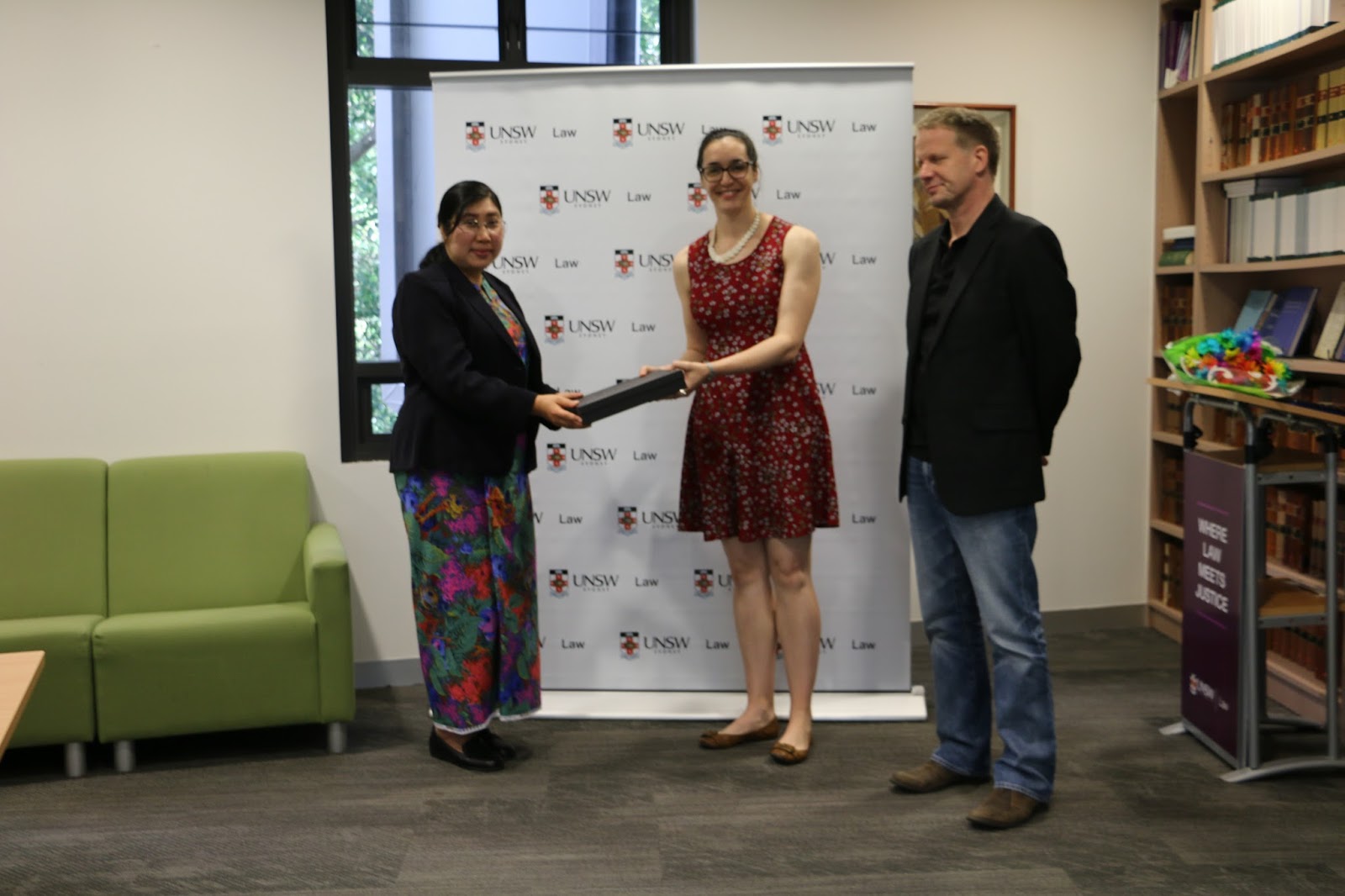
On Friday 9 March 2018, the Institute for Global Development was pleased to host a welcome event for Burmese student scholarship holders at the University of New South Wales. These students are recipients of Myanmar Presidential Scholarships, and DFAT scholarships across a wide range of disciplines. The meeting was hosted by Myanmar Academic Leads, Dr Melissa Crouch and Dr Morten Pedersen. We were delighted to have special guest Dr Yin Myat Phyu Win of the Myanmar Embassy to the event.