Professional Legal Education in Commercial and Corporate Law in Myanmar

Dr Melissa Crouch and Associate Professor Lisa Toohey of UNSW Law Faculty are undertaking a Professional Legal Education Project in Commercial and Corporate law in Myanmar (2016-2017), funded by the Asian Development Bank. Melissa Crouch is the Team leader and Legal Education and Myanmar Law expert. Lisa Toohey is the Legal Education and Commercial Law expert on the project. Emma Dunlop is the Legal Researcher and Project administrator.

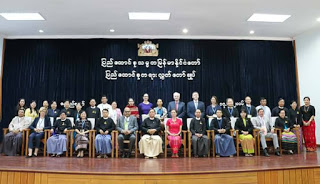
Melissa Crouch at the USC Strategic Action Plan meeting 2016

The focus of the project is on improving legal education and skills integral to the transactional practice and adjudication of commercial law, at this critical time in Myanmar’s transition to democracy. The project includes developing a training program for the practical legal training needs of private lawyers, government lawyers, prosecutors and judges in commercial and financial law. 

Melissa, Lisa and Melinda with law students from Dagon University

In 2016, the first stage of the project has included meetings and focus group discussions with most of the major law firms – foreign and local – in Yangon. It has also involved consultants with university professors, the bar association, and law students. 

Meetings have also been held with the Attorney General’s Office, and Melissa attended the Supreme Court’s Annual Strategic Action Plan meeting in November 2016. 

The team for this Professional Legal Education program also includes Patricia Rhee and Jogendra Ghimire (Senior Counsel, ADB), Melinda Tun (Corporate Law Specialist), and Khin Thandar (National Legal Specialist).

The Role and Function of a Constitutional Court

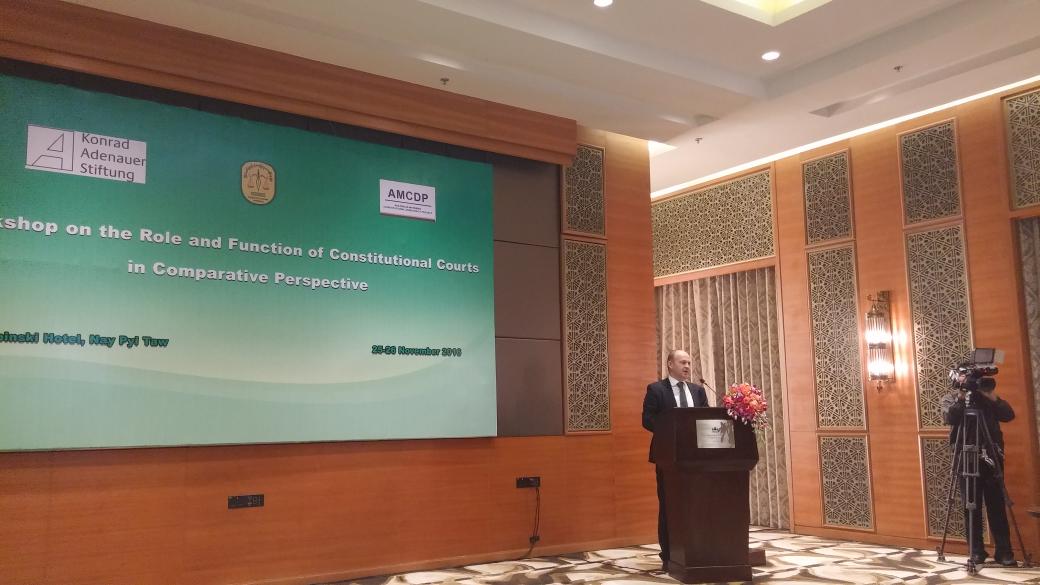
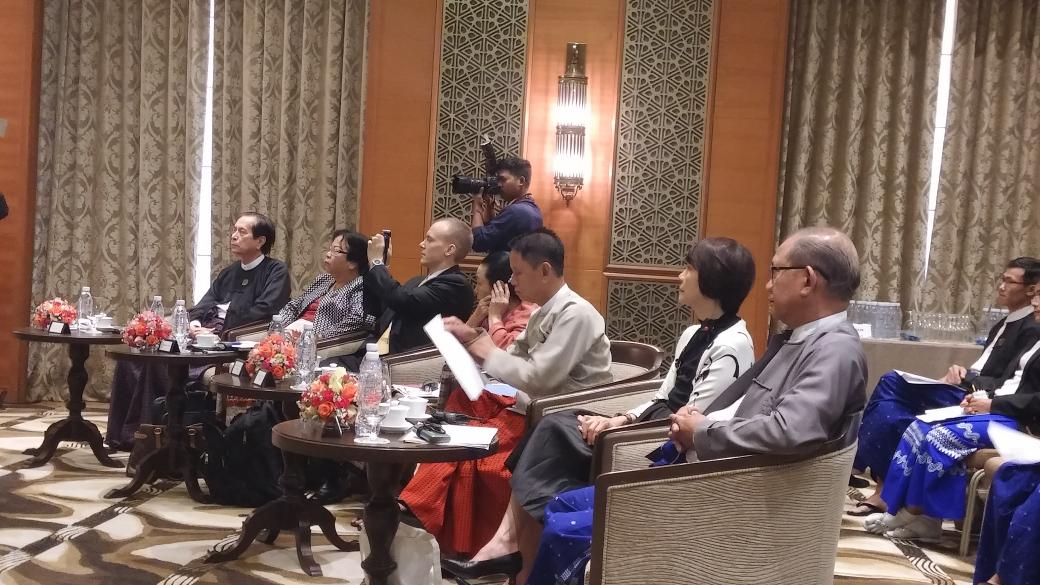
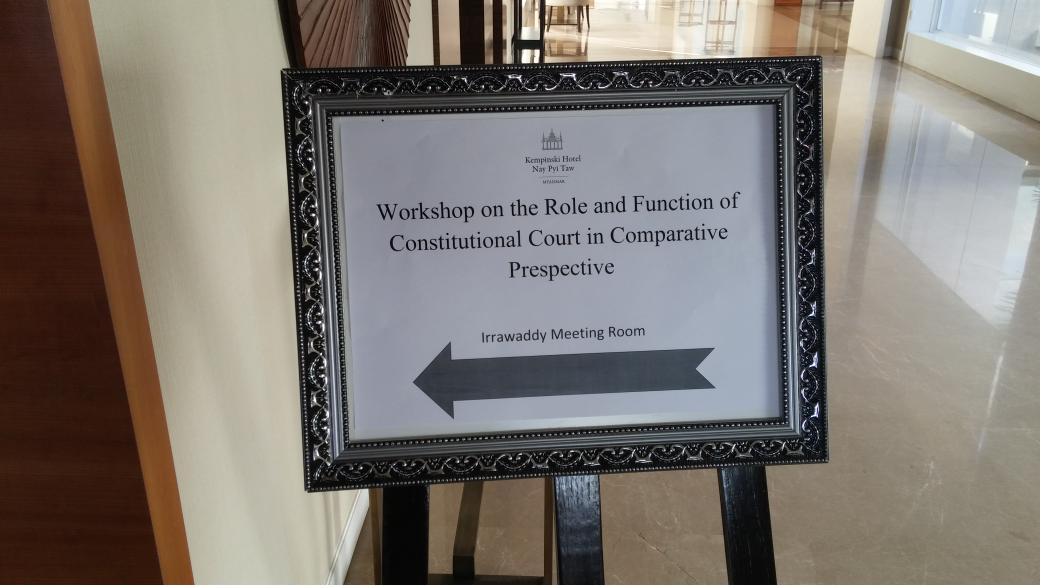
On 25-26 November 2016, a workshop was held with the Myanmar Constitutional Tribunal in Naypyidaw on “The Role and Function of a Constitutional Court in Comparative Perspective”. 

The conference was organised by the Australia Myanmar Constitutional Democracy Project, and supported by Konrad Adenauer Stiftung. The conference was attended by the nine members of the Constitutional Tribunal and 40 of their research staff. The two speakers for the event were Professor Theunis Roux and Dr Melissa Crouch of the University of New South Wales.

The workshop included the following sessions:

Day 1

Session 1: The Role of a Constitutional Tribunal in a Democracy – Theunis Roux

Session 2: Jurisdiction of the Constitutional Tribunal – U Kyaw San

Session 3: Constitutional Interpretation – Theunis Roux

Session 4: Public Profile of the Constitutional Tribunal – Melissa Crouch

Day 2

Session 1: Procedure and Access to the Tribunal – Melissa Crouch

Session 2: Remedies in Constitutional Law – Theunis Roux and Melissa Crouch

The conference featured on national television, MRTV: https://www.facebook.com/mrtvwebmediaportal/videos/1258493284196495/

The workshop was also reported in Myanma Alin, 26 November 2016.

Building a Constitutional Culture in Myanmar

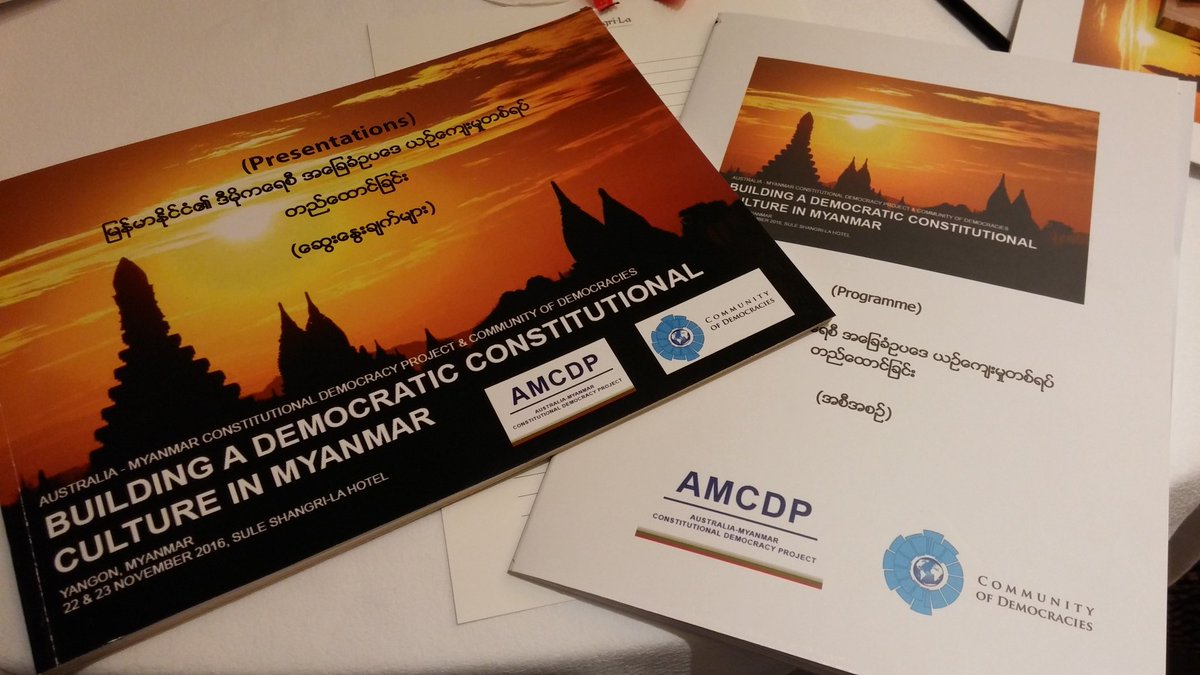
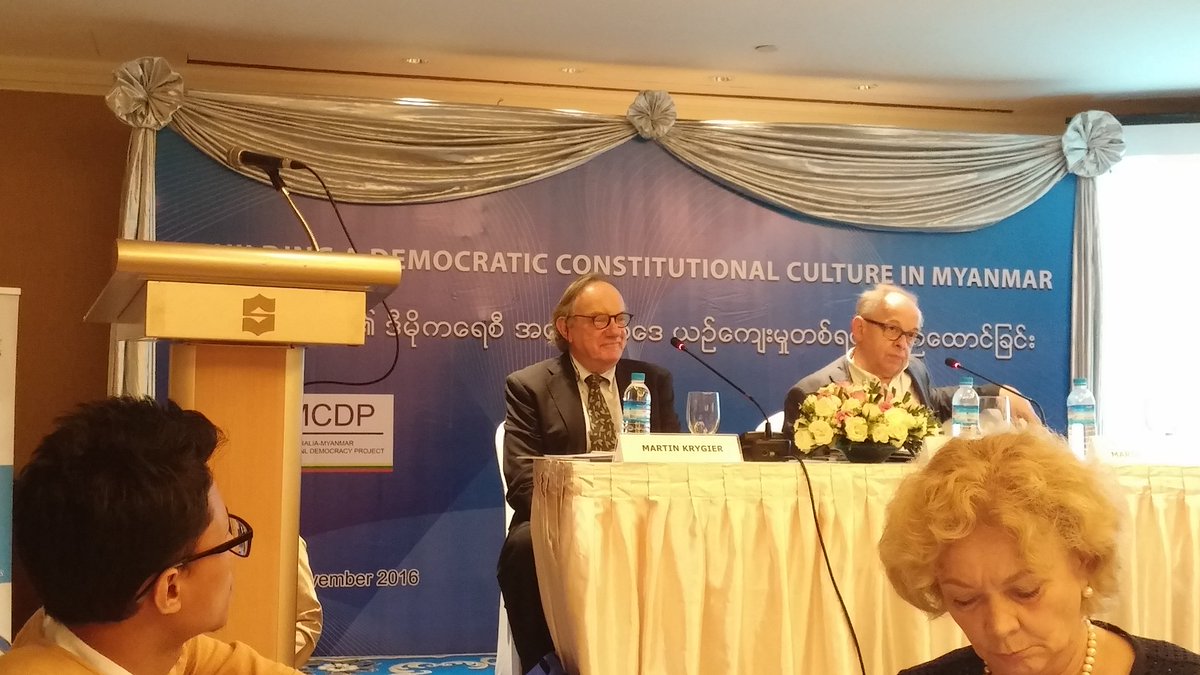
From 22 to 23 November, the Australia Myanmar Constitutional Democracy Project led by UNSW Law held a workshop on Building a Constitutional Culture in Myanmar. Over 60 participants attended including lawyers, civil society organisations, former judges, academics and students. This represented the fourth year of this program, that has now included 9 major workshops and over 600 participants. Discussions, debate and education on constitutional law remain of critical importance in Myanmar since the country made its transition from direct military rule in 2011.

The program for the conference included:
Day 1
Panel 1 – Constitution and Politics in Myanmar, Challenges and Opportunities, Martin Krygier and Wojciech Sadurski
Panel 2 – Constitutions and Constitutionalism in Myanmar, Melissa Crouch and Wojciech Sadurski
Panel 3: Valued Ideals: The Rule of Law, Separation of Powers and Judicial Independence, Martin Krygier and Adam Czarnota

Panel 4: Valued Ideals: Federalism and Minority Rights, Melissa Crouch and Theunis Rous
Day 2
Panel 5: Valued Ideals: Rights, Catherine Renshaw and Wojciech Sadurski
Panel 6: Buliding a Democratic Constitutional Culture, Martin Krygier and Theunis Roux
Panel 7: Summary and way forward, Ambassador Maria Leissner

What do the blasphemy allegations against Ahok mean?

Indonesian police last week declared Jakarta Governor Basuki Tjahaja Purnama, or Ahok, a suspect for blasphemy, over a speech he gave in which he quoted a verse from the Qur’an. In the wake of the police decision, Indonesia at Melbourne spoke to Dr Melissa Crouch, who has published widely on Indonesia’s Blasphemy Law(link is external) (Law No. 1/PNPS/1965), about the growing use of the law in democratic Indonesia, and the possible consequences for Ahok.


Indonesia is a majority Muslim country but the state officially recognises five other religions. Has the Blasphemy Law only been used to prosecute those who blaspheme Islam?


All cases prior to 1998 were for blaspheming Islam. While the majority of prosecutions have been charges of blaspheming Islam, there have been a handful of cases since 1998 where a person has been charged with blaspheming another religion.


For example, in the Pondok Nabi case, a protestant pastor, Mangapin Sibuea, was accused of blaspheming Christianity. He had established his own sect, and there were allegations of abuse and attempted suicide. In 2004, he was sentenced to two years jail(link is external) in Bandung.


In another case, in 2009, the leader and six followers of a Christian sect known as Zion City of Allah (Sion Kota Allah), were accused of insulting Christianity. The allegations were based on claims that the group instructed its followers not to take communion and forbade wedding ceremonies in church. The Kupang District Court sentenced the seven accused to six months in prison under the Blasphemy Law.


In another intra-Christian dispute, a group of students filed a case against the weeklyTempo magazine(link is external). They alleged that a front page photo published in 2008 – which depicted a satirical version of Leonardo da Vinci’s “The Last Supper” with President Soeharto having dinner with his six children – blasphemed Christianity by suggesting an analogy between Soeharto and Jesus. This case did not proceed to trial, as Tempo publicly apologised.


In 2010, the Central Jakarta District Court ruled that the owner of the Buddha Bar was guilty of blasphemy(link is external) for using  Buddha’s name and various Buddhist symbols in the bar.


Some human rights activists and researchers have suggested that the blasphemy charges against Shi’a cleric Tajul Muluk in Sampang, East Java, were motivated by underlying economic disparity and competition for followers between local Shi’a and Sunni groups. Is it common for blasphemy trials to be economically or politically motivated?


Before 1998, many blasphemy trials were politically or religiously motivated. There were two high profile trials of Muslims who had converted to Christianity. There were also trials of some Javanese leaders and students who made jokes about Islam.

Since 1998, however, the reasons blasphemy trials have been brought to court are more complex. Often there are underlying family or community disputes. Sometimes it is a recent convert to Christianity who is seen to be too outspoken in criticising Islam. Other times it is about disputes within a religion over the “correct” teachings and efforts by religious leaders to guard what are perceived to be the orthodox teachings of that religion. In doing so, they also boost their own religious authority and power.


What role is played by the Indonesian Council of Ulama (MUI) in driving blasphemy charges?


Most cases are reported to the police by religious leaders, including by leaders of MUI. One of the key pieces of “evidence” that organisations like MUI offer to police is a fatwa that declares a group and its teaching deviant. Although the fatwa of MUI are not legally binding, such decisions appear to have significant persuasive value in court.


For example, MUI issued a fatwa against Lia Eden(link is external), the leader of a small sect, and the fatwa was produced in court as evidence that she had blasphemed Islam. The reliance on fatwa by the prosecution as evidence in court is difficult for judges to deny without being perceived as questioning the credibility of the Islamic leaders or organisation that issued the fatwa.


What kind of behaviour has been deemed to ‘blaspheme Islam’ in the past?


A whole range of behaviour has been declared blasphemous. Groups that teach that praying five times a day is not necessary have been deemed to blaspheme Islam. One person declared himself to be the prophet Mohammad. One woman published her own fatwa in contradiction to that of the MUI. One religious leader whistled during prayers. Another religious leader taught that it was permissible to pray in two languages, Indonesian and Arabic. One group published a booklet that taught that you do not have to be Muslim to enter heaven. All of these actions or words were found by a court to have blasphemed Islam.


How long do blasphemy trials generally take in Indonesia? Is it realistic that the trial would even be heard before the elections?


Blasphemy trials always begin in the lower courts. If convicted, the accused could then appeal to the High Court, and then to the Supreme Court. So it is not uncommon for this process to take over a year.


In Ahok’s case, there may be significant pressure on the courts to deal with the case quickly, given that the elections are scheduled for February. Of course, the courts may try to avoid this situation by delaying the trial until after the elections, in the hopes of diffusing some of the tension.


If Ahok is convicted of blasphemy before the elections, what happens? Can he still run as a candidate?


If Ahok is convicted of blasphemy, then he is no longer eligible to run as a candidate. A person is ineligible to run as a candidate for governor if they have been jailed for an offence that attracts a sentence of five or more years. The offence of blasphemy attracts a sentence of up to five years.


Over recent years, the judiciary has demonstrated that it is highly susceptible to public pressure, even in cases where evidence is lacking. Is a blasphemy trial likely to be fair and unbiased?


Blasphemy trials have often attracted the attention of Islamist groups and large crowds have mobbed court buildings, sometimes calling for the death penalty for the accused. This has often led to concerns that such groups, which often threaten to use violence, have unduly influenced court proceedings.


Given that more than 100,000 people rallied against Ahok in Jakarta recently, it is entirely possible that such crowds might be mobilised again if the case proceeds to court. Any judge who anticipates having to hear the case under such circumstances and show of force is likely to have grave concerns for their own safety.


Are these charges of blasphemy really about trying to stop Ahok running for a second term, or is there a bigger issue here?


Certainly on one hand there are political implications for Ahok, and also for the president. The bigger picture, however, is that since 1998, there has been a renewed struggle between Islam and the state. This has historical roots in Indonesia, but is a debate that remains of critical importance today. This struggle has increasingly seen Islamists resort to law, as well as extra-legal means, to assert their authority.

http://indonesiaatmelbourne.unimelb.edu.au/qa-melissa-crouch-on-the-blasphemy-law/

I have suggested that there is a common principle of “religious deference” observable in Indonesia. The Blasphemy Law is in fact very vague – there is no clear definition of blasphemy in the law. This has allowed the state to defer to religious leaders and allow them to determine what counts as blasphemy. But in some sense this is on the proviso that religious leaders accept the broader authority and mandate of the state.


The courts have shown themselves willing to enforce these religious opinions in blasphemy trials. This notion of religious deference is therefore about the competing claims to authority and legitimacy between Islam and the state. In the post-Soeharto environment, this balance between religious authority and state authority remains open to contestation.

Q and A at Indonesia@Melbourne, 22 November 2016
Blasphemy charges against Ahok a triumph for Islamists in Indonesia

Note: this article first appeared in the East Asia Forum


One of the most high profile blasphemy allegations may soon be brought before a court in Indonesia. Thousands of Islamists turned out in Jakarta recently to demand that Basuki ‘Ahok’ Tjahaja Purnama, the Governor of Jakarta, be charged with blaspheming Islam. Some protestors displayed sinister signs, demanding that he be put to death. The rally presented an immediate security concern for the Indonesian government.


But this issue is likely to drag on. The Islamic Defenders Front, a notorious radical Islamic group in Indonesia, has already filed a complaint against Ahok with the police. In a significant escalation, on 16 November police announced that the governor had been made a suspect in a blasphemy investigation and would move quickly to prepare a case for prosecutors.


The complaint relates to an event on 27 September at which Ahok made reference to a verse of the Quran, al-Maidah 51. The verse, which warns Muslims against taking Jews or Christians as allies, is often used by Islamists as a reason why Muslims should not support Ahok as a politician. Ahok is both Christian and Chinese, a double minority in Indonesia. He claims that the video that went viral online butchered his actual speech and took it out of context. Regardless, he is now being accused of blaspheming Islam.


This should come as no surprise. Prosecuting Ahok would fit within a broader trend over the past two decades in Indonesia of charging people who have allegedly blasphemed Islam.


The blasphemy law has been central to tensions between religious authority and the state in post-1998 Indonesia. From 1965 when the law was introduced up until the fall of Suharto in 1998 there were as few as 10 cases brought to the courts. Most of these appear to have been politically motivated.


But beginning with the Lia Eden case in 1997 — a woman who considered herself to be the Angel Gabriel — there has been a sharp increase in blasphemy prosecutions.
While the number of cases is not as drastic as the situation in Pakistan, there have still been over 130 people convicted for blaspheming a religion in Indonesia in the past two decades. Most of these people were convicted for blaspheming Islam. Some did hold unconventional or eccentric views, but most appear to have been harmless.


A large number of people who have been found guilty of blasphemy have been Christian. This data is skewed by one particular court case where 41 Christians were tried for blaspheming Islam.


An equally large number of people who were found guilty of blaspheming Islam ironically identify as Muslim. This is because many cases have concerned the perceived need for some Islamic religious leaders to police ‘correct’ Islamic teachings and exercise the authority to decide who is, or is not, a ‘Muslim’.


So what might happen to Ahok? If a case is brought forward, it would first need to be heard in a District Court. Given the controversy and high profile nature of this case, there is likely to be a strong Islamist presence at the court, which could potentially result in intimidation and violence. Courtrooms have been burnt down in Indonesia before as a result of blasphemy proceedings.


If the court found against Ahok, he may have the opportunity to appeal up to the Supreme Court, although the Supreme Court has never overturned a blasphemy conviction.


It would also appear that Ahok could not challenge the constitutionality of the blasphemy law itself. There have already been two failed constitutional challenges.


The first case in 2010 was brought by non-government organisations who were broadly in support of religious freedom. The Constitutional Court held that the law fits within the framework of regulating religion in Indonesia. It rejected the argument that the court should step in just because the blasphemy law might at times be misused.


A second case was brought in 2013 in response to criminal charges brought against Shiites. The applicants were petitioning the court on the grounds that Shiites and their beliefs are an integral part of the Muslim community in Indonesia. On this basis, they suggested, Shiites cannot be accused of blaspheming Islam. But again the Constitutional Court showed little interest in intervening in these religious debates and dismissed the case.


The allegations against Ahok, if the case went to trial, would attract a penalty of up to five years jail. Statistics show that a majority of people who have been found guilty of blasphemy in Indonesia have received between three to five years jail. There’s not a lot of hope for a light sentence.


The best case scenario is that the attention this issue has received may prompt a rethinking of the blasphemy law in its current form, or at the least encourage conversation about the need for safeguards to ensure it is not misused for political purposes.


The worst case scenario could see Ahok behind bars for five years. If this is the case, it would be yet another triumph for a small group of Islamists who have had a disproportionate influence on public debates on religion in Indonesia over the past twenty years.

For the full version of this article, please see East Asia Forum, 17 November 2016.

Annual Review of Constitution-building

The 2015 Annual Review of Constitution-Building Processes has recently been published and is available free online from the International Institute for Democracy and Electoral Assistance.

This is the third edition published by International IDEA.

The contents of the 2015 edition are as follows: 

Introduction and overview, Sumit Bisarya

1. Constitutional protections of electoral democracy in Africa: a review of key challenges and prospects, Ken O. Opalo

2. Constitution-building in the Pacific in 2015
Anna Dziedzic and Cheryl Saunders

3. Forces and mechanisms in plurinational constitution-building in South Asia, Sumit Bisarya

4. Between endurance and change in South-East Asia: the military and constitutional reform in Myanmar and Thailand
Melissa Crouch and Tom Ginsburg

5. Reforming centralism and supervision in Armenia and Ukraine, William Partlett

6. The role of constitutional identity in the responses to the terror attacks in France and the refugee-management crisis in Hungary, Katalin Dobias

Reining in Emergency Powers in Myanmar

This article first appeared in the East Asia Forum, 3 November 2016


In October 2016 serious concerns were raised about the situation in Myanmar’s northern Rakhine State after reports surfaced that nine police officers had been killed in the region. But the state’s precarious situation continues to be shrouded in mystery. Speculation over the motives of the perpetrators and unsubstantiated claims that it may be linked to Islamic terrorism has taken attention away from another pressing threat: the potential abuse of executive power. The curfews in the Rakhine State townships of Maungdaw and Buthedaung have been increased, with limitations on freedom of movement from 7pm until 6am. Yet there has been little questioning of why this curfew — instated under Section 144 of the Criminal Procedure Code — has remained in place for so long or whether the extension of the curfew is justified. One of former president Thein Sein’s acts in his final days of power was to declare an end to the state of emergency in Rakhine State. But emergency powers have now become a nefarious weapon of the new military government administration. Section 144 orders are a clear precursor to a constitutional state of emergency, yet in many ways these orders are in fact the more powerful tool. Under Thein Sein, who was in office from March 2011–2016, a constitutional state of emergency was declared at least three times — in response to anti-Muslim violence in Rakhine State and Meiktila, and fighting in the Kokang area between government and Kokang insurgent forces. In each case, extensions of these emergency orders could only be made with the approval of the national parliament. While all three emergencies have since ended, Section 144 orders remain in place in some areas. The continued existence of these orders constitutes a troubling misuse of executive power by the General Administration Department (GAD) and remains unchecked by the parliament. The GAD is the backbone of government administration in Myanmar and the coalface of interactions between ordinary citizens and the state. But as part of the Ministry of Home Affairs, it is also under the leadership of a military-appointed minister. GAD has acquired enormous power by stealing it directly from the judiciary. For instance, over many decades GAD has appropriated the Section 144 power — and with it the ability to declare curfews in the event of social disturbance — for itself, effectively cutting out the judiciary as a check on its power. From 2011–2015, GAD township officials declared numerous Section 144 orders across the country to enforce curfews and restrict freedom of movement. These include in Maungdaw and Buthedaung in 2012, in Thandwe, Lashio, Ma-ubin, Bago and Okkan in 2013 and in Mandalay in 2014. All of these Section 144 restrictions were imposed after serious anti-Muslim violence. But Section 144 orders have also been used at other times in response to smaller demonstrations and protests — such as in relation to land disputes. Since 2016, when the National League for Democracy (NLD) came into government, there has been speculation about changes to the 2008 Constitution that stacks ultimate power in favour of the military — including in an emergency. Yet if Aung San Suu Kyi is truly serious about building rule of law, one concrete step that the NLD-led parliament could take is to restore the power to declare a Section 144 order to the judiciary. This would mean that the judiciary could once again act as a check on the power of the executive — approving applications for such orders rather than watching on the sidelines as curfews and restrictions on rights are imposed at whim. Despite the revocation of the constitutional state of emergency, a Section 144 order remains in force in northern Rakhine State and has recently been extended and expanded. Instead of ensuring the safety of locals, the order poses serious risks to some groups in the region. There have even been disturbing reports of Rohingya women sexually assaulted by state security forces. Rather than pushing for constitutional change to emergency powers, the president or the parliament could pass a law to revoke GAD’s unilateral power to declare Section 144 emergencies. This would set the NLD government apart from past regimes and signal the beginning of a new role for the courts. It would send a clear message of zero tolerance for the abuse of executive power — a welcome step after decades of abuse of Section 144 emergency orders. 

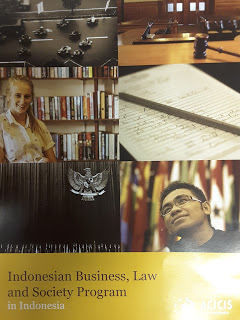
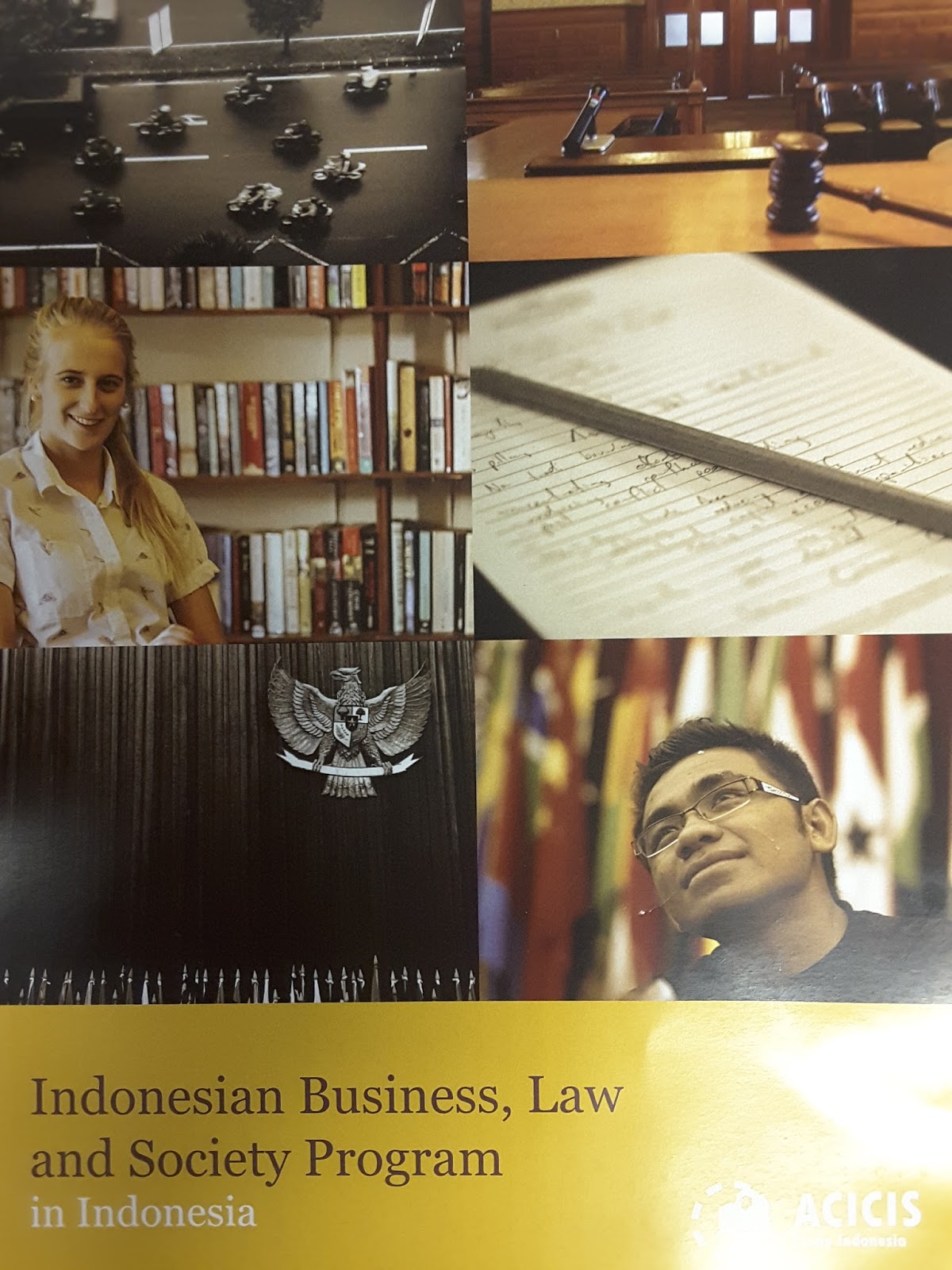
Indonesian Business, Law and Society scholarships

There are currently 5 scholarships of $5000 available for UNSW students who apply for the ACICIS program on Indonesian Business, Law and Society (IBLS) to commence in semester 1, 2017.

The IBLS is a semester-long program hosted by the Indonesian Islamic University (UII), Yogyakarta. Taught in English, this program provides students with a comprehensive understanding of Indonesian business, law and society at regional and global levels, as seen from an Indonesian perspective, while developing necessary critical skills to enter their respective fields.

Students enrol in subjects at UII’s International Schools located within the Faculty of Economics and the Faculty of Law. These subjects cover a range of thematic areas within business, law and society. The IBLS also offers students the option to undertake a ‘professional placement’, enabling students to put their studies into practice and gain a real-world experience outside the classroom. Students are placed with local commercial firms, community-based organisations, government bodies, and non-governmental organisations (NGOs) and are given the opportunity to develop important skills in legal advocacy, public relations, administration, finance, research and reporting. The IBLS has been designed for students with no existing Indonesian language skills; however, students with existing language skills are welcome to participate. This program also includes Indonesian language classes at a beginner, intermediate, or advanced level.

For more information contact ACICIS

Jokowi’s Islamist challenge: curbing terrorism and religious intolerance

In Indonesia, an attempted bomb attack on a church on Sunday has again left religious minorities deeply shaken.

Allegedly linked to Islamic State (Isis), the attack by a lone man may be more symptomatic of historic trends in terrorism against minorities in Indonesia.

In fact, the area near Medan, a city of over two million people, has been the site of recent tensions.

Just last month, an attack was carried out on Confucian temples in Tanjung Balai, not far from Medan.

Last year, a mob burnt down several churches that allegedly did not have a permit in the neighbouring province of Aceh.

These attacks are just the latest in a long line of local terrorism that targets minority groups. Symbolic attacks on places of worship are just one example.

One way to appreciate the sharp escalation of conflict in Indonesia is to compare pre-1998 and post-1998 rates of attacks on places of worship. Prior to the democratic transition in 1998, there were reportedly over 450 attacked or closed during Suharto’s regime (1966-1998).

Since 1998, civil society organisations have documented a sharp rise in attacks against minority groups. In the first 10 years of democratisation, close to 600 churches were attacked, damaged or forced to close. This trend continues.

While tensions between radical Islamists and Christians are well known, in recent years targeted campaigns have been directed against Shia Muslims, Ahmadiyah and Confucians.

There has been an increase in attacks on the places of worship of minority communities. There have also been moves by Islamic leaders to ban minority groups by issuing fatwa (an Islamic legal opinion) or by pressuring local government officials to issue regulations that outlaw its activities. It is this combination of tactics – violence, intimidation campaigns and the use of law – that is most concerning.

The explanation for this is clear. Democratisation has not only created greater freedom of expression, but in the absence of a strong state has amplified the demands of radical Islamic groups.

In addition to democratisation, the shift to decentralisation has politicised religion at the local level. This means that in the competitive political environment, local politicians have become increasingly influenced by vocal Islamic leaders and their demands that the state enforce a certain form of Islamic orthodoxy.

Of course local governments, with the exception of Aceh, do not actually have the power to use law to regulate religious practice. But in the absence of the national government, they do anyway.

Just last week I spoke at a conference in Jakarta on the rise of religious intolerance. The conference organisers had gone to every measure to ensure that radical Islamic groups would not gate crash the event, as they have done in the past.

At the conference we heard from leaders of the Shia and Ahmadiyah minority groups and the serious challenges and fears of their communities. Their concerns are real and ongoing.

Much of this rise in religious intolerance and local terrorism occurred under the leadership of former President Susilo Bambang Yudhoyono (SBY), who led from 2004 to 2014.

The current populist president Jokowi has inherited a major problem. Jokowi must rise to the challenge of curbing terrorism and addressing religious intolerance.

In doing so, Jokowi would be leaving a legacy that affirms that at the heart of democracy is the protection of minorities, rather than simply the rule of the majority. This would be one way that Jokowi could demonstrate that he is really the people’s president.


This article first appeared in The Guardian, Wednesday 31 August.