The bi-annual International Burma Studies Conference will be held in Singapore in August 2014. The theme of the conference is ‘Envisioning Myanmar: Issues, Images, Identities’ and is co-hosted by the Institute of Southeast Asian Studies, the Centre for Asian Legal Studies (Law Faculty, NUS), and the Faculty of Arts and Social Sciences (NUS). For all details on the conference, including panels, speakers and registration, see the website here.
Road to constitutional amendment in Myanmar going nowhere
Since Myanmar’s Joint Parliamentary Constitution Review Committee submitted its report to the Union Parliament on 31 January 2014, the constitutional amendment saga has taken another twist.
The Committee was given the task of reviewing the 2008 Constitution, which had been drafted by the previous military junta. It was required to make recommendations to the parliament, yet it ultimately avoided this responsibility. Many activists now agree that the amendment process is not genuine.
Yet public confidence in the process was shaken when the Committee’s initial deadline to submit its recommendations to the parliament, 31 December 2013, was extended to 31 January 2014. For many democracy activists, especially the older generation, this announcement heightened fears of prolonged constitutional discussions leading to negligible outcomes, like in the past.
When the Committee was established in 2013, there was some scepticism mixed with a glimmer of hope. Confidence in the process grew as a clear timeframe was set, making it possible that any proposals might have time to go through the necessary approval process before the 2015 elections.
A call for public submissions was even issued. This generated a flurry of constitutional campaigns and conversations across the country as political parties, social organisations, ethnic groups and religious groups held discussions and finalised submissions to the Committee. Reports suggest that the Committee received a huge number of submissions.
The constitutional review process has also been marked by Daw Aung San Suu Kyi’s failed request for an audience with the president. In November 2013 and on several occasions since then, she has called for a meeting with the president, the speaker of the lower house and the commander-in-chief. She has insisted that this is a necessary step to discuss the constitutional amendments.
The Committee’s report appears to have confirmed the fears of sceptics. It simply collated data on the number of provisions that were suggested to be amended and those that should stay the same. The Committee failed to come to any conclusions on the substance of the Constitution’s text — that is, which provisions should be amended and how.
The most controversial aspect of the report was that it noted that there were three key aspects of the Constitution that should not be amended. This was based on what appears to have been a petition signed by 106,102 people, although it does not confirm the source of this petition.
The first was the role of the military. The report noted that the petition wanted the military to retain its role in politics (and as the country’s armed forces). It also noted that the petition’s signatories were in favour of retaining the section that grants immunity from prosecution for past and present members of government.
The second affirmation was of the section on presidential requirements, which currently does not allow a person to be nominated if his or her spouse or children ‘owe allegiance to a foreign power’. The report noted that the petition did not want this changed. This would mean that Aung San Suu Kyi could not be nominated by the presidential electoral college after the 2015 elections.
Third, the same 106,102 people of the petition recommended that the provisions on the constitutional amendment process be retained. This process requires 75 percent approval of parliament, and for some provisions also requires more than 50 percent of eligible voters at a national referendum. These provisions would remain an obstacle to be overcome for any future amendments.
Yet this alleged petition has been heavily criticised and suspicions have been raised about its validity.
Some activists are now drawing parallels between the current situation and the lead up to the approval of the 1974 Constitution. In the early 1970s, Ne Win’s socialist regime claimed to have widely consulted the people and gathered a large number of signatures in support of the draft constitution. This alleged show of support for the constitution was used to justify its approval, yet it only entrenched another 14 years of Ne Win’s rule.
Where will Myanmar’s road to constitutional amendment lead today? After the Committee’s report was delivered, on 3 February the parliament established a committee for its implementation. Consisting of 30 members of parliament, this new committee must now make a final report on constitutional amendments.
Yet if this second committee proceeds on the basis of the validity of the first report, the road to amendment will not see any reduction in the role of the military in politics. Nor will it promote greater fairness in the presidential nomination process. This has serious implications for the elections in 2015, and suggests that the reform process itself has stalled.
This article first appeared on 27 March 2014 in the East Asia Forum Quarterly, ‘On the Edge in Asia’. Republished in The Glocal
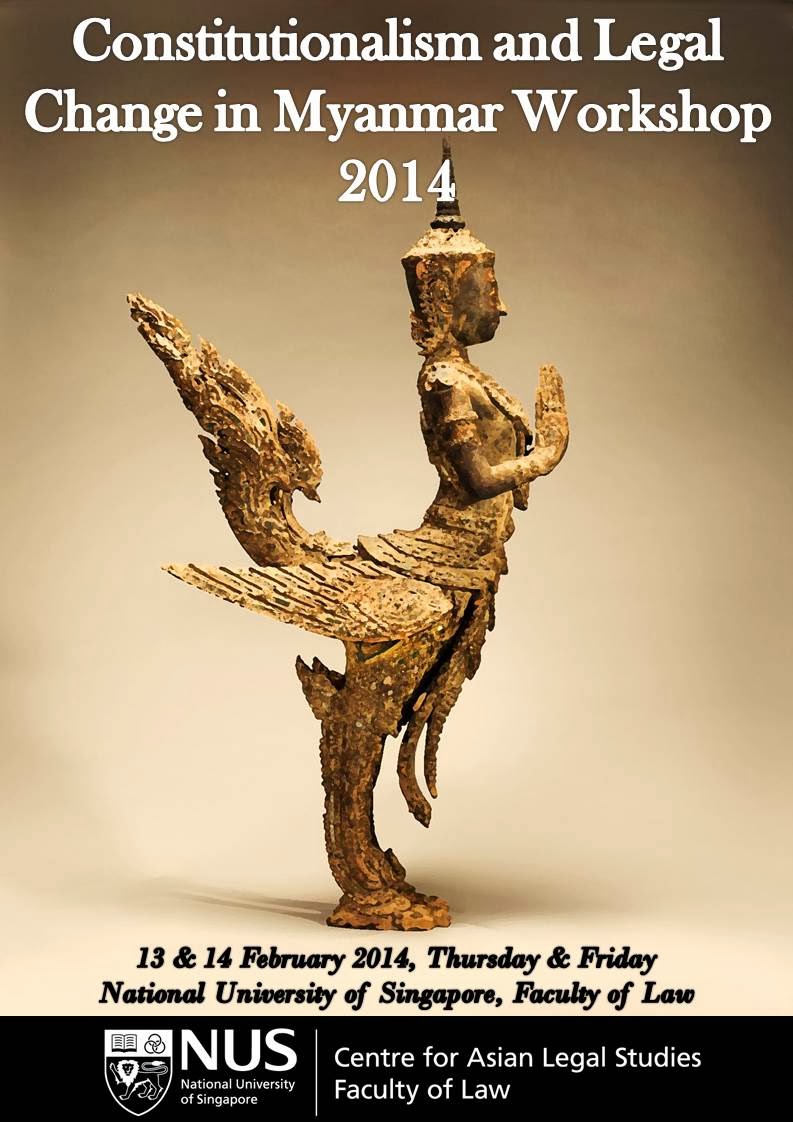
Legal Change in Myanmar Workshop
Transition and the Rule of Law in Myanmar
This semester, I am offering an elective course on ‘Transition and the Rule of Law in Myanmar‘, at the Law Faculty, NUS.
Here is a brief outline of the course. This subject will provide an introduction to the legal system of Myanmar/Burma in the context of the dynamic transition since 2011 from military rule to a quasi-civilian government. It will consider the legal framework and legal institutions in Myanmar in light of the literature on legal transplants and rule of law reform in transitional and developing states. The focus will be on understanding the Myanmar legal system in its social, political and historical context. The subject will include discussions on the constitution; the role of the legislature; the courts; human rights; business and economic reforms; and institutional reform.
For students considering taking the course, the mode of assessment for this course is 80% research essay, 10% class presentation and 10% class participation. If you are a student at NUS and are having trouble accessing the IVLE, please contact me.
Law, Society and Transition in Myanmar

Edited by Melissa Crouch and Tim Lindsey, 2014 Hart Publishing
This is the first edited volume to address the dynamics of the legal system of Myanmar/Burma in the context of the transition to democracy. It includes contributions from leading scholars in the field on a range of key legal issues now facing Myanmar, such as judicial independence, constitutional law, human rights and institutional reform. It features chapters on the legal history of Myanmar; electoral reform; the role of the judiciary; economic reforms; and the state of company law. It also includes chapters that draw on the experiences of other countries to contextualise Myanmar’s law reform process in comparative setting, including Myanmar’s participation in regional bodies such as ASEAN. This topical book comes at a critical juncture in Myanmar’s legal development and will be an invaluable resource for students and academics seeking greater understanding of the legal system of Myanmar. It will also be vital reading for a wide range of government, business and civil society organisations seeking to re-engage with Myanmar, as it navigates the challenges of transition towards democracy and the rule of law. Note: this book is also available for purchase in Myanmar from the Myanmar Book Centre, and Monument Books in Yangon.
“With chapters contributed by renowned legal experts and specialists on Myanmar, it explains how law is understood in Myanmar and how it works in practise” “…this volume will serve as a good reference work for scholars interested in Myanmar by highlighting the importance of legal reform in its nascent transition.” U Chit Win, PhD candidate at ANU; Deputy Director from the Ministry of Foreign Affairs in Naypyidaw; in Australian Journal of Administrative Law (2015) 22: 199-200 UNSW Newsletter, Uniken Winter 2015 review Reviewed by Moe Thuzar (2016), Contemporary Southeast AsiaReviewed by Mahdev Mohan (2015), Asian Journal of Comparative Law.
Islam and the State Workshop

Institute for Global Law and Policy Workshop
The next workshop of the Institute for Global Law and Policy (IGLP) of Harvard Law School will be held from 3-13 January 2014 in Doha, Qatar, hosted by Hamad bin Khalifa University. The workshop includes a stream on Islamic Law and Policy, among a wide range of other topics. For more details on the IGLP and the 2014 workshop, see here.
Australian Journal of Asian Law Edition 14(2)
Edition 14(2) of the Australian Journal of Asian Law is now available on SSRN
It includes the following articles:
In our paper on people smuggling, we analyse the way in which Indonesian judges have defied the legislature and sought to retain judicial discretion in sentencing practises for people smuggling cases, at times handing down a prison sentence less than the five year minimum. While this creates legal uncertainty and does not promote the rule of law, it has meant that an accused has a greater chance of the circumstances of their case being taken into consideration at the sentencing stage of a trial for the offence of people smuggling. This is important, given that most people who are brought to court are small actors in contrast to the bigger networks of people smugglers. This provides a comparative point of reflection on sentencing practises for people smuggling, given that Australia’s High Court recently upheld mandatory sentencing for people smuggling offences, despite the fact that judges and human rights organisations have spoken out against the mandatory minimum sentence.
Indonesia on use of the word ‘Allah’
In the latest development in the Malaysian court case on the use of the word ‘Allah’, the Court of Appeal overturned the decision of the lower court and decided that non-Muslims could not use the word ‘Allah’.
From a comparative perspective, Indonesia provides a different example on this issue. As I discuss in chapter 6 of my book on Law and Religion in Indonesia, the use of the word ‘Allah’ has not been a cause of controversy between Muslims and Christians in Indonesia. Instead, there have been discussions and debates within the Christian community itself about whether it is more appropriate to use the term ‘Allah’, ‘Tuhan’ or ‘Yahweh’ for God.
For example, in 2007, the Indonesian Bible Society was brought to court by an individual who disagreed with the use of the word ‘Allah’. The applicant attempted to argue that the Indonesian Bible Society should translate the word for God in the Indonesian translation of the bibles it prints using the term ‘Tuhan’ rather than the term ‘Allah’. Given the lack of any clear legal basis or argument for the applicant’s claim, the case was dismissed by the court.
New Reports on Myanmar Law
There have been a number of new reports on Myanmar’s legal and political system.
A report on the legal profession was recently released by the International Commission of Jurists. The substantive aspect of the report can be seen as building on the broader assessment of the legal system by the International Bar Association in 2012
There has been a new report assessing legislative activity in Myanmar, released by International Crisis Group.
There have also been a range of reports by other organisations on more specific aspects of the legal system, such as a report on the right to peaceful assembly by Article 19, and a report on state and region governance by the Asia Foundation and MDRI.
Finally, the Konrad Adenauer Stiftung has just published a journal edition on ‘Myanmar in Transition’, available online.
 Melissa Crouch